Haplogroup R1b1a1b1a1a2c1a1a1a1a1a1a4

– 5 min read


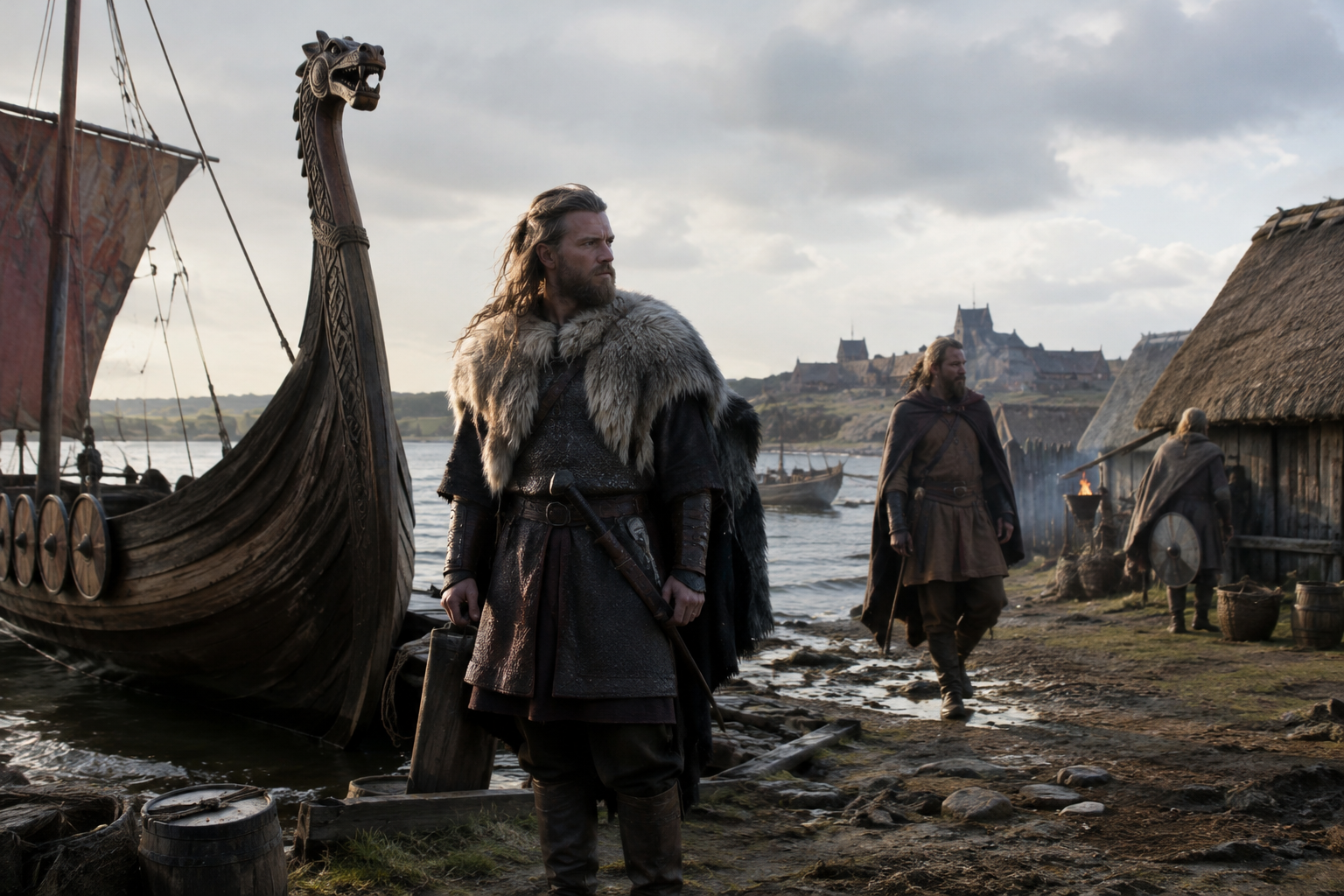
In early medieval Dublin, one ancient man brings a very specific paternal line into sharp focus. The sample known as VK545, dated here to around AD 725 and identified as a Viking warrior from Ship Street in Dublin, is associated in this article with the Y-DNA haplogroup R1b1a1b1a1a2c1a1a1a1a1a4. That long string of letters and numbers may look forbidding, but its importance is quite simple: it marks one direct male line carried by a man living in one of the most active contact zones of the Viking world.
Dublin in the early Middle Ages was not a tidy ethnic box. It was a port, a settlement, a power center, and a place where people from Ireland, Scandinavia, and the wider Irish Sea world met, traded, fought, married, and died. A Y-chromosome lineage like R1b1a1b1a1a2c1a1a1a1a1a4 tracks only one paternal thread among many ancestors, but that thread is still historically useful. It lets us anchor one male line to a real place and time: Viking-Age Dublin.
The most striking thing about VK545 is not simply that he lived in Ireland, nor simply that he is called a Viking warrior, but that he belongs to a settlement famous for mixture. Ship Street lies in the heart of old Dublin, within the zone shaped first by Norse activity and then by the hybrid Hiberno-Scandinavian world that followed. Any male lineage recovered there immediately raises a larger historical question: was this line newly arrived across the sea, already established around the Irish Sea, or part of a more entangled story of movement and settlement?
With the evidence given here, we should be cautious. The sample identifies one man and one paternal line; it does not, by itself, prove the ethnic identity of all men at Dublin, nor does it map a single migration route. But precisely because the claim is narrow, it is useful. VK545 shows that this highly specific branch of R1b1a1b1a1a2c1a1a1a1a1a4 was present in the Dublin region during the Viking Age, inside a settlement that archaeology has long treated as a hub of maritime mobility.
Research on Viking-Age populations has increasingly emphasized this wider North Atlantic and North Sea connected world, rather than any simple picture of closed Scandinavian colonies. A broad ancient DNA study of that world is linked here at https://www.biorxiv.org/content/10.1101/703405v1, and while one should never force more certainty out of a single link than the evidence allows, the larger scholarly setting matters: Viking-Age communities were often mobile, mixed, and regionally diverse.
The haplogroup in question, R1b1a1b1a1a2c1a1a1a1a1a4, is a very narrow twig on a much larger Y-chromosome tree. That distinction matters. The wider R1b family is famous across western Europe, but the presence of a broad parent haplogroup in many places does not automatically tell us the deep history of this exact terminal branch. In other words, it would be bad history to say that because many western European men carry some form of R1b, VK545's precise lineage must have followed one particular ancient route or belonged to one named people.
What we can say is more careful and more interesting. By the early medieval period, a lineage assigned here to this detailed branch was present in Dublin's Viking-Age milieu. That places it in a historically charged setting: a town created through seaborne power, exchange, and political negotiation. Y-DNA traces one direct paternal line only, not a person's whole ancestry, but in port towns especially, even one line can illuminate how male descent lines moved through strategic coastal centers.
Around the eighth and ninth centuries, Ireland's eastern seaboard was pulled into a new pattern of long-distance contact. Norse raiders first appear in written sources as attackers, but archaeology shows something more durable: camps, towns, craft production, trade, slavery, intermarriage, and local political alliances. Dublin became one of the great nodes in that system.
That is why a sample like VK545 matters beyond mere classification. A paternal line recovered from this setting belongs to a world in which identities were layered. Men in Dublin could be recent arrivals from Scandinavia, descendants of earlier migrants, locals incorporated into Norse-led communities, or families that had already become culturally Hiberno-Scandinavian. The label "Viking warrior" gives a useful archaeological and historical frame, but it should not tempt us into imagining a pure or uniform population.
One of the best ways to understand VK545 is to stop thinking of Dublin as peripheral. In the Viking Age it was central: tied to western Britain, the Isle of Man, northern England, and Scandinavia by ships, tribute, exchange, and family formation. A male lineage found there belongs to the same broad historical arena that linked York, the Hebrides, the Irish coast, and the western Scandinavian homelands.
This wider frame also helps explain why a haplogroup article should resist simplistic ethnic labelling. Ancient Y-DNA does not translate neatly into language, legal status, or self-identity. A man carrying R1b1a1b1a1a2c1a1a1a1a1a4 in Viking-Age Dublin may have lived in a Norse-speaking household, an Irish-speaking household, or something more mixed. He may have participated in cultural practices shaped by both shores of the Irish Sea. The archaeology of early medieval port towns repeatedly points in that direction: movement first, tidy categories second.
The same general caution appears in related work on early medieval populations elsewhere in northwestern Europe, where genetics often reveals continuity mixed with fresh arrivals rather than wholesale replacement. That makes Dublin an especially good place to encounter this lineage: not at the edge of history, but in a place where several histories met.
There is a temptation, when only one ancient individual is named, to treat the evidence as too thin to say anything worthwhile. In fact the opposite is often true, provided we keep the scale right. VK545 does not define all Viking paternal ancestry, all Irish paternal ancestry, or even all of Dublin. What he does provide is a secure historical foothold for this lineage in an early medieval urban context of exceptional importance.
That foothold matters especially for people exploring paternal ancestry today. A modern tester matching somewhere within this branch is not "proved Viking" by a single Dublin man. But neither is the connection trivial. It places their direct paternal line within a branch that appears in a real Viking-Age burial context in Ireland. That is not a mythic saga claim; it is exactly the sort of modest, concrete finding that ancient DNA does best.
The value of haplogroup R1b1a1b1a1a2c1a1a1a1a1a4 here lies in its scale. It is not the grand catch-all history of western Europe, but one fine-grained paternal line tied to one early medieval man, VK545, at Ship Street in Dublin. In a city shaped by Norse expansion and Irish Sea entanglement, that is enough to make the lineage historically vivid. For descendants researching their paternal line, the most responsible conclusion is also the most rewarding one: this branch has a documented place in the human traffic of Viking-Age Dublin, where ancestry, mobility, and identity were never simple.
Comments