Haplogroup R1b1a1b1a1a2c1a~

– 4 min read


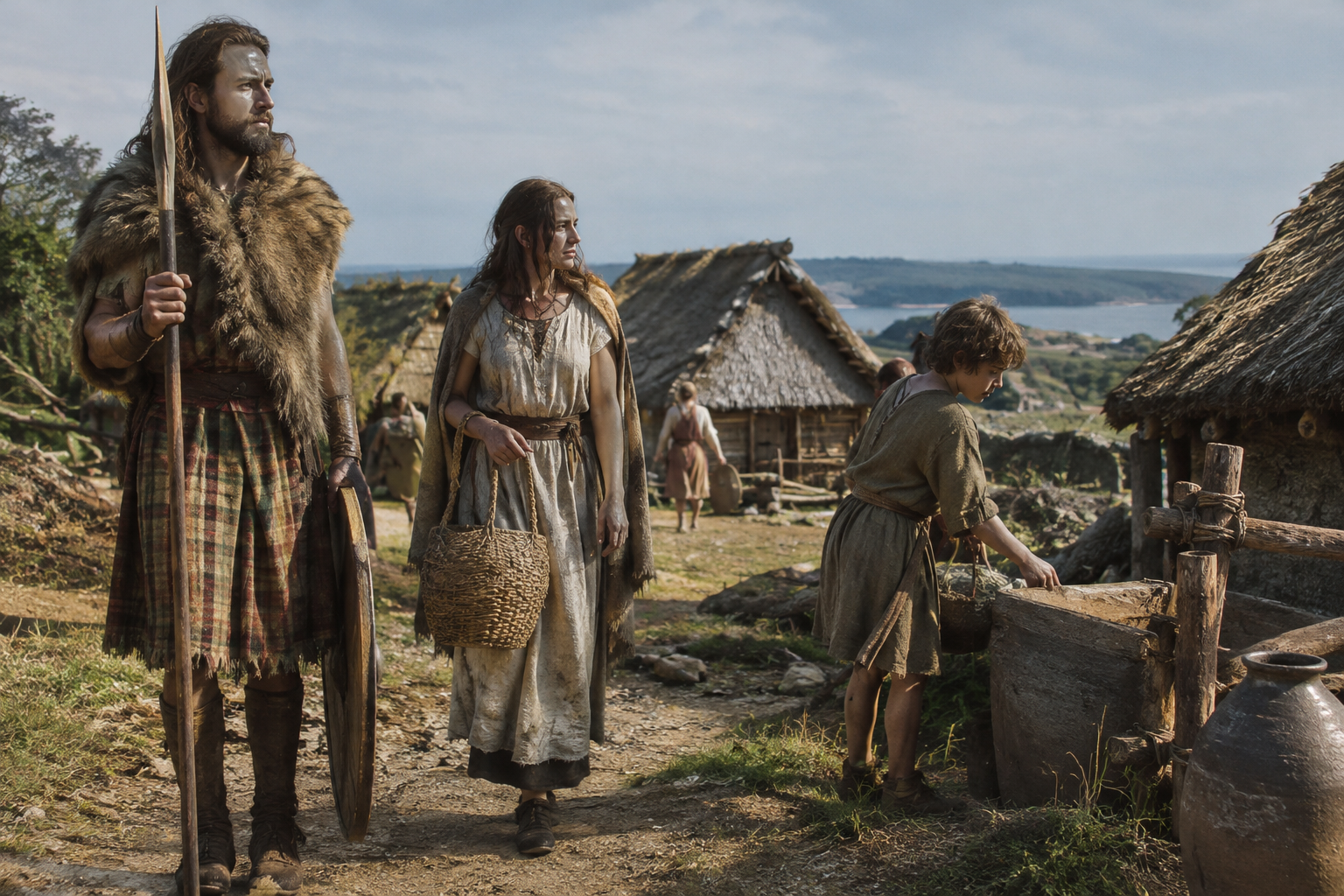
At Pech-Maho in southern France, archaeologists uncovered the remains of an Iron Age man identified as PECH3, dated to around 212 BC. That date matters. It places him in the last turbulent centuries before Rome absorbed much of southern Gaul, in a fortified settlement tied into Mediterranean trade and the shifting politics of Celtic and Iberian worlds. For anyone exploring the Y-DNA haplogroup R1b1a1b1a1a2c1a~, this is the sort of discovery that gives the lineage a proper historical setting: not an abstract branch on a tree, but a person from a real community at a real place.
That said, a Y-DNA label tracks only one direct paternal line. It does not tell us everything about PECH3's ancestry, language, or identity. Still, ancient evidence like this is exactly how a narrow branch begins to acquire historical texture. Instead of guessing from modern maps, we can place one paternal line within late Iron Age society in the western Mediterranean.
Pech-Maho lies near the lower Aude, not far from the Mediterranean coast. In antiquity this was a contact zone: local communities, traders, and wider political forces all met here. By the 3rd and early 2nd centuries BC, southern France was not an isolated Celtic backwater but part of a busy and sometimes violent landscape linked to Iberia, Massalia, and Carthaginian and Roman interests.
Sample PECH3 comes from a setting usually described as Gaulish, but that word needs a little care. "Gaulish" is a historical and archaeological shorthand for communities in Iron Age France; it does not automatically settle every question of language, tribe, or family origin. What makes PECH3 useful is that he anchors R1b1a1b1a1a2c1a~ in an Iron Age population of southern France, in a region where local traditions and long-distance exchange had been intertwined for generations.
A genetic study of the site and region has helped bring these burials into sharper focus, including the broader ancient population background in which individuals like PECH3 belonged. The relevant research can be found here: https://www.sciencedirect.com/science/article/pii/S2589004222003649.
Celtic languages and ancient DNA
The haplogroup in this article, R1b1a1b1a1a2c1a~, is a very specific paternal designation nested within the much larger R1b family, one of the major Y-chromosome lineages in western Europe. The important thing is not to let the wider fame of R1b do all the storytelling. A broad parent haplogroup can spread across huge regions and many different periods, while a narrower branch may have a much more specific and local history.
The tilde at the end also deserves caution. In practical terms, it often signals an approximate or provisionally placed branch rather than a neatly finished terminal assignment. So the safest reading is that PECH3 is reported in association with this lineage level, not that we can reconstruct an entire clan history from one ancient chromosome.
Even so, one ancient placement is valuable. For men researching this paternal line today, PECH3 shows that a related branch was present in Mediterranean Gaul during the late Iron Age. That does not prove direct descent from this individual, of course, but it does place the lineage in a meaningful archaeological world: fortified settlements, maritime contact, and the political upheaval that preceded Roman domination.
There is a temptation, when looking at ancient DNA, to jump straight from a haplogroup to a people with a capital letter: Celts, Romans, Iberians, Phoenicians. Pech-Maho is a good antidote to that habit. Southern France in the 3rd and 2nd centuries BC was precisely the sort of place where identities overlapped and local communities negotiated several spheres of influence at once.
That matters for interpreting R1b1a1b1a1a2c1a~. The branch appears here not in a mythical point of origin, but in a lived frontier of exchange. A paternal line could persist through local continuity while the surrounding cultural world changed dramatically. Archaeology often shows that material culture, trade, and political allegiance can shift faster than deep family descent lines.
Pech-Maho itself is especially evocative because it belongs to a coastal corridor that linked Gaul to the Iberian Peninsula and the wider Mediterranean. So PECH3's lineage should be understood in that connected regional context, not boxed into a simple ethnic label. One direct paternal line can survive across changing languages, alliances, and empires.
Roman Hispania's genetic legacy
Ancient DNA articles sometimes seem strongest when they have dozens of individuals and elaborate kinship reconstructions. But there is another kind of importance: the value of a securely dated point on the map. PECH3 gives R1b1a1b1a1a2c1a~ one such point in late pre-Roman Gaul.
That matters because later history in this region is so transformative. Roman conquest, urbanization, military movement, and imperial connectivity all altered the human landscape of southern France. When a lineage is visible just before those processes intensify, it provides a useful anchor for thinking about continuity as well as change.
It also helps correct a common misconception. Modern paternal lineages in western Europe are often imagined as if they arrived neatly with one migration and then sat still. The archaeology of southern Gaul suggests something more complicated: longstanding local communities participating in broad networks while retaining inherited family lines over generations.
Iron Age Iberian burial evidence
There is also a larger historical point here. When Roman authors wrote about Gaul, they described peoples and territories in ways that were useful to Roman politics and geography. Ancient DNA works on a different scale. It can show us individuals, biological kinship, and long-term ancestry patterns, but it does not simply confirm the labels used in classical texts.
So with PECH3, it is best to keep categories in their proper places. He was an ancient man from Pech-Maho in southern France, dated to around 212 BC, associated in the available record with R1b1a1b1a1a2c1a~. He lived in a region commonly described as Gaulish and deeply connected to Mediterranean exchange. Beyond that, precision is better than overreach.
That restraint is not a weakness. It is exactly what makes archaeogenetics useful. Rather than flattening the past into slogans, it lets us see how a paternal lineage sits inside a richly historical landscape.
How ancient genomics tracks language spread
For this haplogroup, the strongest present insight is not a grand migration claim but a concrete Iron Age foothold. With PECH3 at Pech-Maho, R1b1a1b1a1a2c1a~ is tied to southern France at the edge of the Roman world, in a community shaped by both local continuity and Mediterranean connections. For someone tracing this paternal branch today, that is a useful and genuinely historical clue: your line belongs to a family of ancestries already established in western Europe before Rome finished remaking the map.





Comments