Haplogroup R1b1a1b1a1a2b2b1

– 4 min read


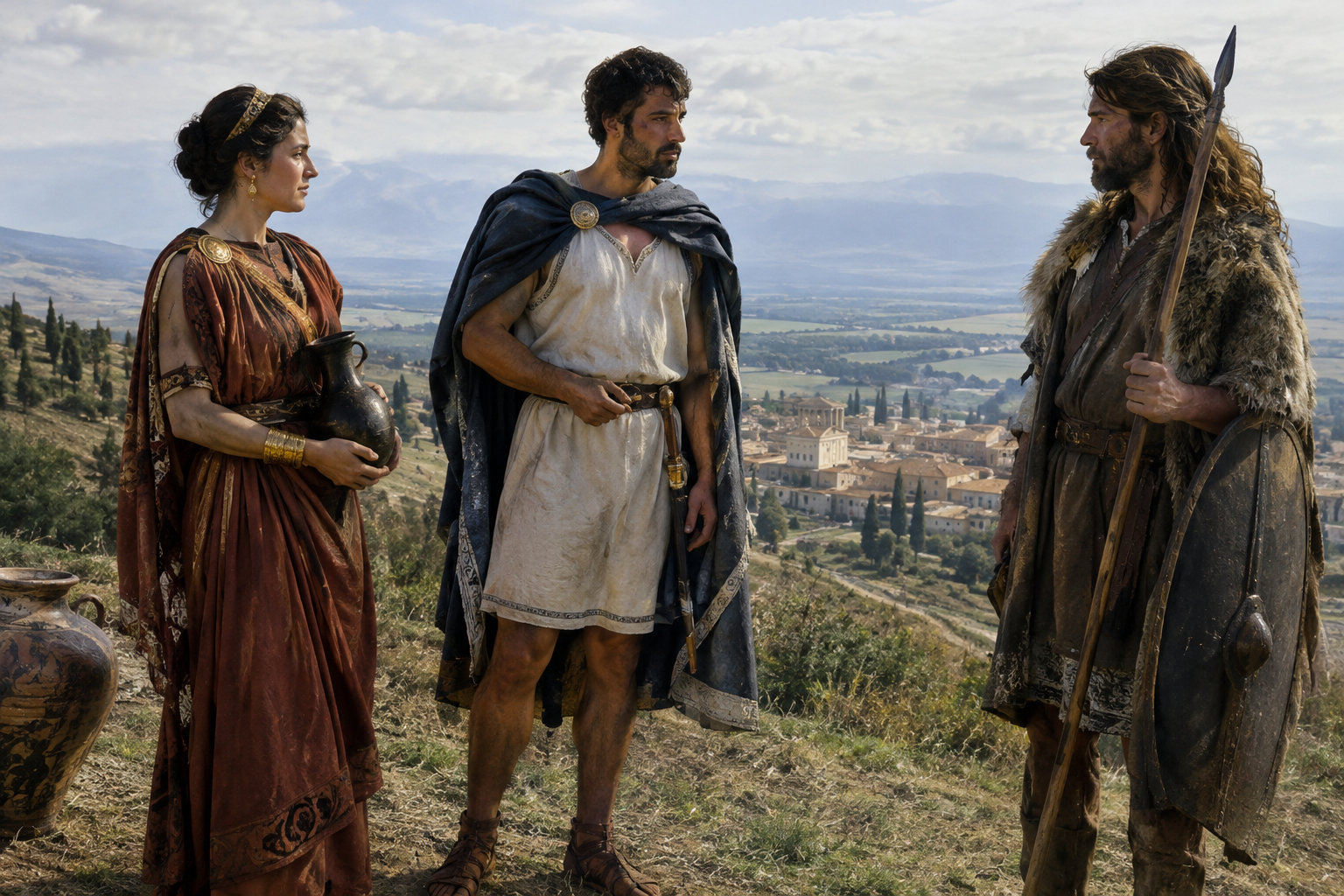
At Felsina, the ancient city beneath modern Bologna, one paternal line turns up in a particularly revealing place: among the people buried as the old Etruscan world was changing. One individual from Archaic Etruscan Bologna, sample I34530, dated to around 500 BC, is associated here with the Y-DNA haplogroup R1b1a1b1a1a2b2b1. A second man from the same city, I40854, dated to around 300 BC and described as Late Etruscan Celtic, appears in the same broad branch as Bologna moved from an unmistakably Etruscan centre into a more mixed Iron Age society.
That makes this haplogroup interesting for a very specific reason. Rather than appearing in just one neatly bounded "people," it shows up in a setting where archaeology already tells us identities were layered, local, and changing. Y-DNA tracks one direct paternal line only, not a person's whole ancestry, but in this case that single line is attached to one of Iron Age northern Italy's most debated historical transitions.
Long before it became Bononia under Rome, Bologna was Felsina, one of the major Etruscan centres of the Po Valley. This was not marginal territory. It sat in a crossroads zone linking peninsular Italy with the routes leading north and west, and that matters when we think about how paternal lineages could persist, arrive, or be absorbed into new communities.
Sample I34530, labelled Archaic Etruscan Felsina Bologna Po Valley Italy and dated to around 500 BC, places this branch in the city during a firmly Etruscan phase. Then I40854, from the same place but around 300 BC, is classified as Late Etruscan Celtic. Even without embellishing the evidence, that pairing is valuable. It suggests that the paternal line associated here with R1b1a1b1a1a2b2b1 was present in Bologna across a period when the cultural language of the cemetery record was no longer exactly the same.
That does not mean a simple ethnic handover from "Etruscan" to "Celtic," as if one label suddenly replaced another. Northern Italy in the later Iron Age was far messier than that. Communities changed through mobility, marriage, alliance, trade, and political pressure. A genetic study of this broader regional history, including Bologna, helped underline that complexity in ancient northern Italy rather than reducing it to a single migration story: research published on Iron Age and Roman Italy has been central to that discussion.
The exact subclade name here, R1b1a1b1a1a2b2b1, is very precise. But ancient reports do not always publish every sample at the same level of Y-chromosome resolution, and responsible interpretation has to keep that in mind. What we can say safely from the samples provided is that this paternal line is being tied to men in Iron Age Bologna across two different archaeological descriptions and two different moments in the city's history.
That is more interesting than a map covered in modern frequency estimates. The real value lies in context. Felsina was one of those places where older local traditions and wider continental connections met each other face to face. If a paternal line appears there in both an Archaic Etruscan and a later Etruscan-Celtic setting, the best reading is continuity within a changing social world, not a neat badge of one exclusive identity.
It is worth stressing, too, that the Po Valley has long been central to arguments about interaction between Etruscans, Italic-speaking groups, and peoples associated archaeologically with Celtic expansion into northern Italy. Ancient DNA does not abolish those debates, but it does force them onto firmer ground. A lineage can stay in place while languages, styles, and political affiliations shift around it.
The third sample attached to this haplogroup moves the story westward. I20817 comes from Iron Age Chemin de Coupetz in Marne, France, dated to around 250 BC. This is a very different setting from Bologna, yet still part of the wider Late Iron Age world in which communities across temperate Europe were connected by exchange, warfare, movement, and shared material fashions.
Marne sits in a region deeply associated with Iron Age Gaul. So now the same paternal branch appears not only in northern Italy's Etruscan and later mixed context, but also in Iron Age northeastern France. That does not prove a direct line of migration from Bologna to Marne, still less a family tree linking these buried men. But it does place this lineage within a recognisably transalpine zone of Iron Age Europe.
This is precisely the kind of pattern that archaeologists like, because it is suggestive without being simplistic. We are not looking at a branch confined to a single city or cultural label. We are seeing it in both the Po Valley and Gaul at dates that fit the centuries of stronger contact between northern Italy and Celtic-speaking Europe.
For the broader sample framework behind these ancient individuals, the Harvard-hosted ancient DNA resource associated with these records is here: ancient population research data linked to these burials. It is useful not as a substitute for archaeology, but as part of the evidential backbone for comparing lineages across regions.
What, then, does R1b1a1b1a1a2b2b1 look like in the ancient evidence given here? Not a royal signature, not a magic ethnic label, and not a line that belongs to one famous tribe. It looks more like a paternal thread running through the connected societies of Iron Age western and south-central Europe.
Bologna is especially telling because it refuses tidy categories. The city begins in this article as Etruscan Felsina and then reappears in a Late Etruscan Celtic context. Marne adds another layer from Gaul. Together, those finds suggest that this branch belonged to the human traffic of the Iron Age world north of Rome's early heartland: communities that were local, yes, but never isolated.
That point fits well with the wider direction of ancient DNA research. Again and again, cemetery evidence shows that cultural frontiers were not biological walls. A burial may be archaeologically classified one way, a genome may show mixed ancestry, and a Y-chromosome line may connect that person to paternal histories stretching across several regions at once.
If you belong to R1b1a1b1a1a2b2b1, these ancient matches point toward an Iron Age paternal presence in two historically important zones: Etruscan and later mixed Bologna in the Po Valley, and Celtic-period northeastern France. The most distinctive insight is not that the lineage "belongs" to one named people, but that it appears in exactly the sort of places where identities were being negotiated, blended, and remade. That makes it a particularly good reminder that paternal ancestry is often most illuminating when it is set inside real archaeological landscapes rather than modern mythologies.






Comments