Haplogroup R1b1a1b1a1a2b1d1b

– 5 min read


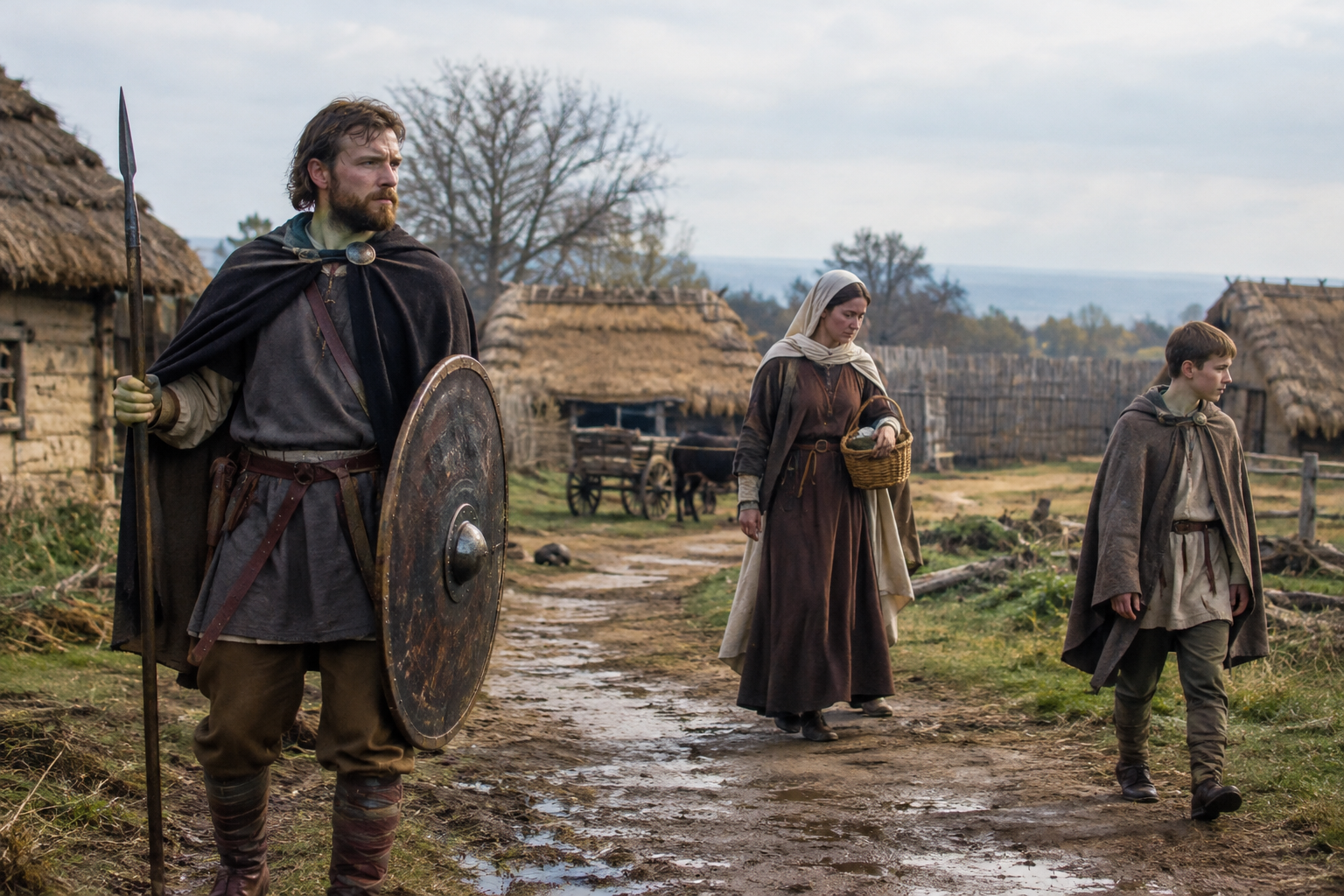
At Beli Manastir in eastern Croatia, one man buried around AD 350 carries a surprisingly precise paternal label in modern reconstructions: R1b1a1b1a1a2b1d1b. He is recorded as sample R3542, placed in a Visigoth or Ostrogoth era context. That may sound like a thicket of letters and numbers, but in archaeological terms it is rather useful: it gives us one direct male line anchored to the unsettled centuries when Roman frontiers, Gothic groups, and provincial communities were all colliding and recombining in the Balkans.
The fascination here is not that one grave can "solve" Gothic origins. It cannot. The interest is that a single Y-chromosome branch, traced through one ancient man, turns up in a region that was anything but simple in late antiquity. Y-DNA follows one direct paternal line only, not a person's whole ancestry, language, or identity. But when that line appears in a well-dated archaeological setting, it helps us ask a better historical question: what did male ancestry look like inside the mixed communities of the post-Roman Danube world?
Beli Manastir lies in a part of Croatia that sat close to the great river corridors of the middle Danube. In the fourth century AD, this was not a quiet edge of empire. It was a zone of military movement, local continuity, imperial administration, and the arrival or settlement of groups that Roman writers would often flatten into broad labels such as Goths.
That is exactly why sample R3542 matters. He is not merely "Germanic" in some vague culture-war sense, nor simply "Roman" because the date falls within imperial history. He belonged to a human landscape in which those categories were often entangled. Archaeology across the wider region increasingly shows that late Roman and migration-period cemeteries can include people of varied genetic backgrounds living under similar material cultures or political umbrellas.
An ancient DNA study investigating Gothic-period and related burials in eastern Europe and the Balkans has helped sharpen that picture, showing that communities associated with Gothic archaeology were not biologically uniform but often quite mixed. That broader research context is important when thinking about R3542, even if one should be cautious about treating any single man as a stand-in for an entire people. For readers following these debates, MyTrueAncestry has also covered mixed origins in late antique Gothic communities.
Gothic communities in Bulgaria
The haplogroup in this article, R1b1a1b1a1a2b1d1b, is a very narrow twig on the much larger R1b tree. That distinction matters. It is reasonable to say that R3542 is associated with this specific paternal branch as reported in the sample record. It would not be reasonable to turn that into a sweeping claim that the branch as a whole was "the Gothic haplogroup", or to assign it a neatly mapped migration route from prehistory to late Roman Croatia without direct evidence.
Still, a narrow subclade is useful because it reminds us that paternal history is granular. Big umbrellas like R1b cover enormous stretches of western Eurasia and many different historical episodes. A branch as specific as R1b1a1b1a1a2b1d1b narrows the frame. For someone researching a matching modern line, the most responsible takeaway is not ethnic certainty but context: at least one bearer of this paternal branch was present in a fourth-century community in the Croatian-Danubian world during the Gothic era.
That is often how ancient DNA is most illuminating. It does not hand over ready-made identities. It pins lineages to real places and times, and then makes the historical map less lazy.
The words Visigoth and Ostrogoth are useful historical shorthand, but archaeology has become much warier of treating them as tidy biological boxes. By AD 350, communities linked to Gothic material culture had already emerged through movement, alliance, marriage, recruitment, and absorption across a large swathe of Europe north of the Black Sea and toward the Danube. In plain English: people moved, and labels moved with them.
That wider point has been made repeatedly by genomic work on late Iron Age and migration-period populations. MyTrueAncestry's pieces on the spread of Germanic languages and on Goths as a multi-ethnic community both fit the setting of R3542 rather well: language, political identity, burial practice, and paternal lineage do not always travel together.
So if R3542 belonged to a community described as Visigoth or Ostrogoth era, that tells us the archaeological and historical horizon in which he lived. It does not mean his paternal line was exclusive to Goths, nor that every man buried nearby shared his ancestry. What it does suggest is that this branch participated in the same mobile world as the Gothic groups known from texts and cemeteries across the Danube frontier.
Germanic languages and genomes
There is another reason this Croatian sample is so interesting. The Balkans are one of those regions where deep local continuity and repeated incoming influences sit side by side. Ancient DNA from Croatia has increasingly suggested that maternal lines can show remarkable long-term persistence, while paternal patterns may shift more sharply across different periods. That makes a late Roman or migration-period male lineage especially informative, because it may reflect episodes of political and social change more clearly than the overall population picture does.
In other words, R3542 belongs to a region where the ground under people's feet might stay the same while the ruling structures, military networks, and some male family lines changed dramatically. A reported Gothic-era context for this sample therefore matters not because it proves replacement, but because it gives us a fixed point within that larger process.
This is one reason the Croatian evidence deserves to be read alongside other regional studies rather than in isolation. MyTrueAncestry's article on long-term maternal continuity and shifting paternal lineages in Croatia offers a useful parallel background: lineages can move unevenly, and male-line history may capture social transformations that a broad ancestry average obscures.
Croatia's shifting paternal lines
By the fourth and fifth centuries, the middle Danube was one of Europe's great hinge zones. Roman institutions still mattered; imperial armies still recruited and moved people; federate arrangements brought in outside groups; and local communities carried on through it all. A man like R3542, buried in what is now Croatia, belongs to that hinge world.
His haplogroup does not tell us whether he spoke Gothic, Latin, or something else. It does not tell us whether he thought of himself in ethnic terms familiar to modern readers. But it does place one paternal line inside a historical moment when frontiers were porous and identities practical. That is often a more interesting historical insight than a simple origin myth.
A research preprint linked to this sample, https://www.biorxiv.org/content/10.1101/2022.05.15.491973v1, belongs to this wider wave of scholarship on ancient populations in the region. Even without over-claiming from a single study, the direction of the field is clear: late antique communities in southeastern Europe were not neat ethnic islands but social mixtures with complicated ancestry profiles.
For members of the MyTrueAncestry community who carry or approach this branch, the strongest supported point is pleasantly concrete. R1b1a1b1a1a2b1d1b is represented by at least one ancient male, R3542, in a Gothic-era context at Beli Manastir in Croatia around AD 350. That places this paternal line in the turbulent late Roman Balkans, among communities shaped by mobility, frontier politics, and the blending of local and incoming populations.
That is not a certificate of Gothic ethnicity. It is better than that: it is a documented foothold in a real archaeological landscape.






Comments