Haplogroup R1b1a1b1a1a2b1c2b1a1a

– 5 min read


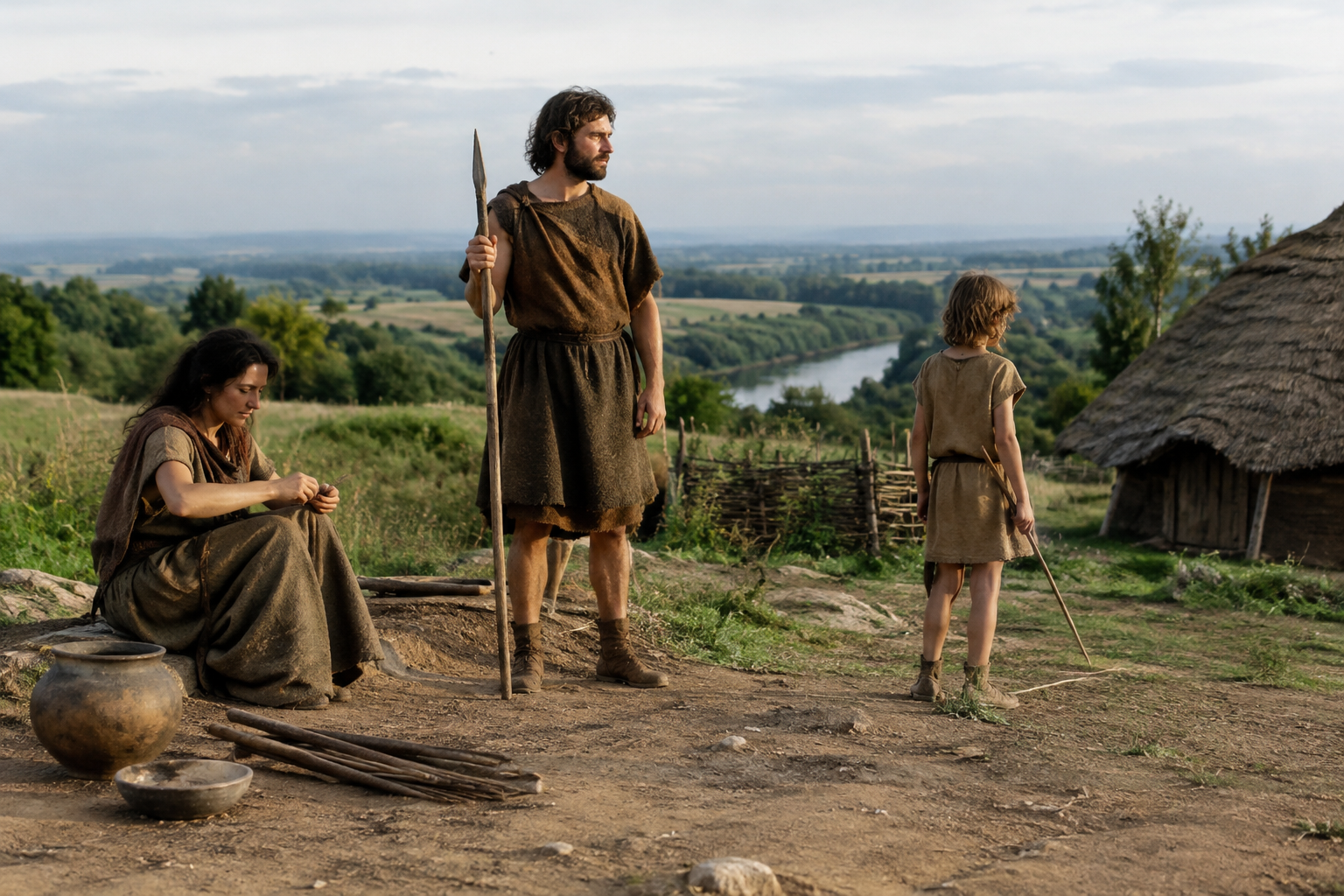
At Chemin de Coupetz in the Marne, in northeastern France, one Iron Age man has become unexpectedly important for the history of a very specific paternal line. He is sample I19357, dated to around 250 BC. In the MyTrueAncestry framework, he is associated with the Y-DNA haplogroup R1b1a1b1a1a2b1c2b1a1a, a very narrow branch inside the broader and famously widespread R1b family.
That may sound forbiddingly technical, but the basic point is simple. Y-DNA follows one direct male line only: father to son to grandson. It does not describe a whole person's ancestry, language, or identity. What makes I19357 interesting is not that he can stand for all Iron Age Gaul, plainly he cannot, but that he places this particular paternal branch in a historically charged landscape: the Champagne region in the centuries before the Roman conquest.
The Marne sits in one of the classic zones of later Iron Age Europe, a corridor of movement, exchange, and burial traditions that connected the Paris Basin, the Rhine world, and the wider Celtic-speaking regions to the east and south. By about the 3rd century BC, this was no backwater. Communities here were tied into the La Tene cultural sphere, the archaeological horizon usually associated with much of Iron Age temperate Europe.
So when a paternal lineage like R1b1a1b1a1a2b1c2b1a1a turns up in an individual from this setting, the real historical question is not whether he was "Celtic" in some simplistic genetic sense. It is how a direct male line sat within a world of local continuity, regional marriage networks, and wider cultural connections. One ancient man from the Marne cannot settle that on his own, but he gives us a precise point on the map.
An ancient DNA study of Iron Age and earlier European populations, published in Nature, helped sharpen exactly this sort of picture: not neat tribes made of one lineage, but real communities with both continuity and mixture over time.
The unwieldy label matters because it tells us we are not talking about all of R1b. The parent haplogroup R1b is one of the major Y-chromosome lineages in western Eurasia, and it has a deep and complicated history. But R1b1a1b1a1a2b1c2b1a1a is a much more specific twig on that larger tree, and narrow twigs often have much more local and historically recent stories than their famous parent branches.
That distinction is crucial. It would be careless to take general statements about the spread of R1b in Bronze Age Europe and paste them directly onto this much later Iron Age sub-branch. What I19357 gives us securely is evidence that a paternal line associated with this branch existed in Iron Age northeastern France. It does not by itself tell us where the branch first formed, how common it was, or whether it belonged to an elite family, a farming lineage, or something else entirely.
Still, there is value in precision. Ancient DNA often works by taking what looks at first like a broad historical canvas and pinning it down to one grave, one settlement, one kin network. A lineage this specific reminds us that Europe's Iron Age populations were not just grand abstractions. They were made up of actual paternal lines, some of which can now be located in place and time.
The Marne is not just another dot on a distribution map. Northeastern France lies in a region where archaeologists have long studied changing funerary customs, contact across river systems, and the social worlds of Late Iron Age communities before Rome folded the area into a new imperial order. That makes a sample like I19357 especially useful, because he belongs to a period when local societies were connected yet still politically fragmented.
In practical terms, that means this Y-lineage was present in a landscape that linked inland Gaul to the Rhine frontier and beyond. Such regions are often where archaeogenetics becomes most illuminating. Instead of imagining static peoples, we start seeing zones in which paternal lines could persist locally while material culture, alliances, and even languages shifted around them.
That point sits neatly beside broader MyTrueAncestry discussions of how genetics intersects with language and mobility in Iron Age Europe.
Germanic languages and genomics
There is a temptation, when only one ancient individual is available for a branch this narrow, either to overclaim or to shrug and move on. Both are mistakes. One sample does not establish the full range of the haplogroup, but neither is it trivial. Ancient Y-DNA is often patchy, and a single well-placed Iron Age individual can anchor a lineage in a period where documentary evidence is thin or absent.
That is exactly the situation here. We are dealing with pre-Roman northern Gaul, a world known mainly through archaeology, later classical writing, and now genetics. I19357 does not speak for all men of the Marne, and he certainly does not define all bearers of R1b1a1b1a1a2b1c2b1a1a. But he does tell us that this paternal branch was part of the human reality of Iron Age France, not merely a modern genealogical abstraction.
There is also a methodological lesson. Ancient DNA works best when read alongside archaeology rather than as a substitute for it. The site matters. The date matters. The regional setting matters. Without those, a haplogroup is just a string of letters and numbers.
For many readers, the most striking thing about this sample will be the date: about 250 BC, before Caesar's campaigns, before Roman roads and colonies remade the political map, before "Gaul" became a Roman province rather than an ethnographic label. That makes I19357 a glimpse of paternal ancestry in France before the great imperial reordering of western Europe.
Later centuries would bring conquest, military recruitment, trade, slavery, resettlement, and all the usual untidiness of history. Paternal lines could spread, disappear, or survive quietly through all of that. A branch found in Iron Age Marne might persist in the region, move elsewhere, or become diluted among many other lineages. The fascination lies in catching it before those later transformations.
Readers interested in how Roman rule and later migrations complicated the genetic map of western Europe may want to compare this earlier Iron Age snapshot with later regional studies.
If your paternal line falls under R1b1a1b1a1a2b1c2b1a1a, the strongest ancient clue here is modest but meaningful: this branch, or a reported association with it, is present in an Iron Age man from the Marne in France around 250 BC. That does not make every modern carrier "Gaulish," nor does it turn one grave into a family tree. What it does offer is a historically grounded waypoint for your direct male line in Late Iron Age western Europe.
And that, in truth, is the excitement of archaeogenetics at its best. Not fantasy pedigrees, but a real human being, at a real site, in a real century, whose Y-chromosome helps place a living lineage into the texture of Europe's past.





Comments