Haplogroup R1b1a1b1a1a2b1c2b

– 5 min read


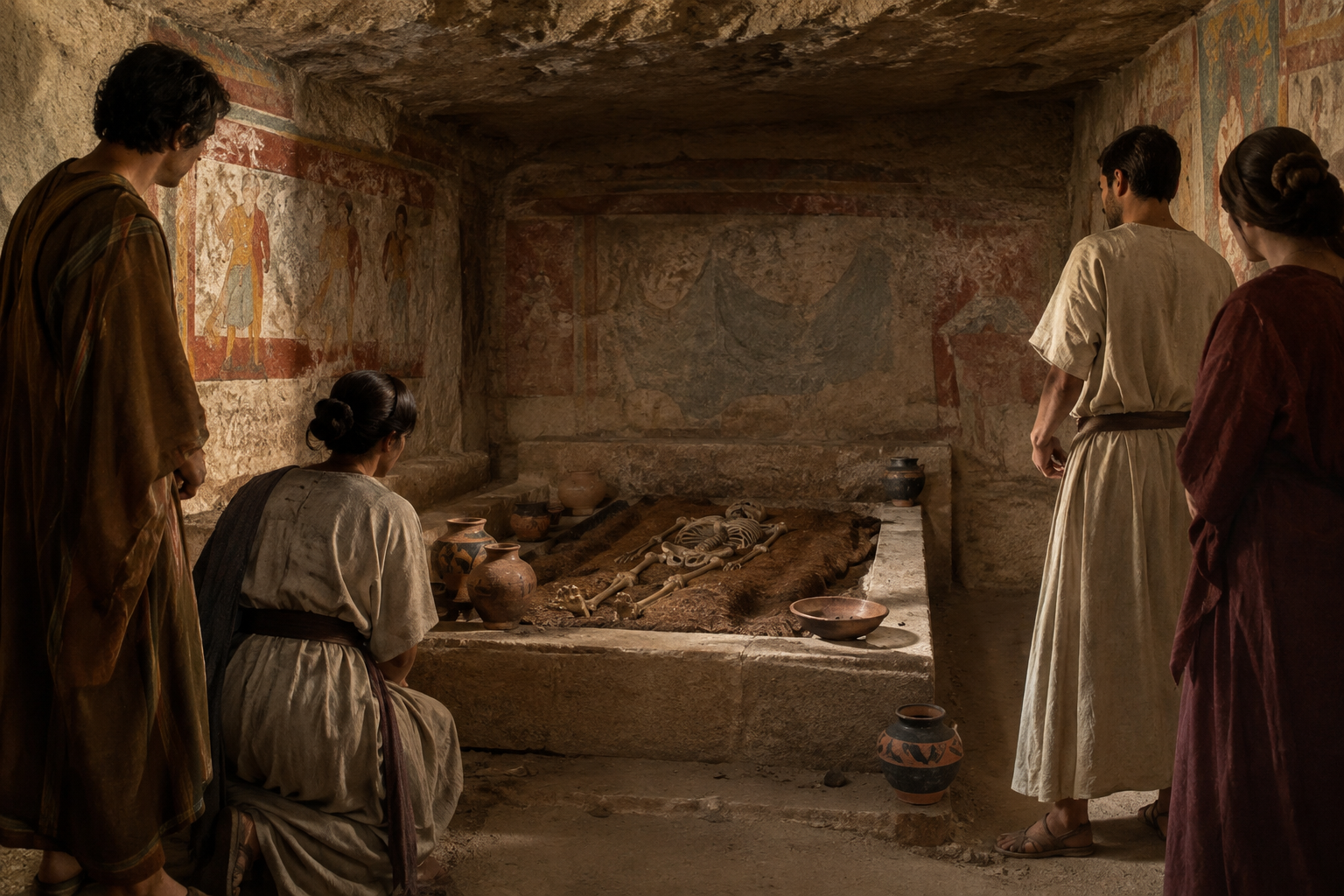
At Castel Sozzio in northern Italy, one burial keeps reappearing under a string of laboratory labels: Tomb 27, around AD 600, with the associated ancient DNA identifiers P9884, P9884a, P9884d, P9884e, P9884f, P9884g, and P9884l. That is already an intriguing archaeological pattern. We are not looking at a lone celebrated skeleton, but at a cluster of genetic traces tied to one post-Roman cemetery context, just at the moment when Italy was being reshaped after the end of imperial rule.
The Y-DNA haplogroup linked here is R1b1a1b1a1a2b1c2b, a very narrow paternal branch within the much wider R1b family. That matters because Y-DNA follows one direct male line only: father to son across generations. It does not tell us a whole person's ancestry, language, or identity. What it can do, especially in a cemetery like Castel Sozzio, is pin one paternal thread into a very unsettled historical landscape.
By about AD 600, Italy was no longer the Roman Empire in any simple sense, but neither was it a blank slate populated by neatly separate "Romans" and "barbarians". Cemeteries from this period are so valuable precisely because they show ordinary communities living through political upheaval, military change, and new social arrangements. Castel Sozzio belongs to that world.
The repeated appearance of the Tomb 27 labels suggests that this burial context has been sampled in more than one way or at more than one analytical stage. In ancient DNA work that is not unusual: one grave, one individual, or one set of remains can generate multiple extract or library IDs. What we can say securely is that the reported paternal line associated with this context falls within R1b1a1b1a1a2b1c2b, and that the date places it in the early medieval aftermath of Roman rule in Italy.
That is a useful reminder that narrow Y-chromosome branches do not float above history. They turn up in graves, in cemeteries, in regions where people were farming, marrying, burying their dead, and adapting to new political masters. Castel Sozzio gives this haplogroup an actual archaeological home, not just a place on a phylogenetic tree.
Because R1b1a1b1a1a2b1c2b is such a detailed subclade name, there is a temptation to read it as a ready-made ethnic label. That would be bad history. The broader R1b family is widespread across much of western Eurasia and deeply layered in time; a fine-grained branch like this one is better treated as a marker of paternal continuity and divergence within populations that were already mixed and mobile long before AD 600.
In practical terms, a finding like this tells us that one paternal lineage present in post-Roman Italy belonged to a branch now fine enough to be distinguished in modern Y-DNA classification. It does not by itself prove whether the man buried at Castel Sozzio thought of himself as Roman, Lombard, local Italian, immigrant, or anything else. Archaeology and genome-wide evidence are needed for those larger questions.
That caution is especially important in late antique and early medieval Italy, where old civic identities, military service, regional loyalties, and incoming groups all overlapped. The point is not to flatten the past into one origin story, but to see how a paternal line sits inside a historically complex community.
The Castel Sozzio data are interesting precisely because they are clustered. P9884 and its related suffixes are all tied to the same tomb designation and date, which hints at the real texture of ancient DNA work: degraded bone, repeated processing, and careful attempts to recover usable genetic information from difficult remains. A methodological study linked to this material discusses ways of improving ancient DNA recovery from petrous bone powder, a reminder that these identifications depend as much on laboratory rigor as on excavation itself: research on optimized ancient DNA yields.
That may sound technical, but it has a straightforward historical consequence. Better recovery means that burials from transitional periods like post-Roman Italy can be brought into clearer focus, allowing paternal lines such as R1b1a1b1a1a2b1c2b to be placed in a firm archaeological setting rather than left as vague modern distributions.
And there is another reason Tomb 27 deserves attention. Around AD 600, burial grounds in Italy are one of the best places to study how communities were actually composed after the collapse of western imperial administration. Cemeteries preserve local realities that grand political narratives often smooth over.
The most sensible historical setting for this haplogroup at Castel Sozzio is not a tale of one dramatic migration, but a world of layered continuity and change. By the 6th and 7th centuries, Italy had seen centuries of population movement inside the Roman Empire, followed by Gothic wars, Lombard expansion, and the survival of older local populations. Ancient cemeteries from this era repeatedly show that communities were not genetically uniform.
That broader picture helps explain why a Y-line like R1b1a1b1a1a2b1c2b is worth noting but should not be overinterpreted. A paternal branch can persist through major shifts in language, law, or political power. Men carrying related Y-chromosome lines might serve in armies, marry locally, join new ruling groups, or remain rooted in the same region while states rise and fall above them.
In other words, the Castel Sozzio evidence is useful because it anchors a paternal lineage in a place where identities were being renegotiated. It gives us a historical context for the branch without pretending that one chromosome can solve every question about post-Roman society.
One of the striking lessons of recent archaeogenetics is that early medieval burial grounds across Europe often resist old tidy categories. Studies from Iberia, the Balkans, Britain, and the Italian peninsula alike have shown local continuity mixed with mobility and new ancestry arriving in different proportions. Italy is especially complicated because it had already been a Mediterranean crossroads for many centuries before the early Middle Ages.
That makes the Castel Sozzio lineage a good example of how MyTrueAncestry matches should be read. If you carry R1b1a1b1a1a2b1c2b, the exciting part is not that you have found a single "tribe" or one grand historical label. The exciting part is that your direct paternal line has an ancient foothold in a documented post-Roman Italian cemetery, in a period when communities were being remade in very human, local ways.
The same interpretive caution appears in other work on mixed early medieval cemeteries in western Europe, where genetics has complicated older stories of simple replacement. A useful comparison is the discussion of a 7th-century cemetery near Madrid, where ancient DNA likewise reveals varied origins within one burial ground.
For someone researching a modern paternal line, R1b1a1b1a1a2b1c2b is most interesting here not as a badge of ethnicity, but as evidence of depth. At least one direct male line of this branch was present in northern Italy around AD 600, at Castel Sozzio, inside a cemetery shaped by the end of Roman rule and the emergence of early medieval society. That is a small but solid historical foothold: not a mythic founder, not a royal promise, but a real burial in a real landscape of transition.






Comments