Haplogroup R1b1a1b1a1a2b1a5a2a1a

– 4 min read


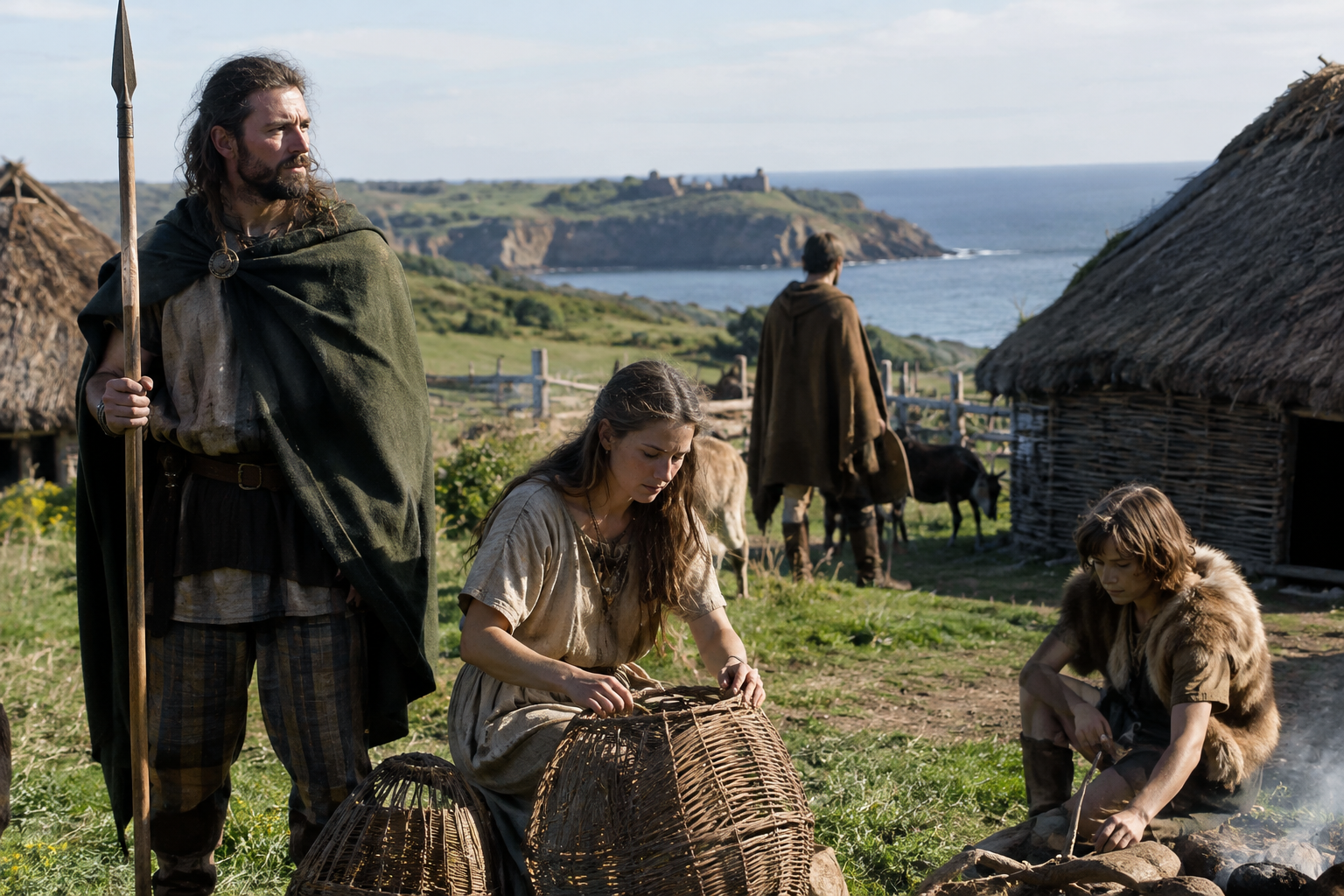
At Urville-Nacqueville on the Normandy coast, archaeologists uncovered the remains of an Iron Age community tied to the Venelli, a Gallic people living at the edge of the Channel world. One of the men from this setting, sample UN19, dated to around 100 BC, is associated here with the Y-DNA haplogroup R1b1a1b1a1a2b1a5a2a1a. That long string may look forbidding, but the historical point is rather simple: it places one paternal line from late pre-Roman Normandy inside a branch of the wider R1b family that is deeply relevant to Iron Age western Europe.
That matters because Urville-Nacqueville was not some forgotten inland hamlet. This was a coastal place in regular contact with Britain and the continental mainland, a perfect setting for asking how male lineages moved, persisted, and mixed in the centuries before Rome absorbed Gaul. Y-DNA follows only a direct paternal line, not a person's whole ancestry or identity, but even that narrow line can be revealing when it turns up in a well-dated archaeological context.
The Venelli are known from the historical geography of northwestern Gaul, and Urville-Nacqueville sits in exactly the kind of maritime landscape where tribal labels, trade routes, and family histories overlapped. By the late Iron Age, this coastline faced Britain as much as it faced the rest of Gaul. Goods, people, and ideas crossed the water constantly, which makes any ancient DNA result from the area especially interesting.
Sample UN19 therefore gives us something quite concrete: not an abstract "Celtic" lineage floating across a map, but a paternal line carried by a real man living in late Iron Age Normandy shortly before the full Roman reordering of the region. A genetic study of ancient individuals from this broader setting can be found in research on ancient populations of Iron Age and historic France. Even without overstating the exact subclade history, the result helps anchor this branch in an archaeologically documented community on the Channel seaboard.
It is worth separating the very specific haplogroup in this article from the much larger R1b picture. The wider R1b family includes many branches spread across Europe and beyond, and several became prominent in later prehistoric and Iron Age western Europe. But R1b1a1b1a1a2b1a5a2a1a is a much narrower twig on that larger tree, and one ancient identification in Normandy does not by itself map the entire history of the branch.
What it does show is that this paternal line, or a lineage reported within this branch, was present among people living in a firmly late Iron Age context in northwestern Gaul. That is already useful. For men researching this haplogroup today, the evidence places at least one bearer in a world of coastal exchange, local tribal identities, and intensifying contact with both Britain and Rome.
There is a tendency, when talking about Gaul, to leap too quickly from "Celtic" to "Roman province," as if the change were immediate and complete. Urville-Nacqueville reminds us that communities in places like the Cotentin peninsula had their own long local histories. Around 100 BC, the Venelli were living in a region shaped by Atlantic mobility, not merely waiting to become Roman.
That makes UN19 especially valuable as a chronological marker. He belongs to the generation before Caesar's conquest transformed political structures in Gaul. A paternal lineage found here belongs, in other words, to the last century of an independent Iron Age society in Normandy, not to a later Roman military colony or a medieval back-projection of identity.
One of the most important things about northwestern France is that it cannot be understood in isolation. The Channel was not a barrier in the modern sense; it was a route. Late Iron Age communities in Normandy, Brittany, southern Britain, and the Low Countries participated in overlapping networks of trade and contact, and those networks would have shaped how paternal lines circulated.
That does not mean sample UN19 can be turned into proof of a single migration episode, still less into evidence for one language or one tribe moving neatly from A to B. But it does make his lineage historically plausible in a region where population links across the Channel were routine. If you are interested in how genomics is reshaping debate around language and movement in northern Europe, MyTrueAncestry has also looked at the spread of Germanic languages using ancient genomics; the case is different, but the methodological lesson is similar: languages, peoples, and Y-DNA branches are related only indirectly, and the archaeology matters.
Ancient DNA articles often work with dozens or hundreds of individuals, and that scale is scientifically powerful. But there is also something properly archaeological about keeping hold of the individual. UN19 is not merely a data point inside a continental trend. He is one excavated person from one documented place, tied to a real late Iron Age community on the Norman coast.
That individual anchor helps keep interpretation honest. We can say that this paternal branch appears in Iron Age Normandy. We can say it belonged to a man from a Venelli-associated context around 100 BC. We can place that finding in a wider western European R1b landscape. What we should not do is inflate one sample into a tribal essence or pretend that a single paternal line explains the whole ancestry of the Venelli.
The strongest insight here is geographical and historical rather than dynastic. R1b1a1b1a1a2b1a5a2a1a, through sample UN19, is tied to a man living in late Iron Age Normandy in a coastal Gallic society connected to the wider Channel zone. For a present-day tester, that does not promise descent from the Venelli as a whole, but it does place this paternal line within a very specific and fascinating corner of pre-Roman Europe: a maritime frontier where local tradition, long-distance contact, and political change met face to face.






Comments