Haplogroup R1b1a1b1a1a1c2b2b1a1a

– 5 min read


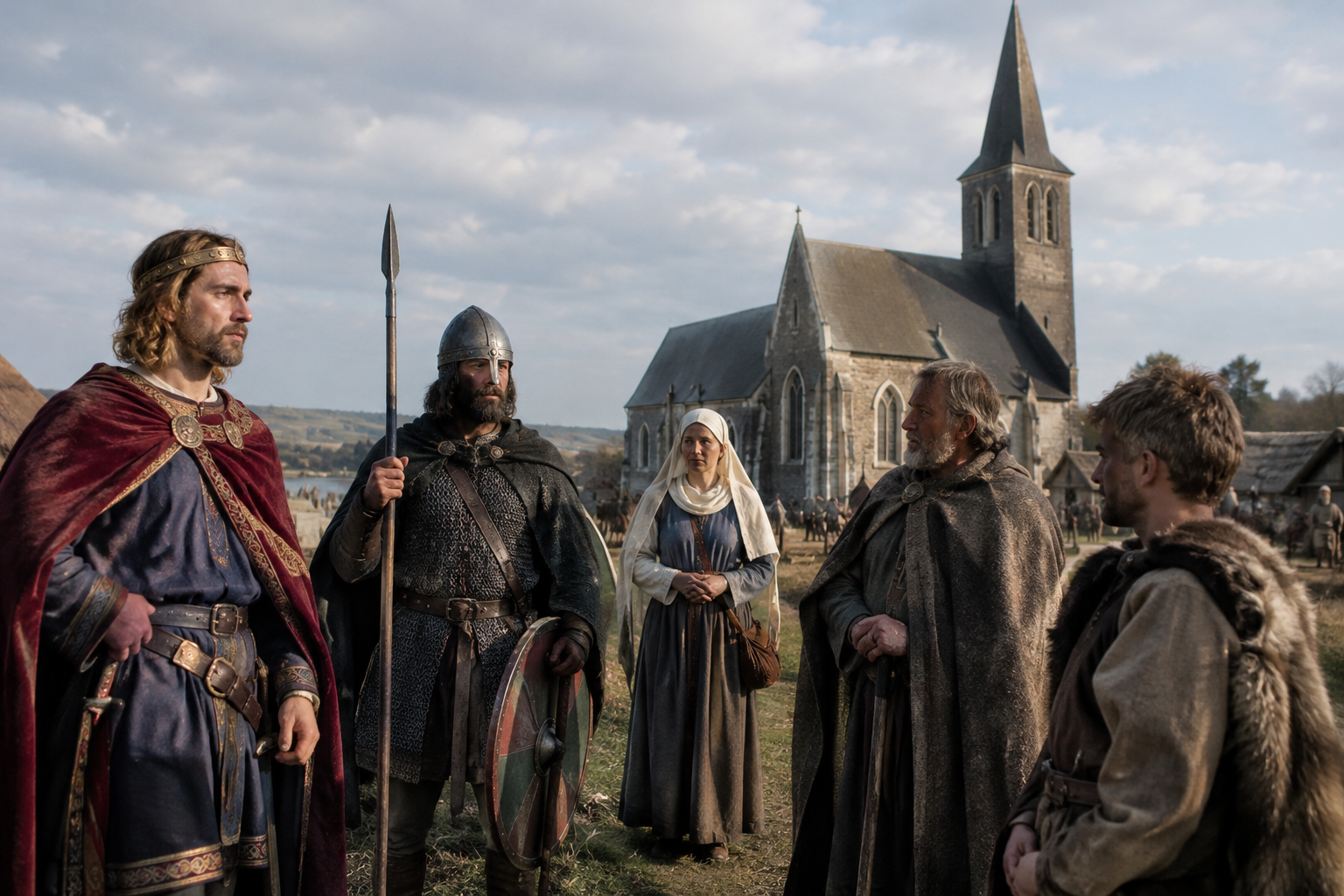
At Sint-Truiden in medieval Belgium, one burial stood out by not quite fitting in. The individual catalogued as ST2329, dated to around AD 900 from the Onze-Lieve-Vrouwekerk site, has been described as an outsider in a town cemetery that otherwise helps illuminate local continuity and urban life. That makes him a useful starting point for the Y-DNA haplogroup R1b1a1b1a1a1c2b2b1a1a: not because one man can explain a whole lineage, but because his burial hints at the sort of mobile, mixed early medieval world in which this paternal branch appears.
That branch belongs within the very large wider family of R1b, a major West Eurasian Y-chromosome lineage. Y-DNA traces one direct paternal line only, so it does not define a person's whole ancestry, language, or identity. What the ancient evidence here does suggest is that this particular branch turns up in a recognisably northwestern European zone stretching across the Channel coast, the Low Countries, and the lower German world between late antiquity and the early Middle Ages.
ST2329 comes from Sint-Truiden, an important medieval centre in present-day Belgium. Urban churchyard cemeteries are often revealing because they gather people who lived in one place but did not necessarily all come from one place. In that setting, an "outsider" label matters: it suggests mobility, marriage networks, migration, or simply a life that connected town and countryside in ways the graveyard alone cannot spell out.
A recent archaeogenetic study of Sint-Truiden examined how medieval urbanisation shaped the local population and found both continuity and diversity within the community. ST2329's association with this haplogroup fits that broader picture rather neatly: a paternal line that sits comfortably in the northwest European world, yet appears in an individual remembered in death as somehow not entirely local. You can explore the wider site background in this MyTrueAncestry post on Sint-Truiden.
There is a temptation, always, to turn an outsider into a dramatic migrant from far away. Usually the evidence is not so obliging. In early medieval Europe, "outsider" can mean movement across quite modest distances: another district, another polity, another speech community, another family network. That is precisely why ST2329 is interesting. He places this paternal line inside a world of ordinary but consequential mobility.
The strongest cluster in this small set comes from Merovingian-period burials dated around AD 605: NIEcap12b, identified as a Merovingian noble, and NIEcap12c, identified as a Merovingian warrior. These labels are already enough to make the material arresting. We are not looking at one isolated chromosome turning up once, but at the same narrow paternal branch appearing in two men from a politically charged post-Roman setting.
The Merovingian world was not some neatly sealed "Frankish" box. It was a kingdom assembled out of Roman provinces, military retinues, regional aristocracies, and families who could move between older imperial habits and newer dynastic power. Research on a cemetery in southern France, published in Science Advances, showed just how varied these communities could be in both ancestry and social composition. Without overstating the exact reach of one subclade, NIEcap12b and NIEcap12c place R1b1a1b1a1a1c2b2b1a1a in a Merovingian milieu where rank, service, and regional integration all mattered.
It is also worth pausing over the contrast between "noble" and "warrior". Those are social descriptions, not genetic categories. Still, the pairing is useful. It reminds us that a Y-line can pass through different positions within the same historical order: landed status, military role, kinship strategy, or all three at once. A paternal lineage need not belong to a single dynasty to be historically visible.
Another appearance comes from SRS004, dated to around AD 775 at Schortens in Lower Saxony, Germany. By this date, the lower North Sea coast was a busy contact zone. Frisia, Saxony, the Frankish realm, and the Channel coast were tied together by trade, warfare, Christianisation, and the stubborn survival of regional identities.
SRS004 matters because it shifts the picture eastward without taking it out of the same broad cultural orbit. This is not a Mediterranean branch suddenly leaping north, nor a Scandinavian line abruptly dropped into Francia. Instead, the distribution of the known samples suggests a lineage moving within connected coastal and near-coastal societies of northwestern Europe.
That pattern sits comfortably beside the larger historical story of frontier blending and post-Roman realignment in the region. The old Roman map had fractured, but people, families, and male lines carried on circulating across newer borders. For anyone with this haplogroup today, Schortens offers a reminder that paternal ancestry can belong to these practical networks of everyday movement rather than to one famous ethnic label.
The earliest dated sample in this group is BUK010 from Buckland, Dover, in England, around AD 400 in the early Anglo-Saxon period. Dover is an ideal place to find a lineage with cross-Channel implications. It sat on one of the most travelled thresholds in early medieval Europe, where Britain faced the Continent at its closest and where migration need not have been dramatic to be historically significant.
An ancient DNA study of early medieval England, available here via ResearchGate, examined how continental migration contributed to the formation of the early English gene pool. BUK010's association with this haplogroup does not prove one tidy origin story for the branch, but it does place it in precisely the setting where continental and insular populations were mixing in substantial ways.
That is perhaps the most revealing point of all. When BUK010 in Dover is considered alongside SRS004 in Lower Saxony and ST2329 in Belgium, the geography is not random. It traces the Channel and North Sea basin: a zone of ferries, raids, marriages, monasteries, markets, and military followings. The paternal line is narrow; the historical world it inhabited was anything but.
The Buckland evidence also helps keep the chronology honest. We are not looking at a lineage first appearing in high medieval towns and then being projected backwards. It is already present by the early fifth century in a site deeply bound up with cross-Channel exchange.
Taken together, these samples do not map the ultimate origin of R1b1a1b1a1a1c2b2b1a1a, and they certainly do not allow us to attach it to one people in the old-fashioned sense. What they do capture rather well is a historical corridor: early medieval northwestern Europe, especially the lands linked by the North Sea and Channel.
That corridor has been turning up repeatedly in ancient DNA work, whether in studies of post-Roman Britain, lower Rhine communities, or mixed populations in frontier regions. The same larger landscape appears in MyTrueAncestry's discussions of Roman and early medieval Britain and of blending on the German frontier.
It is also useful to compare this branch's distribution with the Lower Rhine and adjacent regions, where Roman, Frankish, Saxon, and local populations overlapped for centuries. That wider context helps make sense of why a narrow paternal lineage can appear in a nobleman, a warrior, an English early medieval burial, and a Belgian townsman without requiring a single dramatic migration event.
The most distinctive thing about R1b1a1b1a1a1c2b2b1a1a in the present evidence is not royal glamour or a single founding hero. It is its repeated appearance in the connected societies of early medieval northwestern Europe: Merovingian southern Gaul, Lower Saxony, coastal England, and medieval Belgium. If this is your paternal haplogroup, the ancient record currently points most clearly toward that world of cross-Channel and North Sea connections, where status, mobility, and local belonging were constantly being remade.
Comments