Haplogroup R1b1a1b1a1a1c2b2a1b1a4b1a1

– 5 min read


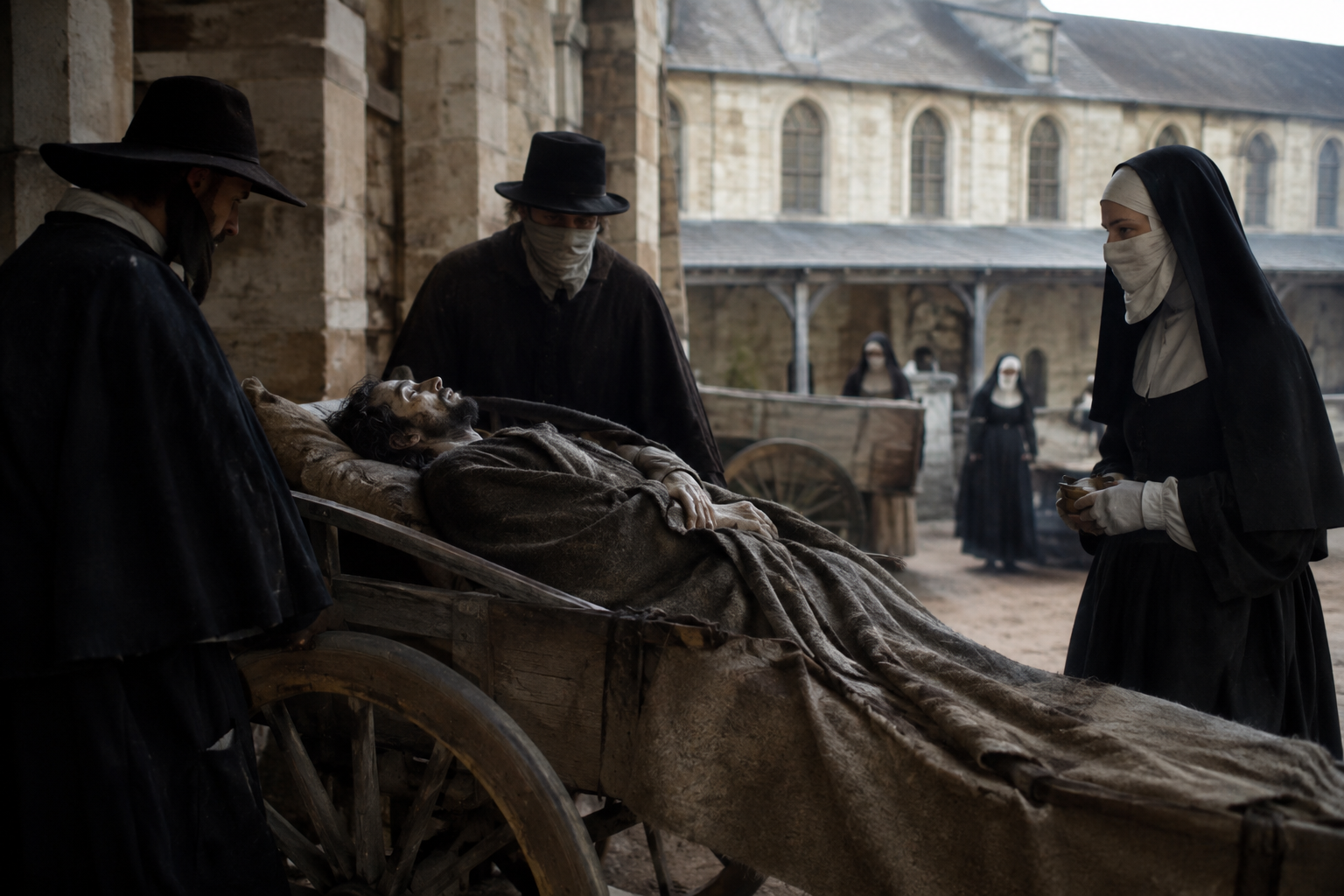
In about AD 1650, a man later catalogued as AMIENS148p was buried at the Hotel-Dieu Saint-Jean-Baptiste in Amiens, northern France. He is identified simply as an early modern plague victim, which is already enough to place him in one of the most unsettling corners of historical archaeology: not a prince in a chapel, not a warrior in a furnished grave, but an ordinary person caught in a medical and social crisis.
That is where this very specific Y-chromosome line, R1b1a1b1a1a1c2b2a1b1a4b1a1, enters the story. Y-DNA traces one direct paternal line only, but even a single securely identified man can be revealing when he comes from a well-dated urban context. Here the interest lies less in grand claims of origins and more in what a lineage looks like when it turns up in a seventeenth-century hospital cemetery in France: embedded in city life, disease history, and the dense movement of people across early modern Europe.
Amiens was no backwater. It was an old cathedral city in Picardy, tied into northern French trade, ecclesiastical life, and the shifting pressures of war, commerce, and epidemic disease. A burial connected with the Hotel-Dieu Saint-Jean-Baptiste points us toward an institutional setting where the sick, poor, and vulnerable gathered, and where plague mortality could leave a sharp mark in the archaeological record.
The sample AMIENS148p matters precisely because it is so grounded. We are not dealing with a vague regional tradition or a legendary ancestor, but with a named archaeological individual assigned to around AD 1650 at a known site. That gives the haplogroup a historical setting: this paternal branch was present in northern France in the early modern period, among the people who lived through recurrent outbreaks and the practical realities of hospital care and emergency burial.
An ancient DNA study connected with these Amiens burials is linked through the research archive at https://www.ebi.ac.uk/ena/browser/view/PRJEB65913. Without over-claiming what can be extracted from a single record alone, the broader value of such work is clear. It brings together genetics, burial archaeology, and pathogen history to show how epidemic cemeteries can illuminate the lives of ordinary townspeople, not just the biology of disease.
Ancient plagues and epidemic DNA
At first glance, R1b1a1b1a1a1c2b2a1b1a4b1a1 looks less like a lineage than a collapsed library shelf. But that unwieldy string is the point: it places AMIENS148p on a very narrow twig of a much larger paternal tree. The broad parent haplogroup R1b is well known across western Europe, yet it would be a mistake to pour the whole history of R1b straight into this much more specific sub-branch.
In practice, a terminal or near-terminal subclade like this tells us that the paternal line had already passed through many generations of branching long before the man at Amiens died. It does not by itself identify language, class, ethnicity, or occupation. Nor does it make this individual a representative of all Frenchmen, all plague victims, or all men carrying nearby R1b branches.
What it does offer is a fine-grained paternal signature. For people researching their own Y-DNA, that is the useful level: not a sweeping map of Europe, but a clue that one branch of the wider R1b world was present in a documented seventeenth-century urban population in northern France.
One reason Amiens is historically interesting is that Picardy sat in a corridor rather than an island. Northern France was shaped for centuries by Roman administration, Frankish kingdoms, medieval lordship, commercial traffic, and early modern military campaigning. By AD 1650, a city like Amiens had behind it a very long history of migration, resettlement, and social mixing.
That matters when thinking about a haplogroup with a modern-sounding precision but an ancient underlying structure. A paternal line found in Amiens could have deep roots in the region, or it could reflect movement into Picardy generations earlier from elsewhere in France or neighboring lands. The archaeological context supports the first part of the claim firmly, presence in Amiens by the mid-seventeenth century, while the deeper route into the city remains a matter for wider comparison, not guesswork.
Studies of medieval and post-Roman western Europe repeatedly show that regions such as northern France were not genetically static. Communities could be locally continuous in some respects and still absorb substantial newcomers over time. That wider pattern is useful background here, especially when readers are tempted to treat a narrow Y-line as a fixed ethnic badge.
Norman Conquest DNA in context
Ancient DNA headlines often gravitate to dynasties, famous tombs, or richly furnished graves. Yet there is something especially valuable about AMIENS148p. He anchors this haplogroup in the lived history of an institution caring for the sick during a time when epidemic disease still had the power to reorganize urban life.
Hospital cemeteries and plague burials can show us the biological history of people who usually leave few traces in written records. Their genomes are often the nearest thing we have to a civic census of vulnerability: laborers, townsmen, migrants, the poor, and the unlucky. In that sense, this Y-line is not appearing in a mythic founder or a heraldic pedigree, but in the sort of person who kept a city going until catastrophe struck.
The wider French setting also fits with other ancient-DNA work showing how local burial grounds can transform our sense of population history. Sometimes the revelation is very early, as in Neolithic northern France; sometimes it is much later, in urban cemeteries where documentary and biological histories begin to overlap more closely.
Neolithic France and ancient DNA
If you carry R1b1a1b1a1a1c2b2a1b1a4b1a1, the most responsible historical takeaway is not a dramatic origin legend. It is something more solid, and in its way more interesting. This branch is represented by at least one documented man in an early modern French plague context, linking the lineage to the crowded, mobile, and often precarious world of seventeenth-century northern Europe.
That makes the haplogroup historically visible in a setting where archaeology, disease history, and genetics meet. It belongs, at least in the evidence currently before us, not to a single celebrated house but to the deeper and more democratic record of the dead: a man from Amiens, around AD 1650, whose paternal line survived long enough for us to recognize it today.
Pre- and post-plague population change
That is often how Y-DNA becomes most meaningful. A narrow paternal branch does not tell you everything about who your ancestors were, but it can place one strand of your family story into a real historical landscape. In this case, the landscape is Amiens in an age of epidemic pressure, and the reminder is a sharp one: lineages do not survive only through nobles and conquerors, but through ordinary men in extraordinary times.




Comments