Haplogroup R1b1a1b1a1a1c2b2a1b1a4b1

– 5 min read


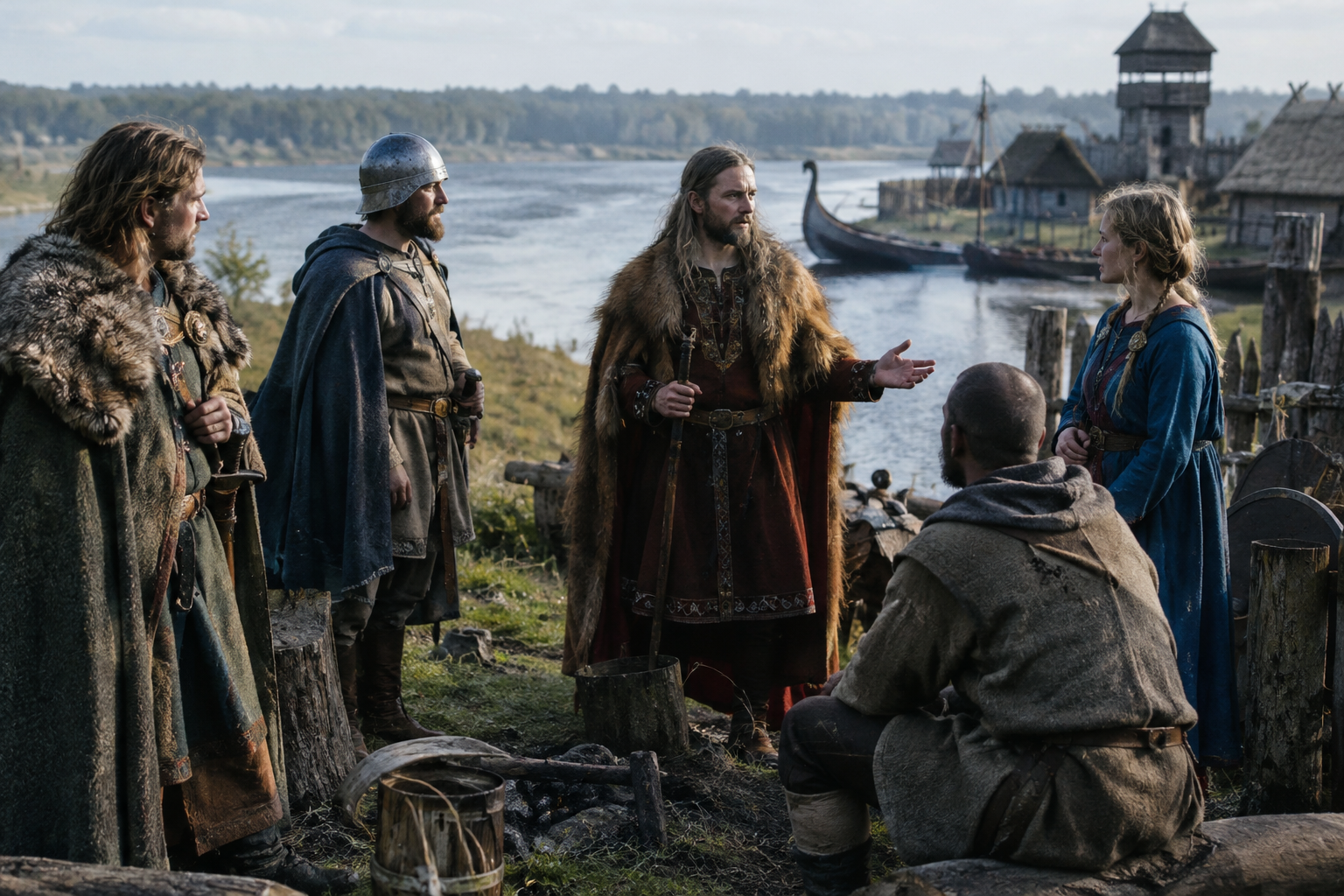
At Santok, on the Lubusz-Greater Poland border, one medieval male sample has drawn unusual attention because it sits so close to one of the best-known ruling houses of early Poland. The individual PCA0422, dated to around AD 1100 and described as connected with the Piast dynasty milieu, is associated here with the Y-DNA haplogroup R1b1a1b1a1a1c2b2a1b1a4b1. That formidable label is a very narrow paternal branch: one twig on a much larger Y-chromosome tree, tracing only a direct father-to-son line.
What makes this case interesting is not a single glamorous burial, but a pattern. The same reported branch appears in early medieval contexts stretching from central Europe to England and Scandinavia: Santok in Piast-era Poland, Migration Period sites in Saxony-Anhalt, an early medieval Jutish burial in Kent, and a Viking Age individual from Varnhem in Sweden. That is not proof of one dynasty roaming the map. It is, however, a useful reminder that paternal lines could travel through very different political worlds while remaining genetically continuous in the strict male line.
PCA0422 comes from Santok Lad, dated here to about AD 1100, in a frontier zone of real historical importance. Santok stood near the meeting ground of Greater Poland, Pomerania, and the lands to the west, a place where Piast authority, trade, war, and settlement all overlapped. A paternal lineage turning up in such a setting matters because borderlands are often where political history becomes human history: not in chronicles alone, but in actual bodies recovered from the soil.
The cautious point is the important one. A Y-line in a Piast-associated context does not mean every man of that branch was a Piast, nor that everyone near Santok belonged to one elite family. What it can suggest is that this narrow paternal lineage formed part of the male population present in a politically charged zone of medieval Poland. For readers interested in the broader dynastic setting, MyTrueAncestry has also covered genetic work on the Piast rulers and the question of their wider connections.
One reason Santok deserves attention is that it pulls this haplogroup away from the lazy habit of treating paternal history as if it belonged to one modern nation. Medieval frontiers were messy. Men moved through marriage, military service, local recruitment, colonization, and shifting loyalties. A line found in Piast Poland may also have earlier or parallel histories further west and north.
Two of the strongest comparative samples are earlier: BRC022x from Bruecken in Saxony-Anhalt, dated to around AD 500 and described as Saxon Tribe Migration Period, and DRH021 from Deersheim, also in Saxony-Anhalt and also around AD 500, described as Thuringii Tribe Germany. Even with those labels, some care is needed. Archaeological and historical identities do not always align neatly with Y-DNA, and a burial in a region associated with Saxons or Thuringians does not reduce a person to a tribal stereotype.
Still, these two finds matter because they place the reported branch in post-Roman central Europe at the very moment when old imperial structures were collapsing and new regional powers were hardening into view. This was a world of shifting confederations, local elites, and communities negotiating between Roman inheritance and emerging early medieval identities. To find the same narrow paternal signal in both Poland and Saxony-Anhalt is to glimpse a line that belonged to that north-central European world before the better-documented high medieval states took shape.
An ancient DNA study on early medieval cemeteries in this broad zone, available at https://www.biorxiv.org/content/10.1101/703405v1, helped bring exactly this kind of evidence into focus: not just grand migrations, but local populations whose ancestry and social identities were more mixed and more interesting than old textbook labels implied.
For a wider look at how genetics is complicating the old Roman-versus-barbarian picture on this frontier, see the related discussion below.
The English sample in this cluster, POH009, comes from Polhill in Kent and is dated to about AD 600, described as Jute Early Medieval. Kent is precisely the sort of place where one expects movement across the North Sea rather than tidy ethnic boxes. In the sixth and seventh centuries, southeastern Britain was tied into networks linking the Continent, the Channel coast, and Scandinavia. A paternal lineage found there could be part of those maritime worlds without needing a heroic migration story attached to it.
Then there is VK34 from Viking Age Skara Varnhem in Sweden, dated to around AD 1050. Varnhem belongs to a period when Scandinavian societies were transforming under Christianization, kingdom-building, and long-distance connectivity. By itself, one Swedish sample does not map the origin of this branch. But set beside Kent, Saxony-Anhalt, and Santok, it shows that this line appears in several of the key regions tied together by early medieval mobility around the Baltic and North Sea.
That is the real historical value of the cluster. Not a single people, not a single kingdom, but a corridor of interaction: central Germany, southern Scandinavia, early medieval England, and Piast Poland. If your paternal line falls on this branch, the ancient parallels point less toward a fixed ethnic label than toward a northern European zone of repeated contact.
The most awkward thing about very specific Y-DNA names is also the most useful: they force precision. R1b1a1b1a1a1c2b2a1b1a4b1 is not the same thing as the whole of R1b, one of western Eurasia's major paternal haplogroups. The broader parent branch has a deep and complex history reaching back long before the Middle Ages. This article's branch is a far narrower descendant line, and the evidence here only supports a modest claim: men associated with this reported branch appear in several early medieval and medieval sites across north-central Europe.
That matters because Y-DNA can easily be over-read. It does not tell you a language, a culture, or a full ancestry profile. But it can be powerful when the archaeological settings line up in revealing ways. Here, the alignment is strikingly medieval: AD 500 Saxony-Anhalt, AD 600 Kent, AD 1050 Varnhem, AD 1100 Santok. These are not random dots. They belong to a connected historical landscape shaped by migration, frontier politics, conversion, and trade.
Research on early medieval and Viking Age populations in Scandinavia and neighboring regions has repeatedly shown how much movement underpinned these societies. A broader scientific resource tied to some of this material is available at https://www.ebi.ac.uk/ena/browser/view/PRJEB81250, which reflects the expanding genomic record behind such reconstructions.
The best supported picture for this haplogroup is not a fairy-tale founder, but a historically plausible spread through the societies bordering the North Sea, Baltic, and central European frontier. Its ancient matches place it among men living in Saxony-Anhalt during the Migration Period, in Kent during the early medieval centuries, in Viking Age Sweden, and in Piast-era Poland. For someone researching this paternal line today, that is a meaningful clue: your direct male ancestry may connect most strongly with the mobile, entangled world of early medieval northern Europe rather than with one isolated national story.






Comments