Haplogroup R1b1a1b1a1a1c2b2a1b1a1a2
– 5 min read


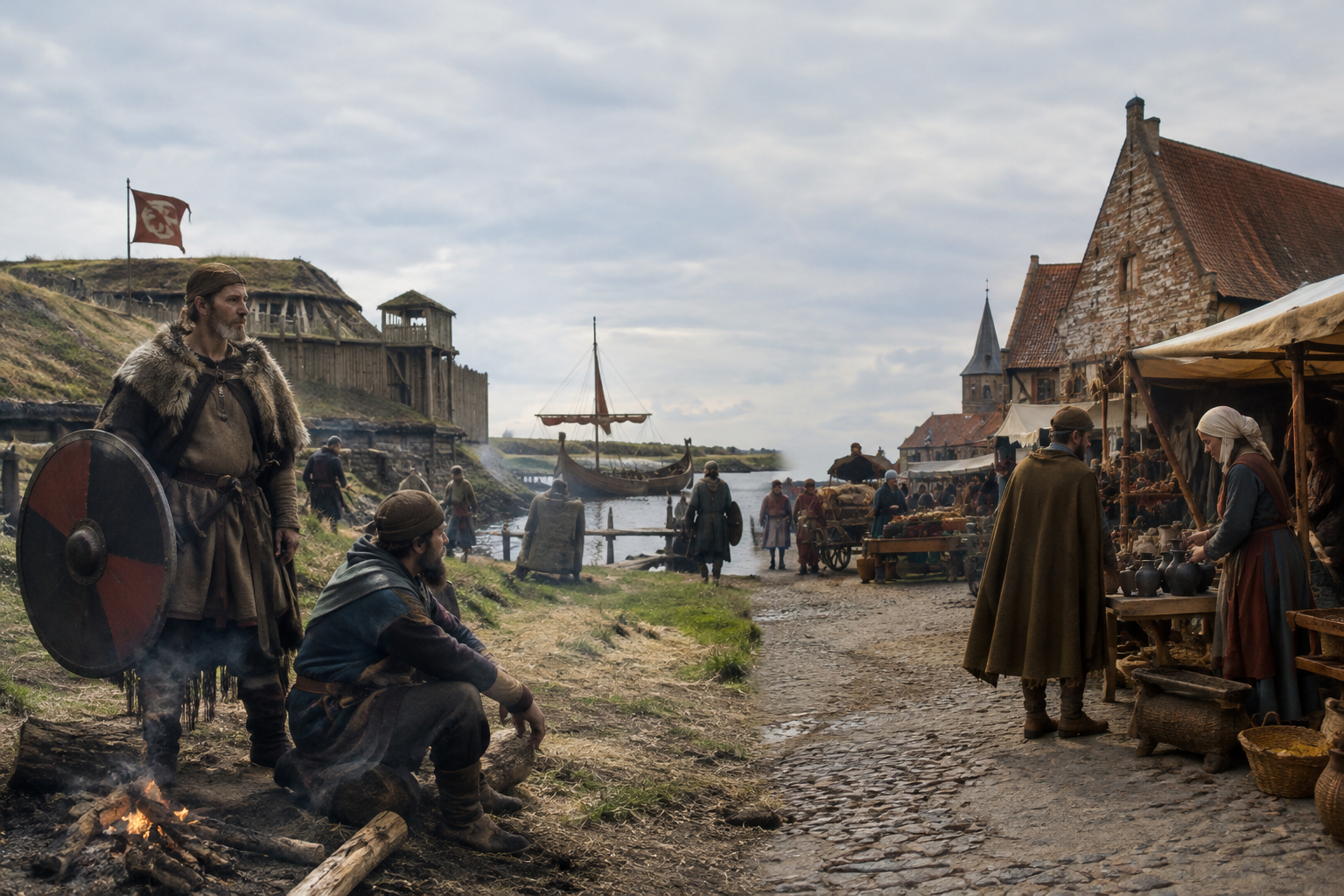
At Trelleborg in the Kingdom of Denmark, around AD 965, one excavated man labeled CGG106832 adds a very specific paternal thread to a famously public Viking-age place. Trelleborg is not just any settlement name in Scandinavian archaeology; it belongs to the ring-fort world associated with late 10th-century royal power, military organization, and the tightening political geography of Denmark. That makes this lineage especially interesting, because the Y-DNA branch R1b1a1b1a1a1c2b2a1b1a1a2 appears here not in a vague "Viking" setting, but in a site tied to the building of states.
A second sample, SWG013, comes from Hedeby, at Schleswig Rathausmarkt in Southern Jutland, dated around AD 1175. By then the old Viking Age was over, Christianity was established, and the North Sea and Baltic world had become more urban, commercial, and institutional. Taken together, these two men do not tell us everything about the branch, but they do place it in southern Scandinavian settings across a long stretch of change: from fortress-age Denmark to the post-Viking trading world.
Trelleborg has long attracted attention because it sits at the intersection of archaeology and political history. Ring fortresses in Denmark are often discussed in connection with the consolidation of royal authority under Harald Bluetooth and his contemporaries. So when a direct paternal line like R1b1a1b1a1a1c2b2a1b1a1a2 turns up in an individual from this context, the main point is not glamour but placement: this branch was present among men living in the very landscapes where kingship, war-bands, labor, and fortified planning were being reorganized.
We should be careful here. Y-DNA tracks one direct male line only; it does not equal a person's whole ancestry, language, or legal status. But archaeology gains something from such a result nonetheless. It shows that this paternal branch formed part of the human reality of late Viking-age Denmark, not merely the broader prehistoric story of western European R1b lineages.
The broader haplogroup background matters in a limited way. R1b is one of the major paternal lineages in western Eurasia, but that is a very large umbrella. The branch in this article is much narrower, and the evidence here is about its attested presence in medieval southern Scandinavia, not about assigning the entire history of R1b to one tiny twig of the tree.
There is a temptation, whenever a Scandinavian sample appears, to leap straight to raiders, ships, and saga imagery. Trelleborg asks for something more disciplined. A fortress is an administrative and logistical statement. It suggests labor mobilization, planning, supplies, and people gathered under authority or obligation. A man buried in that orbit may have been many things, but archaeologically he belongs to a world where Denmark was becoming more centralized.
That is what gives CGG106832 his value for readers researching this haplogroup. He anchors the branch in a recognizable historical moment: the late 10th century, when Danish political structures were hardening into something more state-like. The branch is therefore not merely "old in Europe" in some abstract sense; it is documented in a specific Scandinavian setting at a time of intense historical transformation.
Research on medieval and Viking-age populations in Scandinavia and nearby regions has increasingly shown that these societies were not sealed ethnic boxes. People moved through war, trade, marriage, fosterage, slavery, and seasonal exchange. So a paternal lineage found at Trelleborg should be understood within that dynamic North Sea and Baltic world, not as a badge of a single timeless identity.
The second sample, SWG013, comes from Hedeby, specifically Schleswig Rathausmarkt in Southern Jutland, around AD 1175. Hedeby is one of the great names in northern European archaeology, though by this date we are already beyond its classic Viking-age peak. What matters is continuity of region and change of historical setting. The same paternal branch appears not in a fortress context now, but in a post-Viking landscape shaped by towns, markets, ecclesiastical institutions, and a different political order.
That shift is important. The world of AD 1175 was not the world of AD 965, even if both belonged to the same wider Danish-Southern Jutland sphere. By the 12th century, the old Scandinavian raiding age had given way to Christian kingdoms more fully tied into continental Europe. A lineage present in both periods suggests durability through transition rather than attachment to a single dramatic episode.
Hedeby and Schleswig also remind us that southern Scandinavia was a zone of contact. Goods, people, and ideas moved through this region for centuries. A paternal line turning up there may reflect long local continuity, movement within the Danish realm, or connections across the broader North Sea and Baltic exchange network. With the evidence presently at hand, the most responsible conclusion is simply that this branch was part of that mixed and active historical environment.
An ancient DNA preprint focused on this wider regional material can be found here. It is useful not because it licenses grand claims, but because it places these medieval Scandinavian individuals within a larger research effort to understand population history in context rather than in legend.
Post-Viking Christian Scandinavia
The geography of these two samples deserves emphasis. Trelleborg and Hedeby are both in the southern Scandinavian sphere, close to routes that linked Denmark with the German coast, the North Sea, the Baltic, and the British Isles. This matters historically because lineages do not move on maps by themselves; they are carried by men embedded in systems of shipping, lordship, warfare, craft production, and family life.
That wider pattern is visible in many studies of early medieval northwestern Europe. One useful comparative frame is research on migration and ancestry around the North Sea, including work on the formation of early medieval English populations, such as this study. It does not prove a direct link for these two Danish-area men, but it helps explain the kind of connected maritime world in which such paternal branches could persist, spread, and reappear in different local settings.
If anything, the lesson from archaeology is that southern Scandinavia was repeatedly reworked by mobility. Traders, settlers, retainers, captives, clergy, and craftspeople all passed through. A haplogroup found here may therefore speak less to isolation than to successful survival within a corridor of contact.
For someone who belongs to R1b1a1b1a1a1c2b2a1b1a1a2 today, these two ancient men offer something quite concrete. They place the branch in southern Scandinavian historical settings spanning the late Viking Age and the post-Viking medieval period. One appears in the orbit of a Danish ring fortress at about AD 965; the other appears in the old Hedeby-Schleswig zone around AD 1175, when the region had become more urban and Christian.
That does not make every modern carrier "a Viking" in any simplistic sense. What it does suggest, responsibly, is that this direct paternal line was present among men living through some of the most important centuries in the making of medieval Scandinavia. It is a small but solid archaeological footprint: not a myth, not a royal fantasy, but two real points on the map where lineage and history briefly meet.






Comments