Haplogroup R1b1a1b1a1a1c2b2a1b
– 5 min read


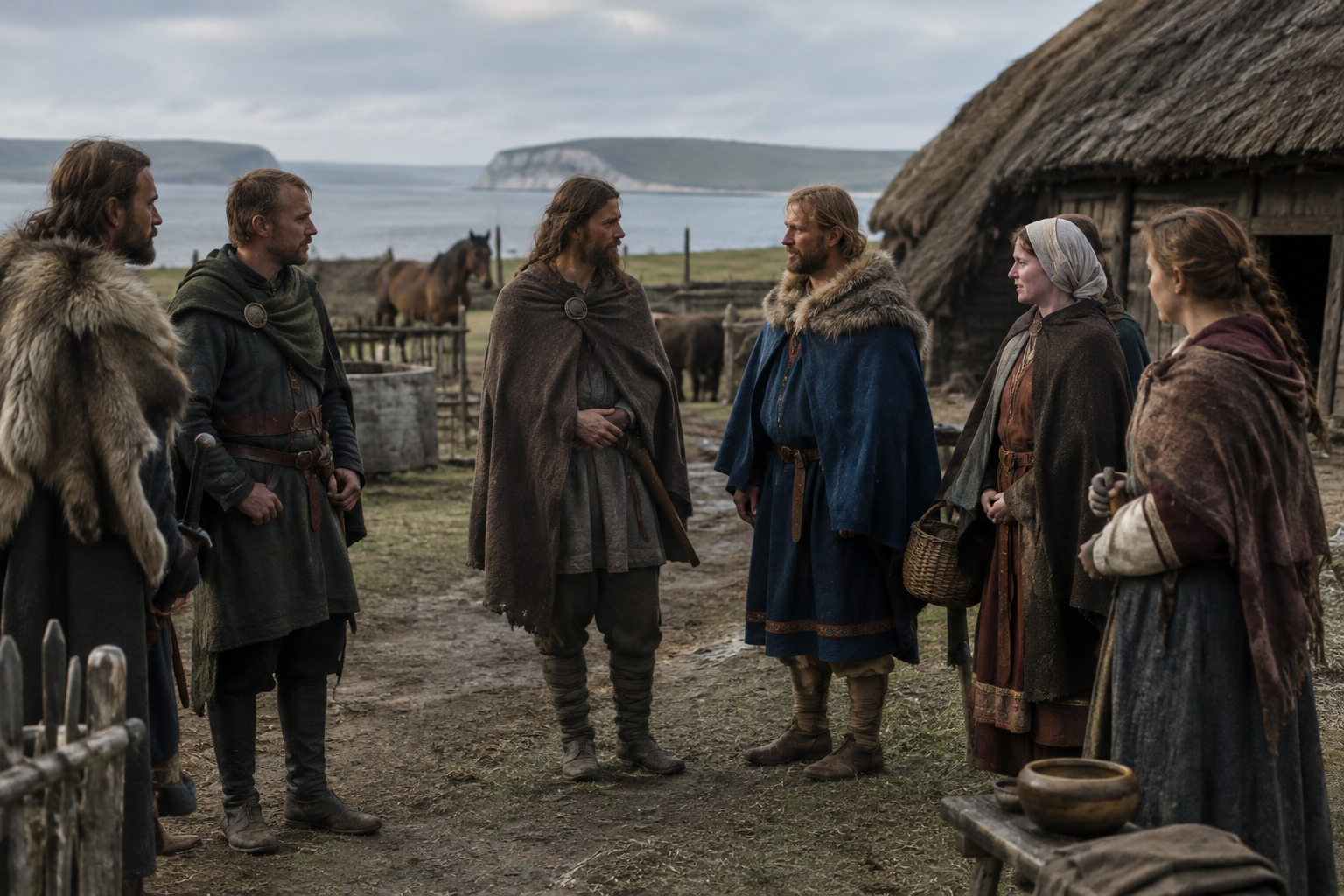
Some Y-DNA branches are so broad that they cover half a continent and several thousand years of history. Others, like R1b1a1b1a1a1c2b2a1b, are much narrower and therefore more tantalizing. They sit low on the paternal family tree, where the grand sweep of prehistory gives way to something more local, more human, and sometimes more historically legible. What makes this branch especially interesting is not that it can be pinned to one people or one kingdom, but that ancient DNA places it among communities moving through the unstable world of late Roman and early medieval Europe.
That is exactly where Y-DNA is at its most revealing. A Y-chromosome haplogroup traces one direct paternal line only: father to son, back through time. It does not describe a person's whole ancestry, identity, language, or culture. But when a rare or specific branch appears in ancient burials from Germany, Hungary, and early medieval England, it begins to sketch a pattern. In this case, the pattern points toward the Germanic-speaking world of the Migration Period, from the Thuringii and Franks to the Longobards and the Jutes who crossed to Britain.
This subclade belongs to the vast Y-DNA haplogroup R1b, one of the major paternal lineages in western Eurasia. R1b has an enormous and complicated history stretching back long before the early Middle Ages, and many of its branches became widespread in Europe through different prehistoric and later population movements. But it is important not to lazily pour the whole history of R1b into one very specific downstream branch. A narrow lineage like R1b1a1b1a1a1c2b2a1b represents just one twig on that large tree, with its own more recent history.
What the supplied evidence suggests is a branch present in the north-central and northwestern European world during late antiquity and the Migration Period. That is a world of shifting confederations, military service, frontier settlements, intermarriage, and movement across the old Roman borders. It is also a reminder that paternal lineages do not respect the neat labels found in later chronicles.
Explore Ancient DNA and Archaeogenetics
The ancient samples linked with this haplogroup sit in a remarkably coherent historical landscape. One of the clearest is OBM054, dated to 500 AD and identified as a Thuringii Tribe Germany Obermoellern burial. The Thuringii occupied a strategic zone in central Germany during the troubled centuries after Roman power withdrew from much of the west. A paternal lineage found in that context immediately places this branch in the middle of the Germanic-speaking societies that emerged between empire and kingdom.
Another sample, ADN014, comes from a Frankish Grave Lower Saxony Hannover-Anderten Germany dated to 400 AD. Here again the setting matters. The Franks were not a neatly bounded tribe in the modern sense but a coalition that became, in time, one of the decisive powers of post-Roman Europe. A sample like ADN014 does not prove that this haplogroup was "the Frankish lineage" - that would be absurdly overconfident - but it does show that this paternal branch was present within the social world from which Frankish power emerged.
Then there are the samples from Buckland Dover in England: BUK040, described as Jute Early Anglo Saxon Period Buckland Dover England Year:400 AD, alongside BUK011, BUK001, and BUK006, all from the Early Anglo Saxon or Early Medieval setting at the same site and date. Buckland has become one of the most evocative cemeteries for the study of the early English population, because it captures the moment when the North Sea became a corridor of migration rather than a barrier. The presence of this paternal branch there fits well with the long-recognized connections among Jutland, northern Germany, and early Kent.
If you want to dig further into that eastern English setting, the MyTrueAncestry community also has a broader piece on how such migration shaped the early medieval English gene pool.
Explore Anglo-Saxon Migration DNA
The most striking geographical jump in the evidence comes from the Carpathian Basin. Two samples are especially important: SZL070, from Longobard Period Pannonia Savaria Szeleste Barbaricum Hungary Year:525 AD, and MFC016, from Longobard Period Pannonia Arrabona Menfocsanak Barbaricum Hungary Year:550 AD. These burials belong to the Longobard world in Pannonia, before the famous migration into Italy.
This is where the history becomes particularly vivid. The Longobards are often imagined only in their Italian phase, as the founders of a kingdom after 568. But before that they were established in the middle Danube region, interacting with other post-Roman groups in a landscape full of old imperial roads, abandoned urban centers, and newly formed warrior elites. Samples like SZL070 and MFC016 anchor this haplogroup in that setting.
What do they tell us? Not that one lineage "was Longobard" in any exclusive sense. Rather, they show that this paternal branch circulated in populations involved in the north-to-south movements of the Migration Period. A branch seen among Thuringian, Frankish, Jutish, Anglo-Saxon, and Longobard contexts begins to look less like an isolated family accident and more like part of a wider network across the old Germanic-speaking zones of Europe.
For readers interested in that Danubian frontier world, one especially relevant companion article is the study of post-Roman population change in the Little Hungarian Plain.
There is always a temptation to turn a haplogroup into a people: this one Frankish, that one Saxon, another Lombard. Ancient DNA has been very good at showing why that approach is too simple. The same paternal lineage can appear in several neighboring groups, and the same cemetery can contain men from different paternal backgrounds. Early medieval identities were political and cultural as much as biological.
Still, the repeated appearance of this branch across Germany, Hungary, and Kent gives us something precious: a line of evidence independent of medieval chroniclers. Written history tells us that men and families moved across these regions. Ancient DNA lets us see at least some of those movements at the level of actual buried individuals.
This is also why comparisons with later noble lineages must be made carefully. The prompt supplied no explicit noble family or castle data beyond the placeholder itself, so it would be irresponsible to invent a dynasty, ancestral seat, or heraldic tale and tie it to this haplogroup. In principle, later noble houses in regions such as central Germany, the lower Rhine, or early medieval England may have emerged in landscapes where related paternal lines had long been present. But that is regional context, not proof of descent. A shared broad haplogroup never demonstrates that an ancient warrior, a medieval count, and a modern tester belong to the same documented family line.
If anything, the value of ancient DNA is that it keeps us honest. It reminds us that castles and pedigrees come late in the story. Before stone keeps and parchment genealogies, there were burial grounds at Obermoellern, Hannover-Anderten, Buckland Dover, Szeleste, and Menfocsanak.
For a wider look at how these frontier communities blended Roman and so-called barbarian worlds, there is another useful MyTrueAncestry article worth exploring.
Read About the German Frontier
R1b1a1b1a1a1c2b2a1b is interesting not because it offers a tidy slogan, but because it refuses one. Its ancient appearances belong to a corridor running from northern and central Germany into Pannonia and across the North Sea to early England. That corridor was one of the great engines of European transformation in the fifth and sixth centuries.
For anyone who carries this branch today, ancient DNA cannot hand over a ready-made identity card. It cannot tell you that you are "a Frank," "a Jute," or "a Longobard." What it can do is place one direct paternal line inside a documented historical landscape. It can show that closely related branches were present among real men living in the centuries when Roman Britain vanished, Kent filled with new settlers, Frankish power expanded, and the Longobards stood on the edge of their move into Italy.
That is the thrill of archaeogenetics. Not fantasy ancestry, but a sharper sense of where one slender paternal thread once ran through history.
If you have tested your DNA, MyTrueAncestry can help you explore whether your results show similarities to ancient individuals like OBM054, ADN014, BUK040, SZL070, or MFC016, and to the populations they represent. Those matches do not prove direct descent from a named ancient person or membership in a noble house, but they can open an extraordinary window onto your deeper past.






Comments