Haplogroup R1b1a1b1a1a1c1a2b1
– 5 min read


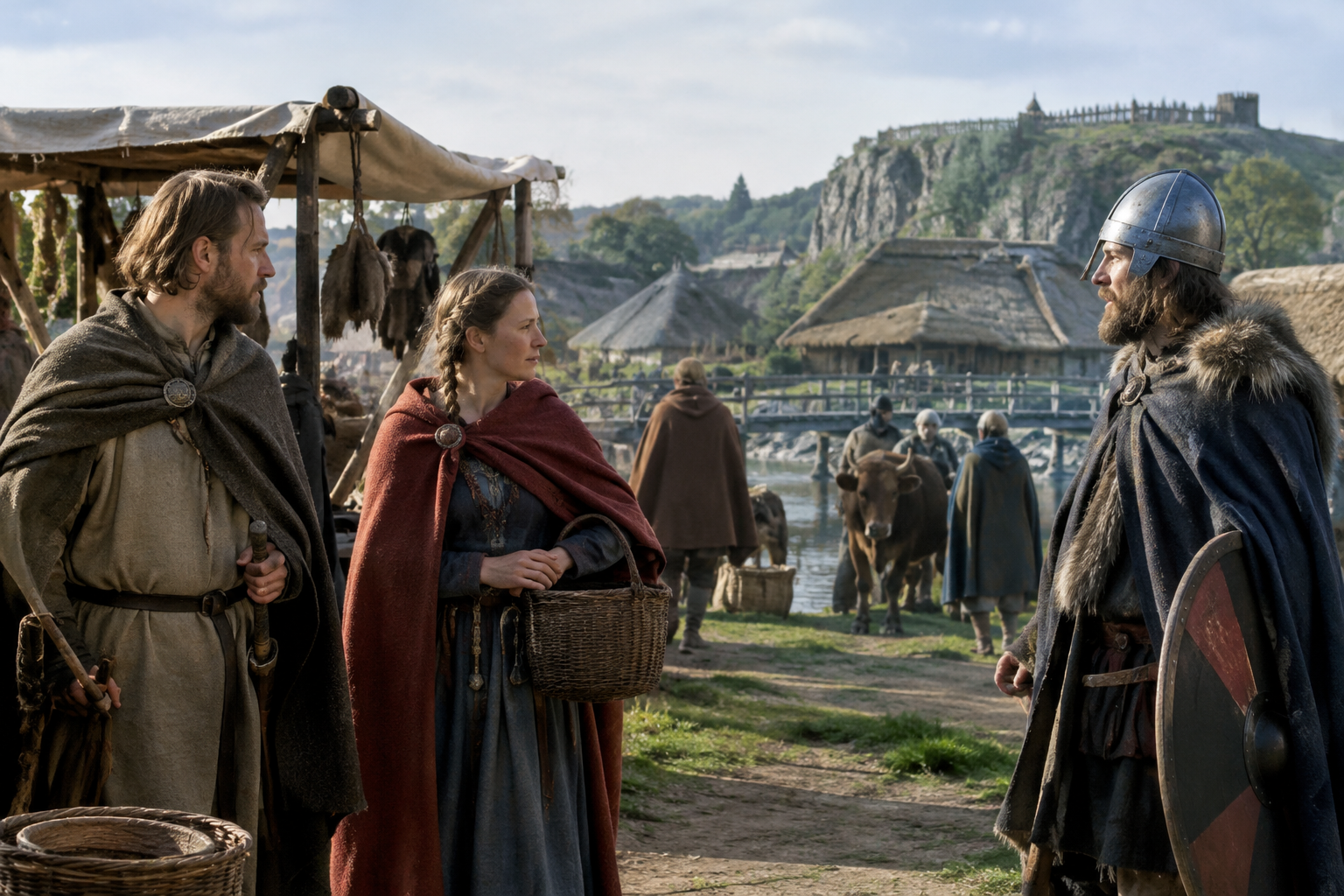
At Valkenburg Marktveld in the Netherlands, archaeologists recovered the remains of a man dated to around AD 250 and associated with the Batavi region of the Roman frontier. In genetic terms, he is reported here as sample CGG107751, linked with the Y-DNA haplogroup R1b1a1b1a1a1c1a2b1. That may look forbiddingly technical, but the real interest is straightforward: this is a paternal line turning up on the Lower Rhine at a moment when Roman military power, local identities, and cross-border movement were all tightly entangled.
A later appearance of the same reported branch in Viking Age Ribe, Jutland, in sample VK323 from around AD 1000, gives the story a second anchor point. We are not looking at a single tribe, kingdom, or family marching neatly across the centuries. We are seeing a paternal lineage within the broader R1b world appearing in two historically charged North Sea settings: one on Rome's frontier, the other in Scandinavia's busiest emporium at the end of the Viking Age.
R1b1a1b1a1a1c1a2b1 is a very narrow branch within the much larger R1b Y-chromosome family. Y-DNA follows one direct paternal line only: father to son to son. It does not describe a person's whole ancestry, language, or ethnic identity. So when this lineage appears in a Batavian-era burial and again in Viking Age Denmark, that does not mean all Batavians or all Vikings belonged to it, nor that the two men were close relatives in any genealogical sense.
Still, narrow branches matter because they show how specific paternal lines persisted inside wider historical worlds. A frontier soldier, farmer, trader, townsman, or descendant of any of these could carry such a lineage forward for many centuries without leaving a written name. Ancient DNA gives us those glimpses where texts are usually silent.
The Valkenburg find matters because the Lower Rhine was never a simple dividing line between "Roman" and "Germanic." It was a lived frontier, full of forts, roads, river transport, civilian settlements, recruited auxiliaries, merchants, and families with mixed local and imperial connections. A man buried there around AD 250 belonged to a world in which identity was practical as much as ethnic: one might be tied to local communities, imperial service, and regional mobility all at once.
The label "Batavi" is historically evocative, but it needs careful handling. The Batavi were a well-known people of the Rhine delta in Roman sources, and Valkenburg sits in that broader frontier zone. Yet a Y-chromosome result does not by itself prove tribal membership in the way a Roman historian might have used the term. What it does show is that the paternal branch reported as R1b1a1b1a1a1c1a2b1 was present in this riverine borderland during the later Roman period.
That fits a larger archaeological pattern in the region, where burial grounds and settlements often reveal local continuity alongside outside connections. Research on ancient populations of the Lower Rhine has increasingly emphasized just how mixed these communities could be, biologically as well as culturally. One recent ancient-DNA study examining this frontier zone can be found here: https://www.biorxiv.org/content/10.1101/2025.02.28.640770v1.
So the significance of CGG107751 is not that he solves the Batavian question once and for all. It is that he places this paternal line in a concrete archaeological setting where Roman administration and local North Sea populations met every day.
The second sample, VK323, comes from Ribe in Jutland around AD 1000. That is an altogether different world from Roman Valkenburg, but no less cosmopolitan. Ribe was one of Scandinavia's earliest and most important towns, with trading links stretching across the North Sea and Baltic and beyond. By the year 1000 it was also part of a changing religious and political landscape, as Christianity became more established and royal power more organized.
Finding the same reported Y-DNA branch here is interesting precisely because Ribe was not an isolated village. This was a port town, a marketplace, and a point of contact. A paternal lineage present in such a place might reflect deep local roots in southern Scandinavia, movement around the North Sea, or the ordinary churn of families over generations in a trading center. The caution is obvious: one man does not stand for the whole town. But one man in Ribe does show that this branch belonged within the Scandinavian world by the end of the Viking Age.
An earlier large-scale ancient DNA study of Viking Age populations helped establish just how mobile and varied that world could be, even when the archaeology looks recognizably Scandinavian. That research can be consulted here: https://www.biorxiv.org/content/10.1101/703405v1. Without forcing VK323 into a grand migration tale, it gives useful background for understanding why a North Sea paternal line might appear in a town like Ribe.
Put these two samples side by side and a distinctive pattern emerges. Both come from regions shaped by water, trade, and political contact: the Rhine delta under Rome, and Jutland during the Viking Age. Neither context is inward-looking. Both are places where people, goods, and affiliations moved.
That does not let us draw a straight line from CGG107751 to VK323. Ancient DNA is powerful, but it is not a licence for romantic map-drawing. What it does allow us to say is that the branch R1b1a1b1a1a1c1a2b1 was present in historically important North Sea environments across a span of roughly 750 years. For anyone carrying this haplogroup today, that is a more grounded and more useful observation than any invented tale of tribal destiny.
It also sits comfortably with the wider picture emerging from northwest European archaeogenetics. River frontiers, port towns, and emporia were not genetic islands. They were precisely the kinds of places where paternal lines could survive, shift in status, and become folded into new cultural settings while remaining biologically continuous along the male line.
Roman soldiers on the Lower Rhine
There is a temptation with any R1b branch to tell an enormous story beginning in prehistory and sweeping across Europe. Sometimes that is justified, but here the better story is narrower and sharper. These two samples belong to a coastal and riverine zone that connected the Netherlands, northern Germany, Denmark, and Britain long before modern borders hardened. This was a corridor of exchange, recruitment, settlement, and re-settlement.
That is why the combination of Valkenburg and Ribe is so suggestive. One sample stands in the orbit of Rome's northwest frontier; the other in a Scandinavian urban center at the close of the Viking Age. Between those points lie centuries of shifting power, but also enduring North Sea connectivity. The paternal branch did not need to belong to conquerors or kings to travel through that history. Ordinary men living in extraordinary contact zones are enough.
The clearest insight from the current evidence is that R1b1a1b1a1a1c1a2b1 appears in two well-documented northern European settings where mobility mattered: the Roman Lower Rhine and Viking Age Ribe. That does not assign the haplogroup to a single people or guarantee a neat ancestral narrative. But it does place this paternal line within the lived history of the North Sea world, where frontiers and seaports connected communities as much as they divided them.
For someone researching this haplogroup today, that is the valuable takeaway: your direct paternal line is not just part of broad European prehistory, but is also attested in concrete archaeological contexts tied to Roman frontier society and late Viking Age Scandinavia.

Comments