Haplogroup R1a1a1b2a2b

– 4 min read


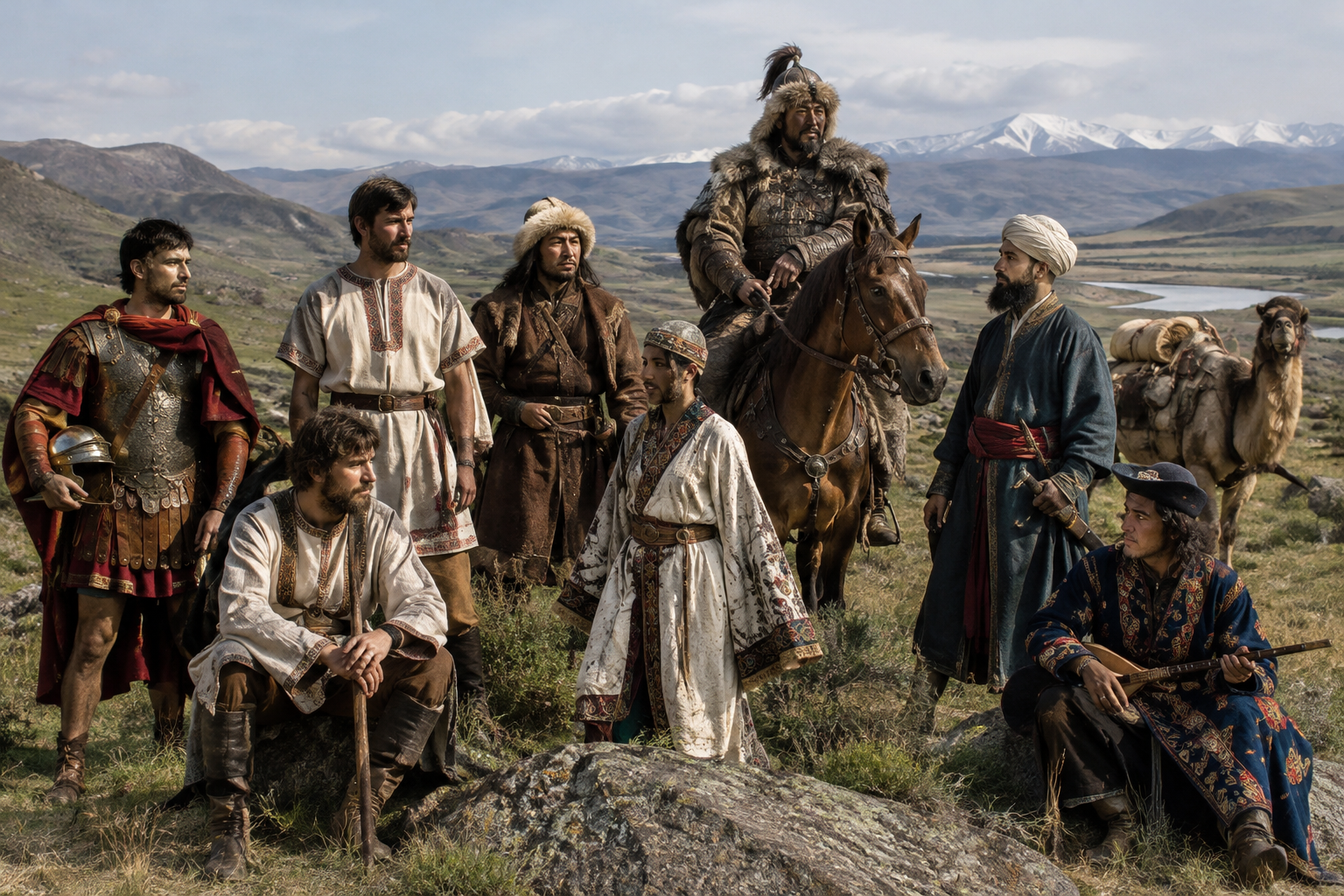
At Rakoczifalva in Migration Period Hungary, one excavated man dated to about AD 650, sample RKO012, carries a paternal line associated here with R1a1a1b2a2b. On its own that may sound like a very narrow technical label, but the setting matters. Seventh-century Hungary sat in the middle of a post-Roman world where the Carpathian Basin linked the Balkans, the Eurasian steppe, and central Europe. A Y-chromosome line turning up there is not just a family marker; it is a clue to how male ancestry could travel through frontier zones, military networks, and mobile communities.
The striking thing is that RKO012 is not alone. Other men associated with this same branch or its immediate paternal neighborhood appear in Roman Serbia, in the Bronze Age steppe world of the Andronovo horizon, and much later in medieval Inner Asia. That does not make them one family, still less one people. Y-DNA traces a single direct paternal line, not a person's whole ancestry. But taken together, these finds give R1a1a1b2a2b an unusually wide archaeological stage.
RKO012 belongs to a period when old Roman structures had collapsed and new political worlds were forming across the Middle Danube. Cemeteries in Hungary from the sixth and seventh centuries often reveal exactly what historians have long suspected: not neat ethnic blocks, but communities shaped by movement, mixture, and local continuity. A genetic study of this wider region, published on the ancient populations of the Carpathian Basin, helped show just how varied these post-Roman groups could be.
That broader setting is important for understanding a lineage like R1a1a1b2a2b. It is a downstream branch within the much larger R1a family, a paternal lineage with deep prehistoric roots across parts of Eurasia. The narrower label should not be inflated into a grand certainty about language or identity. What RKO012 does suggest is that this male line was present in one of the great contact zones of early medieval Europe, where steppe-linked and European ancestries repeatedly met.
Two earlier individuals push the story south into the Roman Balkans. One is I15533 from the Imperial Roman necropolis at Pecine, Viminacium, in Serbia, dated around AD 250. The other is R6688 from Beska-Brest in Serbia, dated around AD 330 in the Late Roman period. These are valuable not because they let us tell a tidy tale, but because they refuse one.
Viminacium was a major Roman city and military center on the Danube frontier. Men buried there might have been local, migrant, military, civilian, or descended from families already mixed over generations. The same caution applies to Beska-Brest. Still, the appearance of this paternal branch in Roman Serbia matters because it places part of the lineage's documented ancient record inside the imperial frontier world well before the Migration Period sample from Hungary.
In other words, the Carpathian Basin evidence does not have to represent a sudden arrival of a wholly new male line in the seventh century. Some strands of this broader paternal ancestry were already present in Danubian landscapes under Rome. That is exactly the kind of complication ancient DNA keeps adding to older historical models.
The oldest sample in this small group is I10112 from Pavlodar, dated to about 1500 BC and assigned to the Andronovo Culture. Now we are in a very different world: the Bronze Age steppe belt of Kazakhstan, far east of the Danube and long before Rome, Huns, Avars, or medieval kingdoms. Yet this is precisely why the sample is so useful.
Andronovo sites are often discussed in connection with mobile pastoralism, metallurgy, and the deep reshaping of steppe societies during the Bronze Age. Research on ancient Eurasian populations, including work associated with large-scale ancient DNA studies of Inner Eurasia, has shown how the steppe was never a blank corridor but a long-lived zone of demographic interaction. A sample such as I10112 does not prove a direct line of descent to any later Roman or Hungarian individual in the list. What it does show is that paternal ancestry associated with this branch reaches back into the Bronze Age steppe world that fed many later population movements.
That long depth also helps explain why a narrow Y-line can appear in very different archaeological settings centuries apart. A paternal branch may survive through pastoral groups, farming communities, frontier garrisons, and medieval elites or commoners alike. The Y-chromosome keeps only one thread of the story, but sometimes that single thread has remarkable durability.
The later eastern samples are just as intriguing. NOM001, from Nomgonii Khundii and dated around AD 900, is identified with an early medieval Turkish tribal context. ARG001, from Argali Mountain and dated around AD 1300, is described as a late medieval Mongol warrior. Another late sample, I1805 from Shah Mirandeh Singoor, dated AD 1565, extends the time range further still.
Here, it is worth slowing down. These labels describe archaeological or historical contexts, not fixed biological peoples. A man associated with a Turkic or Mongol setting is not genetically reducible to that label, and one Y-line does not define a tribe. But the repeated appearance of this paternal branch across Inner Asia does fit a broader historical truth: steppe confederations were built from mixed populations, absorbing and redeploying older lineages rather than replacing them wholesale.
So the pattern is not "this is a Turkic lineage" or "this is a Mongol lineage." That would be far too blunt. The pattern is that R1a1a1b2a2b, or closely reported paternal ancestry associated with it, turns up in several steppe-connected settings from the Bronze Age into the late medieval period. That makes it a lineage at home in the great zone of movement between eastern Europe and Inner Asia.
If you belong to R1a1a1b2a2b, the most responsible historical takeaway is not a claim to one named tribe or empire. It is something more interesting than that. The ancient evidence places this paternal branch in a chain of connected worlds: Bronze Age Kazakhstan, the Roman Balkans, Migration Period Hungary, and medieval Inner Asia. That is a serious span of time and geography, and it points to a lineage that moved through some of Eurasia's most important corridors of contact.
For family historians, that means this haplogroup may preserve a paternal signal linked to steppe-facing regions and the long interaction zone between eastern Europe and Inner Asia. The documentary record of your own family will still matter enormously. But the archaeology gives that paternal line a real historical backdrop: not a fantasy of unbroken tribal identity, but a durable male lineage turning up where empires met, routes crossed, and populations mixed.






Comments