Haplogroup R1a1a1b2a2a3b1a

– 5 min read


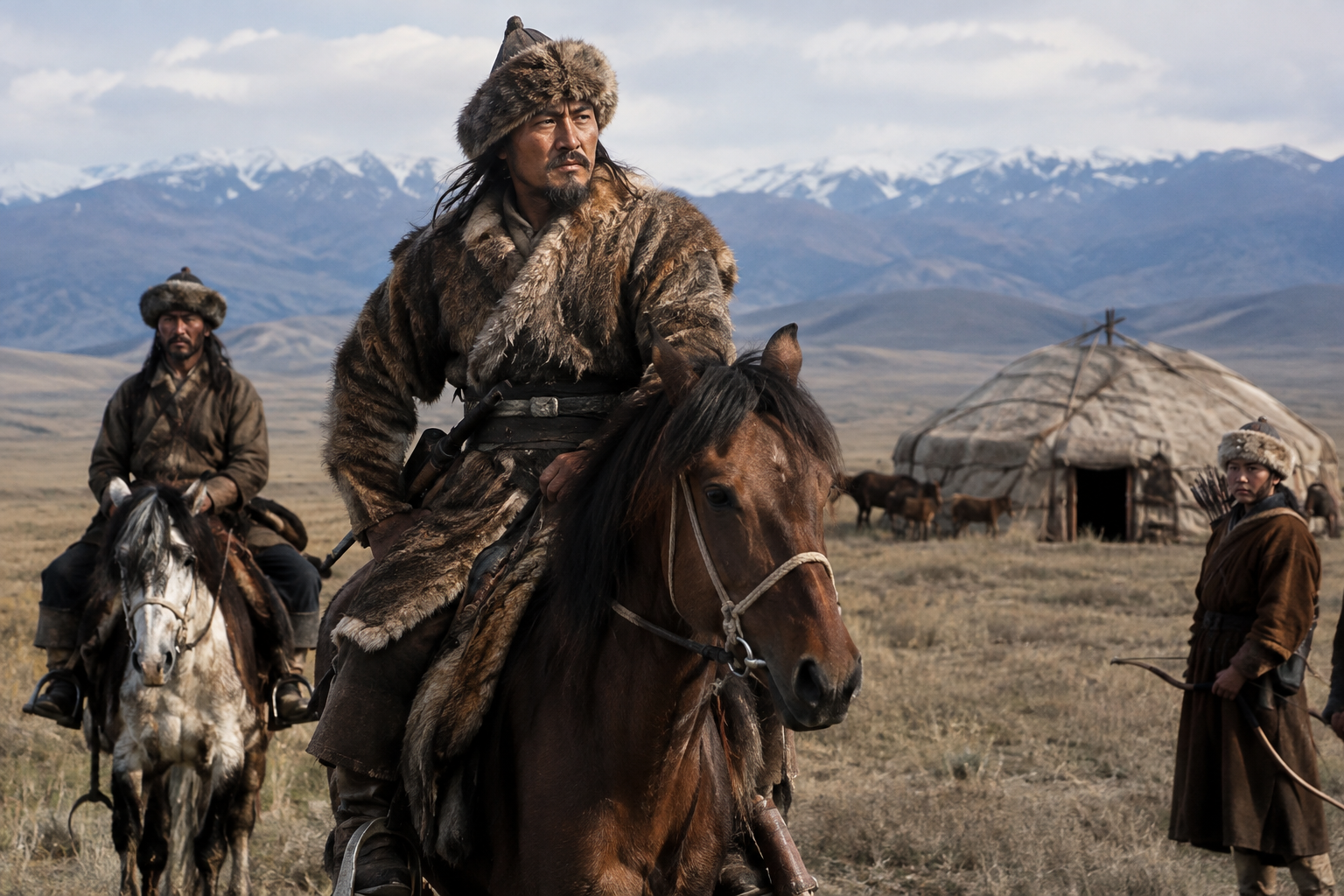
A man identified as KKB002, dated to about AD 830 and described as a medieval nomad from Karakaba, is a small but telling clue in the history of the Y-DNA haplogroup R1a1a1b2a2a3b1a. There is something especially arresting about finds like this: not a king in a chronicle, not a famous conqueror, but one excavated individual from the steppe world, placed by archaeology in a mobile society that connected eastern Europe, Central Asia, and the lands north of the Black and Caspian Seas.
That matters because this is precisely the sort of historical landscape in which paternal lineages could travel far without belonging to any single people forever. Y-DNA traces one direct male line only, not a person's whole ancestry, but when a branch like R1a1a1b2a2a3b1a appears in a medieval nomadic context, it places that paternal line inside one of the great contact zones of Eurasian history.
The Karakaba individual sits in the early medieval centuries when steppe confederations, frontier communities, and mobile elites were reshaping a vast zone from the Altai toward the Pontic steppe. An AD 830 date places KKB002 after the classical Scythian and Sarmatian periods, and well within a later age of Turkic and post-Turkic political formations, long-distance exchange, and repeated migrations. That does not tell us his language, tribe, or personal identity with certainty, but it does give us the right historical frame.
In public discussions of ancient DNA, people often want one burial to stand for an entire nation. Archaeology is usually less tidy than that. A medieval nomad burial from Karakaba is useful not because it offers a romantic label, but because it shows where this paternal line was actually turning up: in a mobile society living in the broad steppe corridor at a time when ancestry, alliance, and culture were all being continually recombined.
A wider ancient DNA study of Inner Eurasian populations, published at this research link, helped establish just how mixed and regionally varied these steppe and frontier populations could be. That larger context is essential. It cautions against crude equations such as "one haplogroup equals one ethnicity," while still allowing us to see recurring paternal lines as part of real historical processes.
R1a1a1b2a2a3b1a is a very specific downstream branch within the much larger R1a family. That larger haplogroup has a deep and complicated history across Eurasia, appearing in many different archaeological and historical settings over thousands of years. But one must be careful here: the broad fame of R1a cannot simply be poured into every narrow descendant branch as if nothing changed along the way.
For this article, the strongest direct anchor is KKB002 from Karakaba. That gives us a documented medieval steppe association for the branch as presented here. It does not by itself prove that every modern carrier descends from medieval nomads, nor that the branch originated at Karakaba, nor that it belonged exclusively to one linguistic or political group.
Still, the placement is historically informative. Many R1a lines are strongly associated, in the long view, with populations of the Eurasian steppe and adjacent forest-steppe. By the early Middle Ages, those landscapes had already seen repeated episodes of expansion, absorption, and reorganization. A paternal lineage surviving in that setting may have passed through Iranian-speaking, Turkic-speaking, and other multilingual worlds before arriving in any later population.
Nomadic burials often do something settled cemeteries cannot: they expose the human reality of movement. A village churchyard may tell us about continuity in one place; a nomadic burial can illuminate the routes that linked many places together. Karakaba belongs to that second category. Even when the archaeological record is terse, the context itself points us toward mobility, exchange, and political fluidity.
This is especially useful for understanding paternal lineages. Male-line descent can persist through centuries of cultural change. A lineage might remain continuous while dress, language, burial custom, and ruling allegiance all shift. That is one reason steppe archaeology and Y-DNA work so well together: both are excellent at revealing continuity inside change.
Across Inner Eurasia, that pattern has appeared again and again. Ancient DNA studies increasingly show that steppe populations were neither isolated nor biologically uniform. Instead, they were often structured mixtures shaped by local ancestry, incoming migrants, elite networks, and frontier marriages. KKB002 is best read within that sort of historical mosaic.
Although KKB002 is medieval, the deeper backdrop reaches much further back. The steppe belt had already been home to Bronze Age herders, Iron Age mounted societies, and later confederations whose power depended on managing movement across enormous distances. By AD 830, anyone buried in a nomadic context was living in a world already layered with centuries of inherited routes and political memories.
That does not let us draw a straight genealogical line from every earlier steppe culture to this exact branch. But it does explain why branches within the wider R1a family so often appear in histories of the steppe. The Eurasian grasslands were not merely empty transit corridors; they were engines of demographic change, carrying people, animals, technologies, and paternal lines across very wide spaces.
For readers trying to place R1a1a1b2a2a3b1a on a historical map, the most sensible approach is not to imagine one heroic migration. Better to picture repeated pulses of movement: some local, some long-range, some attached to conquest, others to marriage, herding, trade, or resettlement. Ancient DNA has been steadily replacing tidy origin legends with something much more interesting and much more human.
The real significance of a sample like KKB002 lies in the setting. Karakaba was part of a wider Inner Eurasian zone where Europe and Asia were never neatly separate historical stages. Peoples moved across these regions in both directions. Some communities were politically dominant for a time; others persisted locally while absorbing newcomers. The result was not chaos, but a patterned kind of complexity.
That complexity also helps explain why a modern paternal lineage can show steppe connections without carrying a simple ethnic label. A branch associated with a medieval nomad might later appear among settled populations, border communities, military descendants, or families whose written histories begin much later and far away. In that sense, steppe ancestry is often less about a single destination than about a chain of historical transfers.
Readers interested in how mobile Eurasian populations can complicate neat historical identities may also find useful comparisons in work on frontier and mixed communities, including the MyTrueAncestry discussion of Black Sea burials at Phanagoria. The recurring lesson is that the steppe and its margins produced people who do not fit simplistic boxes.
On present evidence, R1a1a1b2a2a3b1a is best introduced here through a documented early medieval nomadic context at Karakaba, represented by sample KKB002. That is a valuable clue, because it places the branch in the mobile and mixed societies of Inner Eurasia rather than in a neat modern national story. For someone researching this paternal line today, the strongest historical suggestion is not a guaranteed royal descent or a single ethnic identity, but a connection to the long male-line histories that moved through the steppe world and its frontiers.






Comments