Haplogroup R1a1a1b1a3a3b1
– 5 min read


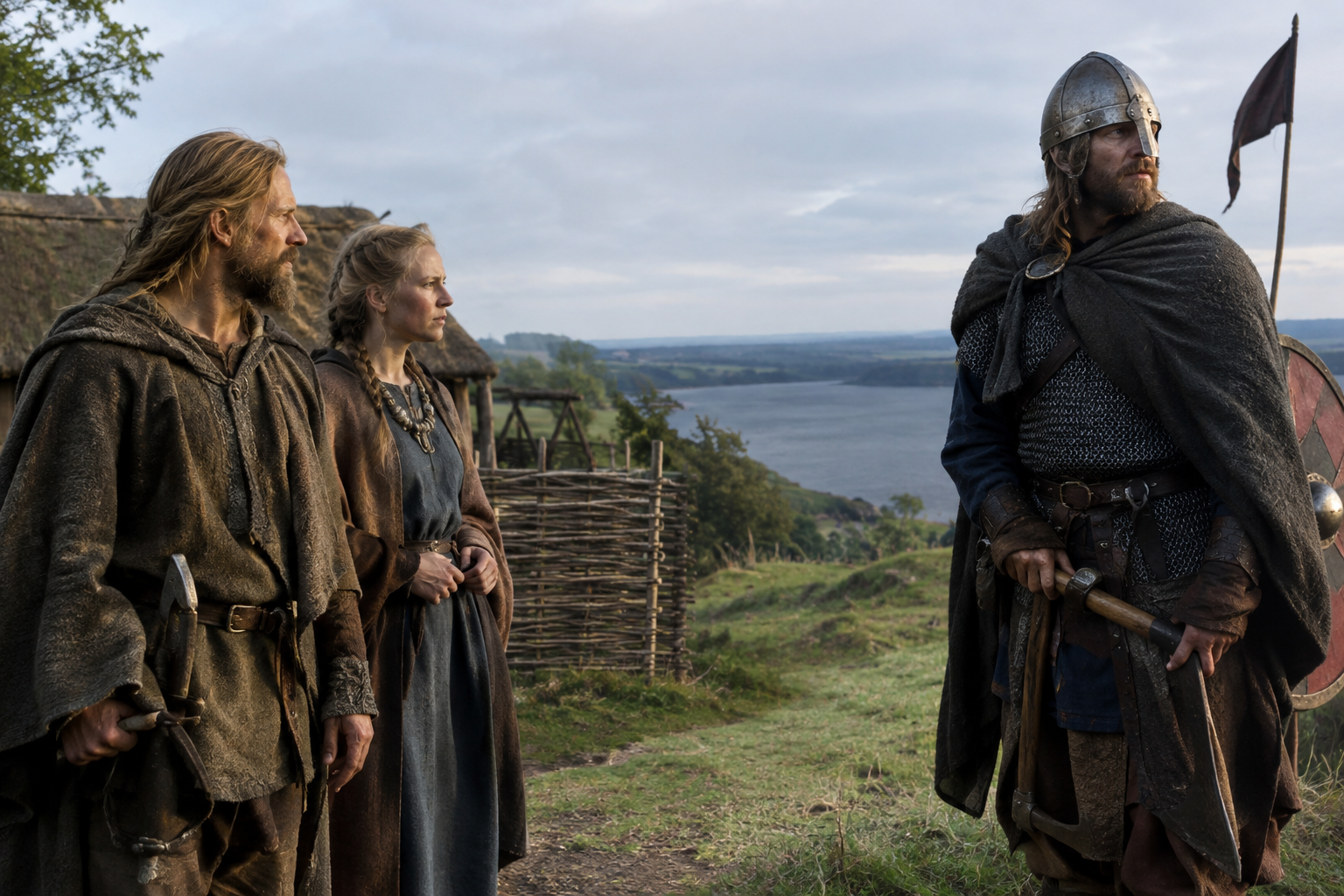
At Ridgeway Hill in Dorset, archaeologists uncovered one of the most unsettling Viking Age finds in England: a mass grave of young men, violently killed around the end of the 10th century. One of the individuals from that group, sample VK258, is associated here with the Y-DNA haplogroup R1a1a1b1a3a3b1. That matters because Ridgeway Hill is not simply "a Viking site." It is a moment of collision between Scandinavia and England, between raiding, warfare, and the movement of male lines across the North Sea.
The other ancient clue comes from much earlier and farther north: CGG107463, dated around AD 151 from Lille Vaseby on Sjaelland, Denmark, identified here as a Germanic-period individual. Put those two finds side by side and a pattern begins to emerge. Not a grand certainty, and certainly not a single family story stretching unbroken across eight centuries, but a plausible northern European setting in which this paternal branch appears in both Roman-period Denmark and Viking Age England.
The earlier of the two samples, CGG107463, comes from Sjaelland, the large Danish island better known in English as Zealand. Around AD 151, this was a world beyond the Roman frontier but hardly isolated from it. Southern Scandinavia in the first centuries AD was tied into exchange networks reaching the Empire, and archaeologists have long seen this period as one of growing hierarchy, mobility, and contact among communities later described as Germanic.
For a lineage like R1a1a1b1a3a3b1, that context is useful. Y-DNA traces one direct paternal line only, not a person's whole ancestry or identity, but it can show where certain male-line branches turn up in the archaeological record. In this case, the Danish sample suggests that the branch, or at least a very closely related paternal line reported under this label, had a foothold in southern Scandinavia well before the classic Viking Age.
That should not be exaggerated into a claim about "the Germans," "the Danes," or any tidy ethnic block. Roman-period Denmark was not a nation-state in waiting. It was a landscape of local communities, changing alliances, and wide-ranging connections. Still, finding this lineage in Sjaelland is precisely the sort of evidence that makes later North Sea appearances historically interesting.
The best-known context in this article is surely VK258 from Ridgeway Hill, England, dated here to about AD 998. Ridgeway Hill has become famous because the burial is so stark: a group of decapitated men, widely discussed as likely Scandinavian raiders or warriors killed in England. The site has featured prominently in the archaeological conversation about the Viking presence in late Anglo-Saxon England, when conflict, tribute, and military campaigns were reshaping the kingdom.
To place R1a1a1b1a3a3b1 in that setting is revealing. This subclade sits within the wider R1a family, a major Eurasian Y-chromosome lineage with a long and varied history. But the broad history of R1a is not the same thing as the story of this exact downstream branch. What the Ridgeway Hill sample gives us is something much more grounded: evidence that this paternal line, as reported for VK258, was present among men caught up in the Viking world of movement and violence across the North Sea.
That does not mean every carrier of this branch was a Viking, nor that Viking identity can be reduced to Y-DNA. Archaeology has repeatedly shown that Viking Age communities were mixed, mobile, and socially complex. But when a paternal branch appears in both Denmark and in a Viking Age burial in England, it becomes easier to imagine how some male lines travelled with the maritime networks that linked Scandinavia, the British Isles, and beyond.
An ancient DNA study connected with Viking Age material in this broader sphere is available at https://www.biorxiv.org/content/10.1101/703405v1. Without forcing conclusions beyond the evidence, research of this kind has transformed how we understand raiding groups, migration, and the biological diversity within historically labeled "Vikings."
R1a1a1b1a3a3b1 is a very specific terminal-style label, far narrower than simply saying "R1a." That distinction matters. The parent haplogroup has an enormous geographic spread and a deep time depth across Eurasia, but a branch this precise belongs to a much smaller part of that family tree. In public ancestry discussions, people often slide too easily from a very broad lineage to sweeping statements about Celts, Slavs, Vikings, Indo-Europeans, or steppe nomads. The genetics does not allow that shortcut.
What we can say, based on the samples here, is modest but meaningful. This branch is represented in two northern European archaeological settings separated by roughly eight and a half centuries: one in Roman-period Denmark, one in Viking Age England. That is not enough to define the entire branch's origin, but it does suggest that one important theater for its documented ancient appearances lies in the Scandinavian and North Sea world.
It is also worth remembering that exact subclade calls in ancient DNA can depend on coverage and reporting conventions. Where an ancient sample is associated with a fine-grained lineage in heritage databases, the safest historical reading is often that the individual belongs somewhere within that immediate paternal cluster unless a published study explicitly confirms the full terminal resolution. Caution here is not pedantry; it is simply good archaeogenetics.
The real interest of these two samples is not that they tell a complete origin myth. It is that they illuminate a corridor. Southern Scandinavia, especially islands like Sjaelland, sat at a strategic crossroads of seaways, trade, and later royal consolidation. By the late first millennium AD, that same maritime zone was projecting people, ships, and power westward into the British Isles.
Seen in that light, CGG107463 and VK258 are not isolated dots on a map. They belong to a broader historical process in which male lines could persist locally, branch, disappear, or move with war-bands, settlers, traders, and mercenaries. Some paternal lines that were already present in Iron Age and Roman-period Scandinavia may well have entered England during the Viking Age, though any direct genealogical jump from one excavated man to another would be pure invention.
Research on ancient populations in northern Europe continues to sharpen this picture. A more recent ancient-DNA study of Scandinavian material is linked here: https://www.biorxiv.org/content/10.1101/2025.02.28.640770v1. Even where one cannot hang every individual sample on a single neat narrative, studies like this are invaluable because they show just how dynamic population history in Denmark and its neighboring regions really was.
North Sea migrations to Britain
Modern haplogroup maps are tempting, but ancient samples are better history. They put lineages into real places, real periods, and real archaeological contexts. In this case, the combination of Lille Vaseby and Ridgeway Hill is stronger than any vague statement about where R1a1a1b1a3a3b1 "is found today," because it anchors the branch in two historically charged moments: southern Scandinavia during the Roman Iron Age, and England during the age of Viking incursions.
That does not make the branch exclusively Scandinavian, and it certainly does not tell every carrier that his paternal ancestors were raiders in longships. But it does make northern Europe, and especially the Scandinavian-North Sea zone, a sensible place to focus historically when thinking about how this lineage may have moved through the first millennium AD.
Roman and early medieval Britain DNA
For someone researching the haplogroup R1a1a1b1a3a3b1, the most distinctive point from the current ancient evidence is its appearance in a northern European arc running from Roman-period Denmark to Viking Age England. That is not a claim of royal descent, nor a guarantee of one single ethnic story. It is something better: a historically grounded glimpse of a paternal line moving within the world of southern Scandinavia and the North Sea, where archaeology and ancient DNA briefly allow real men, real places, and real dates to come into focus.



Comments