Haplogroup R1a1a1b1a3a2b2b
– 5 min read


At Schleinbach in Lower Austria, one Early Bronze Age man has become an unexpectedly useful witness to a much larger story. Sample SLB035, dated to about 1875 BC, carries the Y-DNA haplogroup R1a1a1b1a3a2b2b in the MyTrueAncestry classification. That matters not because one grave can explain a continent, but because it places this paternal line in a Central European Bronze Age setting where mobility, disease, and new social worlds were all colliding.
The Schleinbach evidence is especially evocative because this was not a quiet age. Early Bronze Age communities north of the Danube were tied into long-distance exchange networks and wider demographic changes that had followed the great third-millennium transformations of Europe. Y-DNA traces one direct paternal line rather than a person's whole ancestry, but when a branch such as R1a1a1b1a3a2b2b appears in both Bronze Age Austria and, much later, Viking Age Norway, it offers a useful thread through very different historical landscapes.
Schleinbach lies in a region that has become increasingly important for ancient DNA because it sits within one of Central Europe's best studied prehistoric corridors. By the early second millennium BC, this was a landscape of farming communities, burial grounds, and shifting contacts stretching toward Moravia, the Carpathian Basin, and southern Germany. Sample SLB035 belongs to that world.
The details we can state safely are modest but important: SLB035 is an ancient individual from Bronze Age Austria, dated to around 1875 BC, and associated here with haplogroup R1a1a1b1a3a2b2b. A study connected with Early Bronze Age burials in northern Austria, including discussion of plague in the wider regional funerary record, can be found here. Even without forcing SLB035 into a grand claim, the sample fits a broader archaeological picture in which paternal lineages linked to steppe-derived expansions were well established in Central Europe.
That wider picture matters. In Bronze Age Central Europe, ancestry and culture did not move in neat lockstep. Communities could share burial habits or metalworking traditions without being genetically identical, and the same paternal lineage could appear in more than one cultural setting. So the significance of SLB035 is not that he was the "founder" of anything, but that he shows this branch present in a documented Central European population during a period when male lines associated with R1a were already deeply woven into regional society.
R1a is a very large and historically widespread Y-chromosome family, found across much of Eurasia in both ancient and modern populations. The exact label here, R1a1a1b1a3a2b2b, is a much narrower twig on that large tree. One of the easiest mistakes in popular genetics is to take everything known about R1a as a whole and attach it automatically to every tiny downstream branch. That would be careless.
What the present evidence does support is a narrower point: this specific paternal line, as classified here, appears in at least two very different archaeological contexts, separated by nearly three millennia. One is Early Bronze Age Austria. The other is Viking Age coastal Norway. That does not mean a simple uninterrupted march from one named people to another, but it does show that this paternal branch belonged to lineages capable of surviving major cultural turnovers in Europe.
In practical terms for family historians, that makes R1a1a1b1a3a2b2b a branch worth reading through archaeology rather than mythology. Its documented ancient appearances sit in real communities shaped by farming, exchange, migration, and seaborne mobility, not in the tidy ethnic boxes that later chronicles preferred.
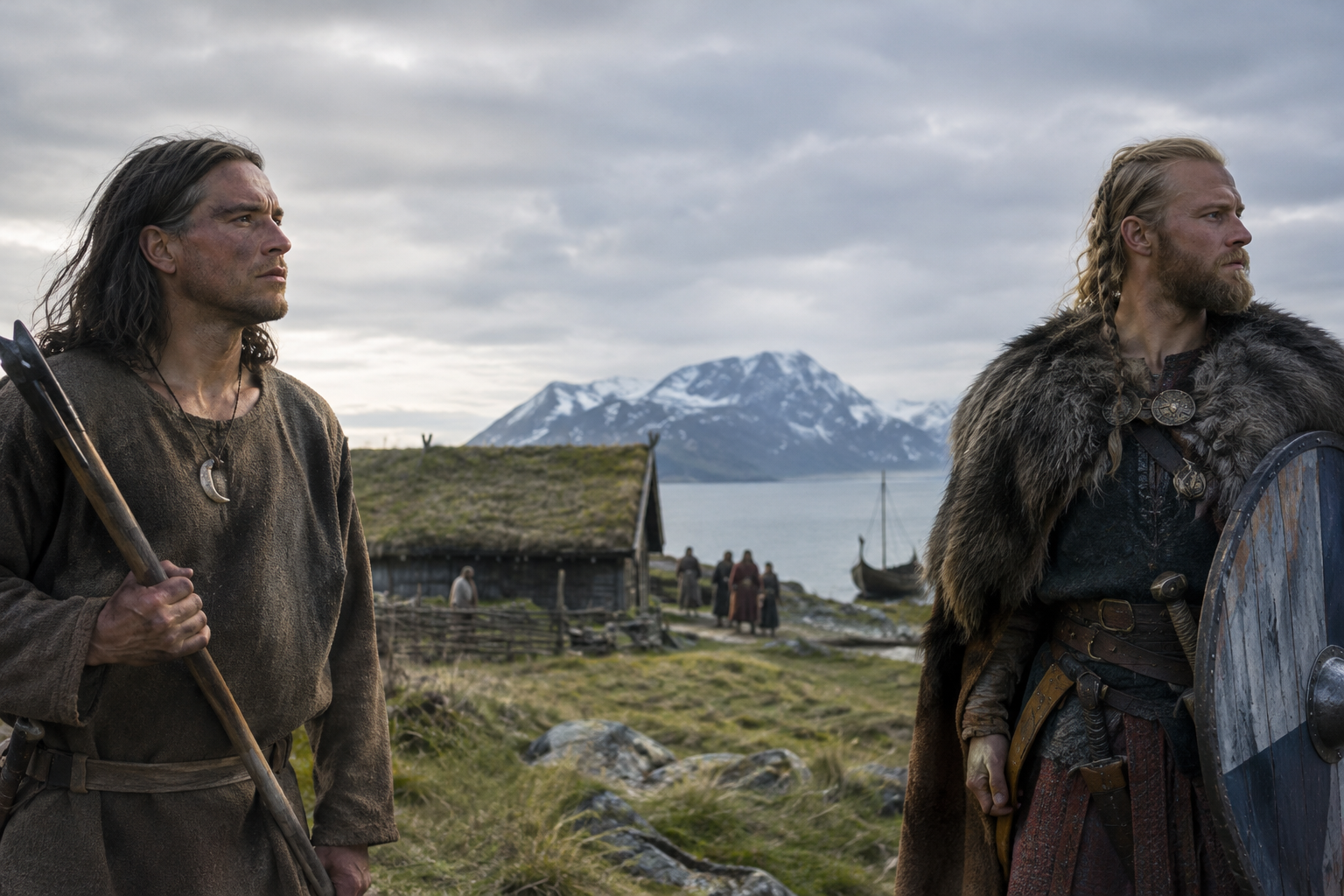
The second ancient appearance in this article comes from a strikingly different setting: Viking Age Norway. Sample VK516, dated to around 950 AD, is from Sør-Trøndelag, a region in central Norway with direct access to the sea and a long history of participation in Scandinavian networks of trade, raiding, travel, and settlement.
By the tenth century, Sør-Trøndelag was part of a Norse world that reached west across the North Atlantic and east through the Baltic and river routes of northern Europe. A large ancient DNA synthesis on Viking Age populations, available here, helped establish just how varied that world could be. Viking Age communities were not genetically uniform, and their cemeteries often capture mobility rather than isolation.
That is the real value of VK516. The sample does not prove that everyone in Viking Age Trøndelag shared the same paternal ancestry, nor does it let us spin a saga of one heroic bloodline. What it does show is that R1a1a1b1a3a2b2b was present in a Scandinavian coastal population at a time when Norse society was outward-looking, maritime, and linked into an enormous zone of contact.
The most interesting thing about these two samples is not that they let us draw a single migration arrow on a map. Archaeology is almost never that obliging. Rather, they show the same narrow paternal branch appearing in two historical environments that were both connected and very different: an Early Bronze Age farming landscape in Austria and a Viking Age maritime society in Norway.
Between those points lie the great population reorganisations of later prehistory and early history: Bronze Age exchange systems, Iron Age regional formations, Roman-era frontier entanglements, and the transformations of the Migration and Viking periods. A lineage found at both ends of that span has plainly passed through many social identities that we cannot recover from Y-DNA alone. Yet the combination is still telling. It suggests persistence, and perhaps repeated incorporation into successful male lines across northern and central Europe.
Central Europe is particularly relevant here because it was not a cul-de-sac. It was a zone of passage. The Danube basin, the Moravian Gate, and the routes northward toward the Elbe and Baltic made this region one of the great connectors of European prehistory. A paternal lineage present in Bronze Age Austria did not need a dramatic one-off migration to become part of later northern populations; over many centuries, ordinary demographic processes, marriages, local expansions, and regional mobility could carry such a line a very long way indeed.
Lower Austria kinship networks
There is a temptation, when a haplogroup turns up in both Bronze Age and Viking Age settings, to leap straight into tales of tribes, conquests, or named dynasties. But the better historical question is simpler: what sort of human continuity does this branch actually document? The answer is not an ethnic essence. It is continuity of a paternal line through radically changing cultural worlds.
SLB035 and VK516 belong to societies that differed in language, politics, and daily life. One lived in the world of early bronze metallurgy and local burial grounds in inland Austria; the other in the world of ships, regional kingships, and far-flung Scandinavian contacts. Yet both can still belong to the same narrow Y-chromosome branch. That is precisely why ancient DNA is so useful: it lets us see continuity where written history is silent, while also reminding us that biological lines and historical identities are not the same thing.
For someone researching R1a1a1b1a3a2b2b, the strongest supported insight is not a claim to one famous people, but a documented place in Europe's long northern and central history. This branch appears in an Early Bronze Age man from Schleinbach in Austria and again in a Viking Age individual from Sør-Trøndelag in Norway. That is enough to suggest a paternal line with real time depth and broad European reach, while still keeping the story where it belongs: in excavated graves, dated human remains, and the patient work of archaeology.

Comments