Haplogroup R1a1a1b1a3a2
– 5 min read


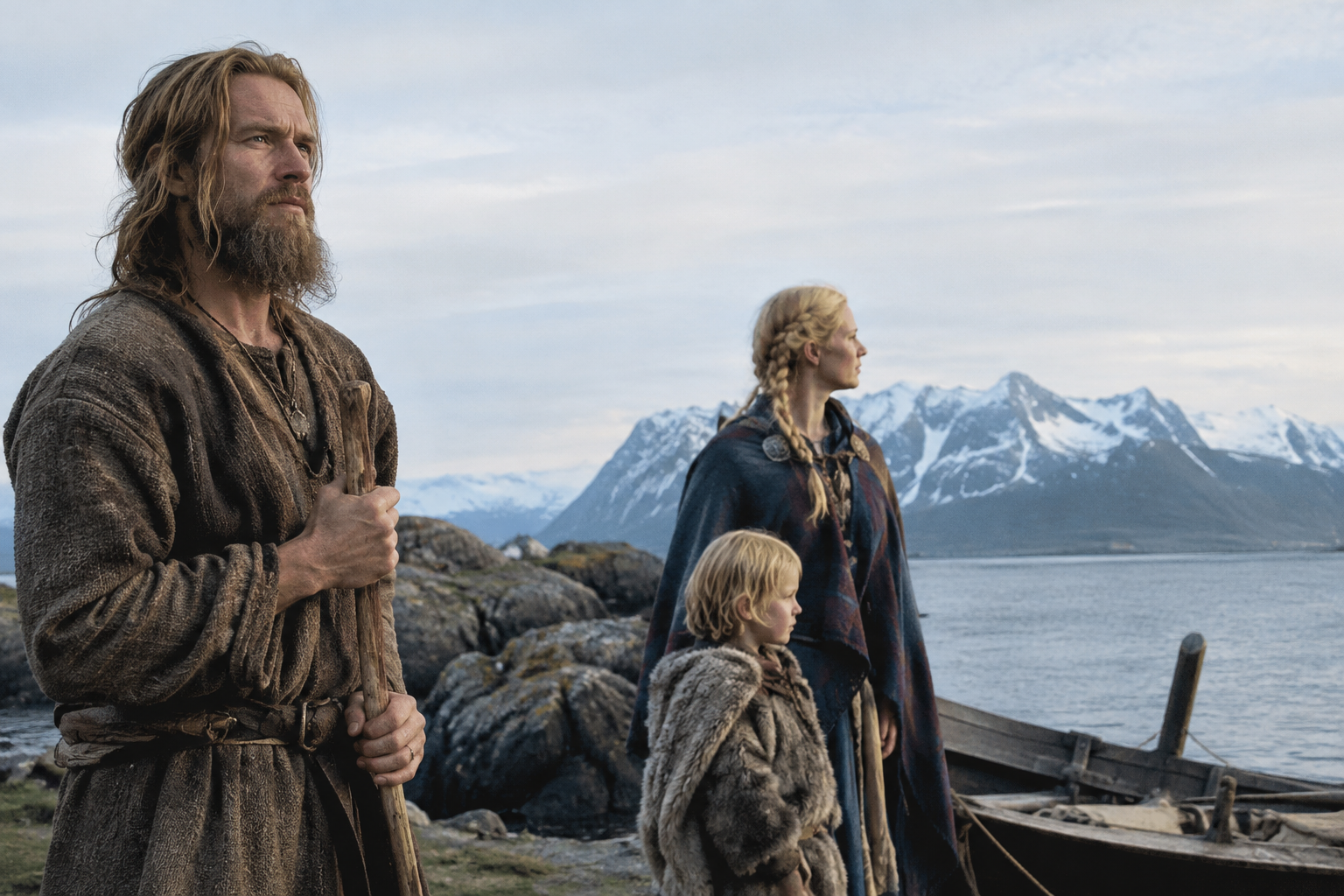
At Skjeggesnes in Norway, an ancient male dated to around 1125 BC carries a paternal line associated here with R1a1a1b1a3a2. That is a very specific Y-DNA label, tucked deep inside the broader R1a family tree, and its interest lies not in grandiose claims but in where it appears: coastal Scandinavia, first in the Bronze Age and then again in the Viking Age far to the north.
The evidence here is modest but suggestive. One ancient individual comes from Bronze Age Skjeggesnes, identified as CGG105636_CGG105637. Another, CGG107016, comes from Ytre Kvaroy in Luroy, Northern Norway, dated to about AD 725, at the opening edge of the Viking Age. Together they do not prove an unbroken family line, but they do show this paternal branch present in Norway across a very long span of time.
The Skjeggesnes individual is the earlier of the two and therefore the most useful place to start. Around 1125 BC, Norway was part of a wider Nordic Bronze Age world linked by seaways, exchange networks, metalworking, and shared styles of material culture. Coastal communities were not isolated backwaters; they were active participants in a North European system of movement and contact.
That matters when thinking about Y-DNA. A haplogroup tracks one direct paternal line only: father to son to son across generations. It does not describe the whole ancestry of the man buried at Skjeggesnes, still less the identity of everyone around him. But when a branch like R1a1a1b1a3a2 appears in a Bronze Age Norwegian context, it places that paternal ancestry firmly inside the human story of later prehistoric Scandinavia rather than making it a purely modern pattern.
Because the surviving details here are spare, it is best not to embroider. We should not invent grave goods, rank, or kinship. The real value of the Skjeggesnes sample is simpler and, in its way, more powerful: it anchors this branch in Norway more than 3,000 years ago.
Scandinavian Bronze Age background
It is tempting to see a long label like R1a1a1b1a3a2 and imagine that every part of its history is neatly known. In practice, ancient DNA is often clearer about broad family relationships than about every historical movement of a narrow sub-branch. The wider parent haplogroup R1a is well known across parts of Eurasia and has a long prehistoric history. But the precise branch in this article should not automatically be given every migration story ever attached to R1a as a whole.
That distinction is important. The Norwegian samples show that a lineage associated with this branch was present in Scandinavia in at least two periods. They do not, by themselves, tell us exactly when this specific subclade first arrived in Norway, whether it came by one route or several, or whether every later carrier in the region descended from a single Bronze Age founder.
Still, the pattern fits something archaeologists have long stressed about Scandinavia: continuity and mobility can exist together. The same coastlines that preserved local communities over centuries also tied them into larger northern worlds.
An ancient DNA study connected with these Norwegian materials is available as research on ancient Scandinavian populations. Without over-claiming details beyond the information at hand, it provides the scientific setting for reading these individuals as part of a larger regional history.
The second individual, CGG107016, comes from Ytre Kvaroy in Luroy, Northern Norway, dated to about AD 725. That is an especially interesting moment. It falls right at the threshold of the Viking Age, when northern seafaring societies were becoming ever more visible in the historical record, though their maritime world was already old by then.
Northern Norway was not some distant fringe waiting for history to happen to it. It was a zone of fisheries, coastal travel, exchange, and cultural contact reaching across the Norwegian littoral and into the wider North Atlantic and Arctic-connected world. Finding the same article haplogroup associated with a man from this setting suggests that this paternal line was not confined to one brief prehistoric phase, but persisted into the early medieval north.
Again, caution is essential. One Viking Age sample does not stand for all Vikings, all Norwegians, or all men in Luroy. Nor does a shared haplogroup with the Bronze Age Skjeggesnes individual prove close kinship across nearly two millennia. What it does give us is a rare and concrete point of comparison: the same narrow Y-line appears in two very different Norwegian settings separated by a very long stretch of time.
Two samples are not a dynasty, but they are not nothing either. Ancient DNA often advances in precisely this way: one burial, then another, and suddenly a pattern begins to emerge. In this case, the pattern is temporal depth in Norway. A paternal branch associated with R1a1a1b1a3a2 appears once in the Late Bronze Age and once again in the early Viking Age, with both finds located in coastal Norwegian settings.
That coastal aspect matters. Much of Scandinavian history is really a history of shorelines: communities connected by water more easily than by inland travel. A lineage that appears in both Bronze Age and early medieval Norway may have persisted through communities shaped by seaborne contact, local continuity, and periodic movement of people along the coast.
There is also a useful contrast between the two finds. Skjeggesnes places the branch in a prehistoric society known only through archaeology. Ytre Kvaroy places it in a world much closer to the literate age of chieftains, trade routes, and expanding Norse connections. The haplogroup therefore sits across a historical threshold, from Bronze Age Scandinavia into the eve of the Viking world.
In broader terms, R1a lineages are part of the deep prehistoric formation of many northern and eastern European populations. Scandinavia's later prehistory, as other ancient DNA work has shown, was shaped by multiple layers of ancestry and by substantial change as well as continuity. The temptation is always to reduce that complexity to one tidy label. But the strength of archaeogenetics lies in doing the opposite.
For this particular branch, the best-supported statement is a measured one: R1a1a1b1a3a2, or a very closely associated reported lineage, appears in ancient Norway in both the Bronze Age and the Viking Age. That makes it relevant to the long-term paternal history of Scandinavia, especially along the Norwegian coast. It does not make every modern carrier "a Viking" in any simple sense, nor does it erase the many other ancestral lines each person carries.
If you are interested in how genetics illuminates early medieval northern populations more generally, the changing connections around the Baltic and Scandinavian world are explored in this related piece on Early Medieval Finland: Genomics, Population Change, and Baltic Connections.
The most distinctive thing about this haplogroup, on the evidence here, is not sheer abundance or imperial glamour. It is continuity of presence. From CGG105636_CGG105637 at Bronze Age Skjeggesnes to CGG107016 at Viking Age Ytre Kvaroy, this paternal line turns up in Norway across roughly eighteen centuries of Scandinavian history. For someone researching R1a1a1b1a3a2 today, that is a meaningful clue: your direct paternal line may belong to a branch with real ancient roots in the Norwegian north and west-coastal world, visible in both prehistoric and early medieval contexts.






Comments