Haplogroup R1a1a1b1a3a1b2

– 5 min read


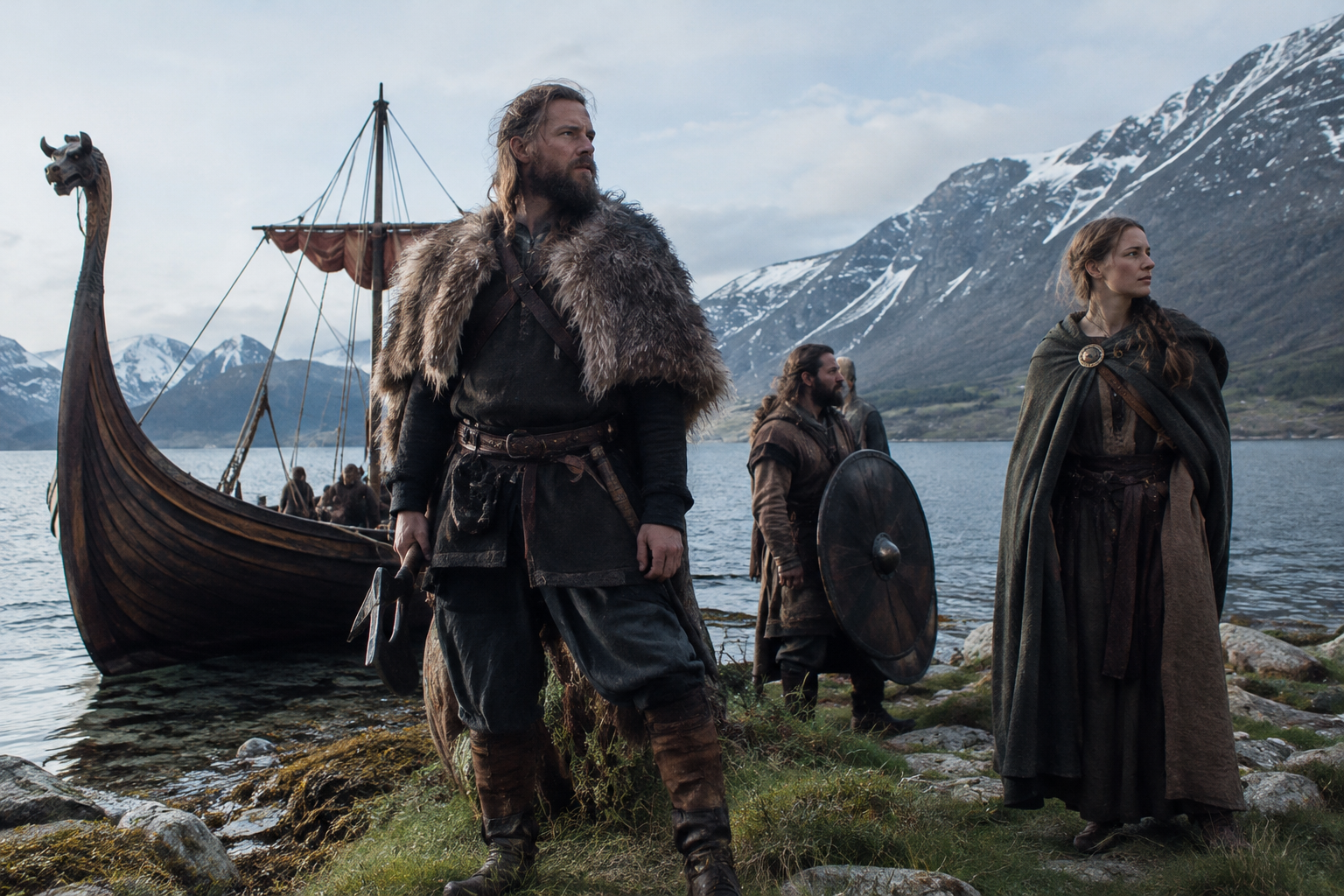
In the far north of Norway, one Viking Age man has become an unexpectedly useful guide to a very specific paternal line. The individual known as VK514, dated here to around AD 700 in Nordland, belongs in the early part of the Viking Age world: a coastal zone of seafaring, exchange, and local power that linked Arctic Norway to the wider North Atlantic. For anyone exploring the Y-DNA haplogroup R1a1a1b1a3a1b2, this is the key ancient anchor in the evidence provided here.
That matters because Y-DNA follows one direct male line only: father to son to son. It does not describe a person's whole ancestry, and it certainly does not turn one burial into an entire people. But when a subclade this specific appears in a documented Viking Age individual from northern Scandinavia, it gives us something much better than legend: a real man, in a real place, at a real historical moment.
Nordland was never some quiet fringe waiting to be discovered by southerners. By the centuries around AD 700, northern Norway was already part of a maritime landscape with long coastwise movement, seasonal travel, fishing economies, elite competition, and contacts stretching south into Scandinavia and west toward the islands of the North Atlantic. A man buried in this setting belonged to a society that was both local and strikingly connected.
The specific interest of VK514 is not that he can be turned into a saga hero. He cannot. The interest is that his Y-chromosome has been associated here with the article's branch, R1a1a1b1a3a1b2, placing that paternal line in Viking Age Norway. A genetic study of ancient Scandinavian populations, available as research on Viking Age genomics, helped establish just how varied Viking Age paternal and overall ancestry profiles could be across the region. That broader context is important: even within "Viking" Scandinavia, lineages were not uniform.
R1a1a1b1a3a1b2 is a very narrow twig on a much larger Y-DNA tree. The wider R1a family has a long and complicated history across Eurasia, appearing in many different ancient and modern populations. But one of the common mistakes in popular genetics is to take a grand story about the parent haplogroup and casually pin it onto a much more precise descendant branch. That is not good archaeology, and it is not good genetics either.
So the careful reading is this: the evidence here places this specific paternal branch, or a reported assignment to it, in one Viking Age Norwegian individual. That does not prove where the branch first formed, nor does it make every later carrier "Viking" in any cultural sense. What it does do is show that by the early Viking Age, this line was present in northern Scandinavia.
That is already historically valuable. Viking Age societies were built not simply on raids and ships, but on households, kin groups, coastal networks, and regional identities. A subclade found in Nordland suggests a paternal continuity that belongs within those northern Scandinavian histories, not just in the better-known southern royal centres that tend to dominate popular imagination.
The geography matters here. Nordland sits along one of the great marine corridors of Europe, where movement by boat was often easier than movement overland. In the centuries around AD 700, that coastline linked communities engaged in trade, travel, and cultural exchange. The old habit of thinking of northern Norway as peripheral has been steadily undermined by archaeology; it was a busy world, deeply plugged into wider developments.
This is exactly why a sample like VK514 is so useful. It places the paternal line in a zone where people, goods, and ideas moved constantly, but where local continuity also mattered. If your own direct paternal line falls within R1a1a1b1a3a1b2, the strongest evidence in hand is not a vague map of Eurasia, but a concrete Scandinavian appearance in the Viking Age.
That also fits the broader picture from ancient DNA work on Germanic-speaking and Scandinavian populations, where paternal lineages can appear in historically mobile settings without reducing identity to genetics alone. Language, law, alliance, trade, and belief do not travel in lockstep with one Y-chromosome branch.
One sample is not a dynasty, and it is not a population census. Still, ancient DNA rarely works by giving us perfect abundance. More often it gives us glimpses - individual lives caught in the archaeological record. A well-placed glimpse can be surprisingly powerful.
VK514 tells us that this paternal line was present in northern Norway at the threshold of the period when Scandinavian expansion became historically visible across Britain, Ireland, the North Atlantic, and parts of eastern Europe. That does not mean the man himself migrated abroad, nor that every carrier of his branch shares the same later story. It means the lineage belonged to the pool of male lines present in Scandinavia as those centuries unfolded.
For descendants testing today, that helps narrow the historical imagination. Rather than attaching the haplogroup to every grand narrative ever told about R1a, the evidence points to an early medieval Scandinavian context worth taking seriously. In historical terms, that is more modest than a myth - and much more useful.
This Norwegian sample also sits well beside the growing body of early medieval ancient DNA from northern and western Europe. Study after study has shown that the centuries after Rome, and into the Viking Age, were full of movement but also local persistence. Communities were rarely sealed off; equally, they were not endlessly replaced. Lineages could endure, spread, branch, and mix into new social worlds.
That is why a Scandinavian Y-line need not imply a simple one-direction migration story. The Viking Age was a web of return journeys, seasonal travel, marriage connections, fosterage, trade links, and settlement. Some paternal lines remained rooted in place; others travelled astonishing distances. Ancient DNA helps us see that these were not contradictions but normal features of the period.
There is a useful comparison here with other MyTrueAncestry discussions of medieval and post-Roman population history, especially where burials reveal both continuity and mobility. The lesson is consistent: paternal markers are most meaningful when tied to excavated individuals, dated contexts, and regional archaeology, not when inflated into sweeping ethnic labels.
For R1a1a1b1a3a1b2, the most distinctive point in the present evidence is simple and solid. This branch is represented by VK514, a man from Viking Age Nordland, Norway, around AD 700. That places your paternal line, at least in one documented ancient case, within the northern Scandinavian world just as the Viking Age was beginning to take historical shape.
It is not a promise of royal descent, and it is not a complete biography of the branch. It is something better grounded: an archaeological foothold. If this is your Y-DNA line, its story is worth exploring through the history of coastal Scandinavia, the northern seaways, and the very real men whose graves now let genetics and archaeology speak together.
Comments