Haplogroup R1a1a1b1a3a1a2c
– 5 min read


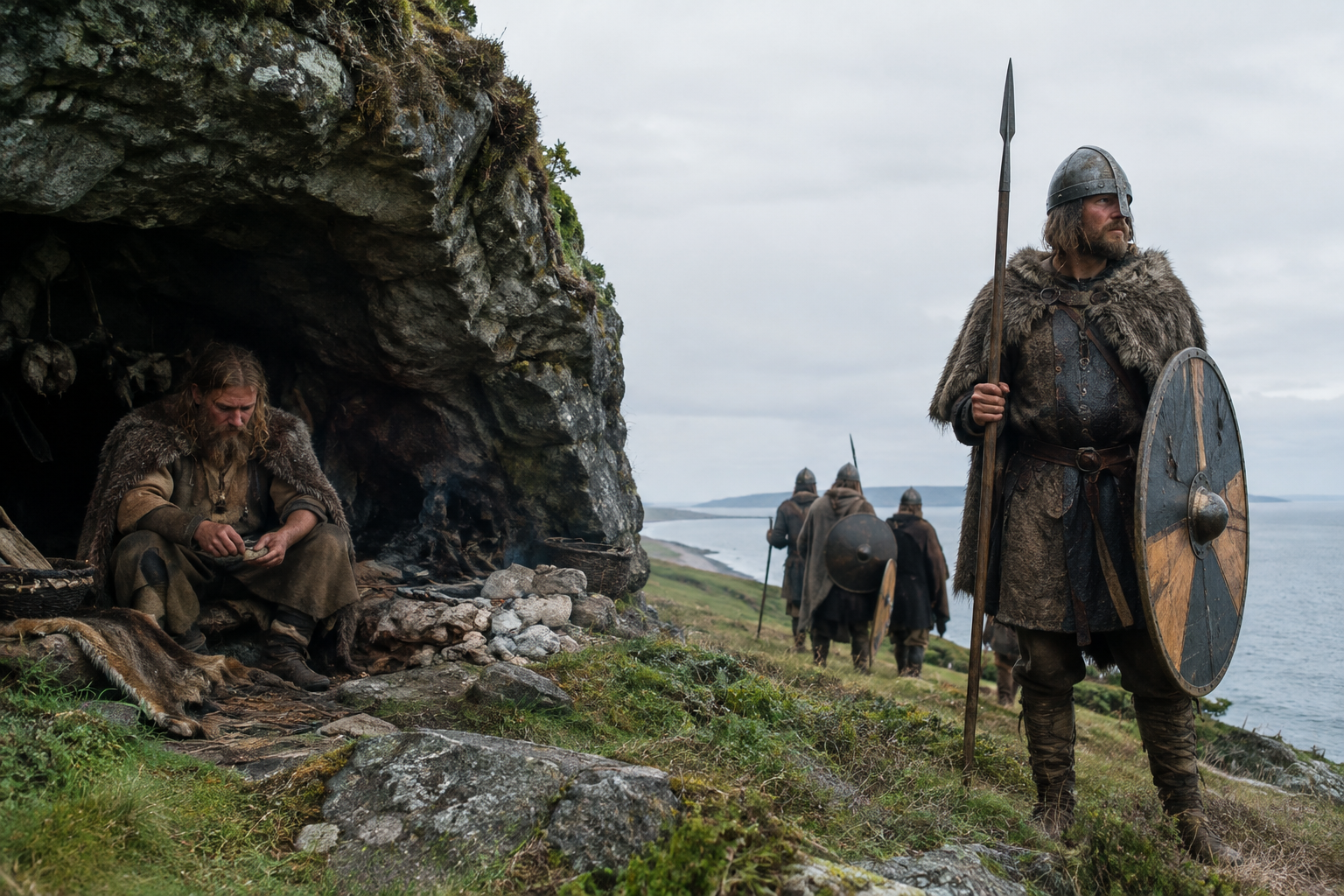
One of the sharper glimpses of haplogroup R1a1a1b1a3a1a2c comes from the west coast of Norway, where an individual from Langenes, Skongeneshelleren, dated to around AD 550, was recorded as CGG107006. That date matters. It places this paternal line in Scandinavia before the classic Viking Age, in the centuries when coastal Norway was already tied into seafaring networks, local power was consolidating, and the social world that later produced Viking raiders and settlers was taking shape.
A second appearance is harder and grimmer to ignore: VK256, one of the men from the Viking burial assemblage at Ridgeway Hill in England, dated to around AD 998. Here the same article haplogroup points not to a single family saga, but to a broader historical truth. Y-DNA follows one direct male line only, not a person's whole ancestry, yet even that narrow line can illuminate how particular paternal branches moved through the North Sea world from pre-Viking Scandinavia into the age of raids, war bands, and overseas expeditions.
The Langenes sample is especially useful because it belongs to a period that is often overshadowed by the later Viking centuries. Around AD 550, western Norway was not an isolated fringe. It was a maritime landscape of islands, inlets, and exposed sea routes, where communities were already accustomed to movement by water and to regional exchange across the North Atlantic seaboard.
Sample CGG107006 from Skongeneshelleren shows that a paternal line associated here with R1a1a1b1a3a1a2c was present in this setting before the Viking Age proper. That does not mean this exact branch "began" in Norway, nor that every later carrier in the British Isles or elsewhere descended from this individual. What it does show is that this lineage was part of the male population of western Scandinavia early enough to belong to the world from which Viking-age mobility later emerged.
Research on ancient Scandinavian populations continues to sharpen this wider background, including work on burials before and around the Viking period in Norway such as this ancient DNA study of the region. For readers with a broader interest in how early medieval Nordic populations changed and connected across the Baltic and North Sea worlds, the Scandinavian evidence is increasingly rich rather than neatly uniform.
The long label R1a1a1b1a3a1a2c is a very specific twig on the much larger R1a tree. That wider haplogroup has a deep and complicated history across Eurasia, appearing in many different regions and historical settings over thousands of years. The important point is not to flatten that complexity. A narrow branch found in two medieval-era northern European contexts should not be treated as if it carries the entire history of R1a on its back.
Still, the pattern here is suggestive. Both known ancient appearances supplied for this article belong to the North Sea sphere: one from pre-Viking western Norway, the other from a Viking-age context in England. That is not proof of a continuous local dynasty or a single migration route, but it does fit a branch moving within the Scandinavian and Anglo-Scandinavian world rather than appearing there as a historical accident.
This also helps explain why Y-DNA can be both narrow and revealing. It tells us nothing by itself about language, ethnicity, or political identity. But when a branch appears in well-dated archaeological contexts, it can show that a paternal line was present in a particular region before, during, or after major historical changes.
The Ridgeway Hill sample VK256, dated to about AD 998, belongs to one of the most discussed Viking-age discoveries in England: a mass burial of Scandinavian men near Weymouth in Dorset. The site has become important not simply because the dead were "Vikings", but because it captures the hard edge of late 10th- and early 11th-century conflict between England and seaborne groups operating from across the North Sea.
In this case, the appearance of R1a1a1b1a3a1a2c in VK256 places the branch in exactly that historical world of military movement and overseas violence. It does not prove that all the men at Ridgeway Hill belonged to one paternal kin group, nor that this branch was typical of every Viking force. But it does anchor the lineage in a documented expeditionary setting outside Scandinavia.
The Ridgeway Hill burials have been examined in ancient DNA research on Viking-age mobility and Scandinavian-linked individuals in Britain, including research on Viking-period remains from England. The broader significance is plain enough: by the end of the 10th century, the paternal line represented here was no longer only a Scandinavian one in place. It was a Scandinavian line in motion.
North Sea migrations to Britain
It is tempting to tell a straight-line tale: an ancestral branch in Norway, then Viking warriors in England, and therefore a simple story of expansion. History is usually less tidy than that. Two samples are not a dynasty, and they are not a full map of the branch's range. But they are enough to show a meaningful distribution across two linked settings at two linked moments.
First, CGG107006 demonstrates a pre-Viking presence in western Norway. Second, VK256 shows the branch in the Viking world abroad, in England, several centuries later. Between those points lies the long development of Scandinavian maritime society: the emergence of elite competition, ship-borne mobility, overseas raiding, trading, settlement, and service in war bands whose members did not always end their journeys at home.
For anyone with this haplogroup today, that is the most historically grounded insight. Your direct paternal line may connect most clearly, in the current ancient record provided here, with the Scandinavian-North Sea zone rather than with a purely inland or purely later-medieval setting. That is a clue, not a closed verdict.
The most interesting feature of this evidence is not simply that one sample is "Viking". Plenty of lineages turn up in Viking-age graves. What makes R1a1a1b1a3a1a2c more intriguing here is that its earlier appearance at Langenes helps push the story back before the headline-grabbing era of longships in England.
That earlier Norwegian context reminds us that Viking expansion did not spring from nowhere in the late 8th century. It emerged from older regional populations already living in highly connected coastal environments. When a paternal line is present in western Norway around AD 550 and then appears in a Viking-age burial in England, the historical value lies in that continuity of setting: a North Sea world taking shape, then projecting itself outward.
There is a useful parallel here with other early medieval studies that show how Scandinavian and adjacent populations were anything but static. Communities changed, absorbed outsiders, and sent people abroad. Yet some paternal lines remained traceable across that changing landscape. That is exactly the scale on which Y-DNA is most informative: not as a shortcut to identity, but as a marker of continuity within movement.
Early medieval Baltic connections
On present evidence, haplogroup R1a1a1b1a3a1a2c is best pictured here as a paternal line tied to the Scandinavian-North Sea sphere, with one documented carrier in pre-Viking western Norway and another in a Viking-age burial in England. That is a small sample, but a historically telling one: this branch appears in the coastal world that helped create Viking expansion, and then in the overseas conflicts that expansion produced. For descendants exploring their direct paternal line, it is a reminder that even a very narrow Y-DNA branch can preserve a sharply focused piece of northern European history.





Comments