Haplogroup R1a1a1b1a3a1

– 5 min read


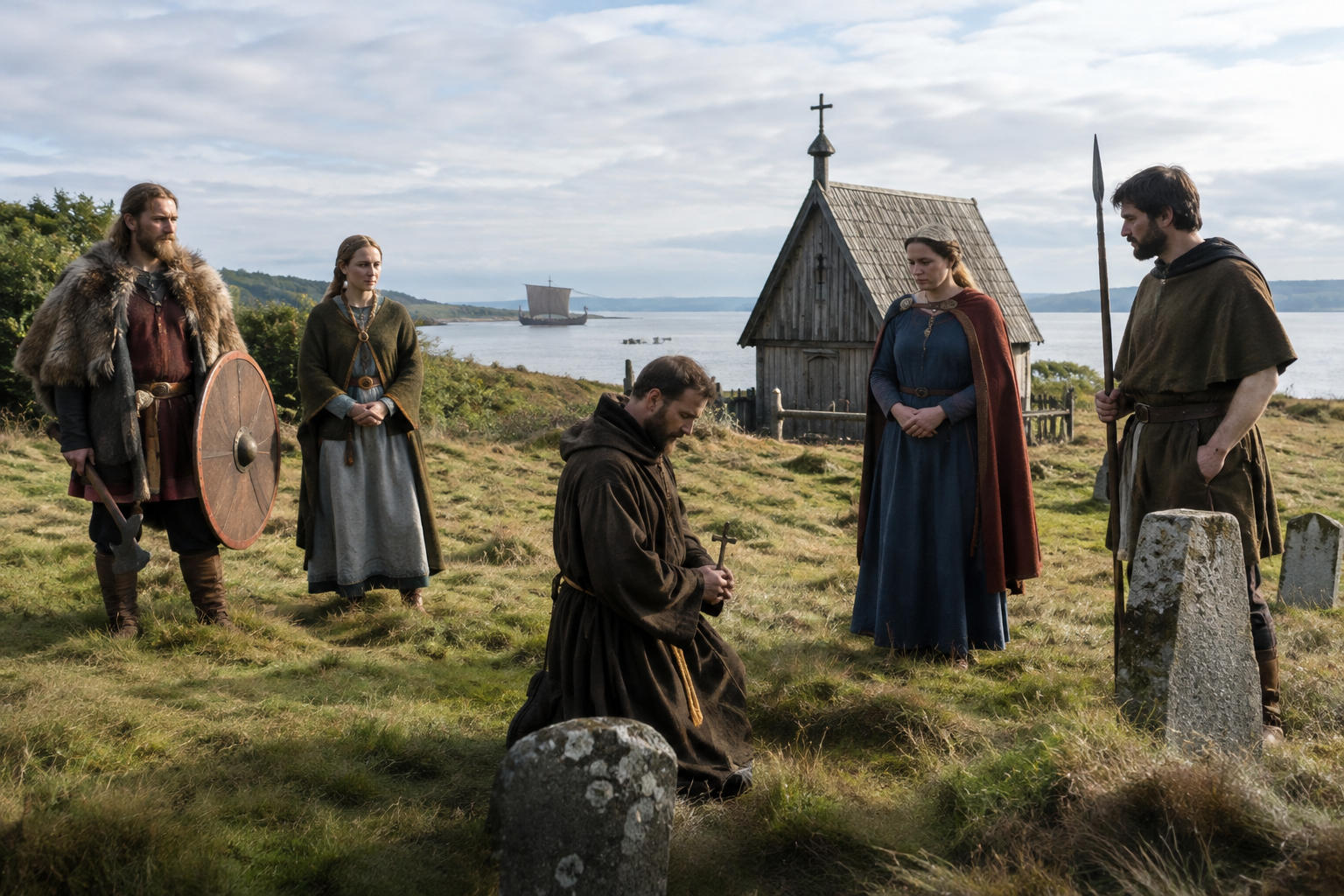
In the chapel field cemetery at historic St. Mary's City in Maryland, one man buried in the 17th-century colonial capital has been assigned to Y-DNA haplogroup R1a1a1b1a3a1. He appears in the record as sample I15285, dated around 1634 AD. That is already enough to make him interesting. This is not a prehistoric steppe burial or a medieval princely tomb, but a man from the fraught first century of English colonial settlement in North America, standing at the far western edge of a much older European paternal line.
What makes this haplogroup especially worth following is that the other ancient matches attached to it sit not in one tidy homeland, but across the North Sea world and the Irish Sea zone: Viking Age Halogaland in northern Norway, early medieval Norfolk and Kent in England, and Iron Age Dublin. Y-DNA tracks one direct paternal line rather than a person's whole ancestry, but even so, this is a striking pattern. It places R1a1a1b1a3a1 in a historical landscape shaped by seafaring, migration, settlement, and the remaking of communities between late antiquity and the early modern Atlantic world.
The label R1a1a1b1a3a1 is a very narrow twig on the much larger Y-chromosome tree of R1a, a lineage famous for its wide distribution across Eurasia. That broader fame can be misleading. It does not follow that every small branch of R1a had the same history, the same homeland, or the same role in later populations.
So the sensible way to read this evidence is not to force a grand origin story, but to look at where this particular branch turns up in dated archaeological contexts. In the cases available here, its ancient appearances cluster in northern and western parts of medieval Europe, especially in regions linked by the North Sea and Irish Sea. That makes the story concrete. We are not dealing with an abstract map of "R1a in Eurasia", but with a paternal line turning up among people in England, Norway, Ireland, and eventually colonial Maryland.
Two of the most useful samples come from early medieval England: SED006 from Sedgeford, Norfolk, dated around 600 AD, and POH006 from Polhill, Kent, also around 600 AD. These are important because they place the haplogroup in two different English regions during the centuries after the end of Roman rule, when eastern and southern Britain were being reshaped by migration, local continuity, and new political identities.
Norfolk and Kent are not interchangeable. Kent sat close to the Continent and played an outsized role in early Anglo-Saxon England, while Norfolk belonged to the wider East Anglian sphere facing the North Sea. Finding the same narrow paternal branch in both places does not prove one family connection between them, but it does suggest that this lineage was present within the male population of early medieval eastern England rather than being a one-off curiosity.
An ancient DNA study of early medieval England published in PNAS helped show just how mixed and regionally varied these post-Roman populations could be. That wider context matters here. A haplogroup like R1a1a1b1a3a1 should not be read as a badge of ethnicity on its own, yet its presence in both Norfolk and Kent fits neatly into the historically messy world of settlement around the North Sea, where lineages, languages, and identities did not move in lockstep.
The northernmost appearance in this group is CGG107030 from Halogaland Holm, dated around 798 AD. Halogaland, in northern Norway, sits in a very different setting from Kent or Norfolk. This was the far north of the Scandinavian world, a region tied into coastal travel, exchange, and the opening centuries of the Viking Age.
That matters because it pushes the branch into a recognisably Scandinavian context just as northern seaborne mobility was becoming one of the decisive forces in European history. One should be careful here: a single male line in northern Norway does not mean this branch was "the Viking haplogroup", and it certainly does not let us assign all later bearers to Norse descent. But it does show that the branch belonged to the pool of paternal lineages present in Viking Age Scandinavia.
When placed beside the English samples, the Halogaland individual gives the pattern more shape. We are looking at a lineage found on both sides of the North Sea. That does not tell us the exact direction of movement in every case, but it does fit the historical reality that the sea connected these regions as much as it separated them.
The Irish evidence comes from VK546, listed as Iron Age Islandbridge, Dublin, Ireland, dated around 725 AD. The label "Iron Age" sits awkwardly beside that date, which is already in the early medieval period, so the safest course is to keep the supplied date in view and avoid forcing a stricter cultural label than the record allows. Even so, the site's significance is clear enough: this branch was also present in the Dublin region within the wider Irish Sea zone.
Dublin before its classic Viking urban phase was not an isolated backwater. The Irish Sea linked eastern Ireland to western Britain and, increasingly, to Scandinavia. A paternal branch appearing in Dublin, eastern England, and northern Norway is exactly the sort of pattern that reminds us how entangled these coasts were long before modern national stories tried to tidy them up.
That does not make every bearer of R1a1a1b1a3a1 an immigrant, raider, or trader. It does, however, place the lineage in maritime-facing regions where movement of people was routine. The story here is less about a single migration event than about repeated circulation across connected shores.
North Sea migrations to Britain
That is what makes I15285 from St. Mary's City so evocative. By 1634 AD, the Atlantic had become the new great corridor of movement for British and Irish settlers, servants, clergy, merchants, and soldiers. A paternal line already visible centuries earlier around Norway, England, and Ireland now appears in the burial ground of an English colonial settlement in North America.
Research on the St. Mary's City cemetery, including a recent genetic study of the colonial population, has underlined how much early colonial society depended on movement across the ocean and on the meeting of people from varied backgrounds. In that setting, haplogroup R1a1a1b1a3a1 is not a relic trapped in one medieval province. It is part of the male-line baggage carried into the colonial Chesapeake by the settlers who helped build, and endure, that fragile new world.
There is a pleasing historical symmetry in this. A branch found in the North Sea and Irish Sea worlds turns up again in a place created by Atlantic expansion. The geography changes dramatically, but the deeper story is still one of connected coastlines, migration, and communities assembled from many strands.
On present evidence, R1a1a1b1a3a1 is best understood here as a paternal line documented in the medieval and early modern populations of the North Sea and Irish Sea orbit, with a later appearance in colonial Maryland. That is a narrower and more useful claim than any sweeping statement about all R1a lineages. If you carry this haplogroup today, the most distinctive clue from these ancient samples is not a guaranteed tie to one kingdom or one people, but a recurring presence in the seaborne worlds of early medieval Britain, Ireland, and Scandinavia, and then in the Atlantic diaspora that followed.




Comments