Haplogroup R1a1a1a1d1a1

– 5 min read


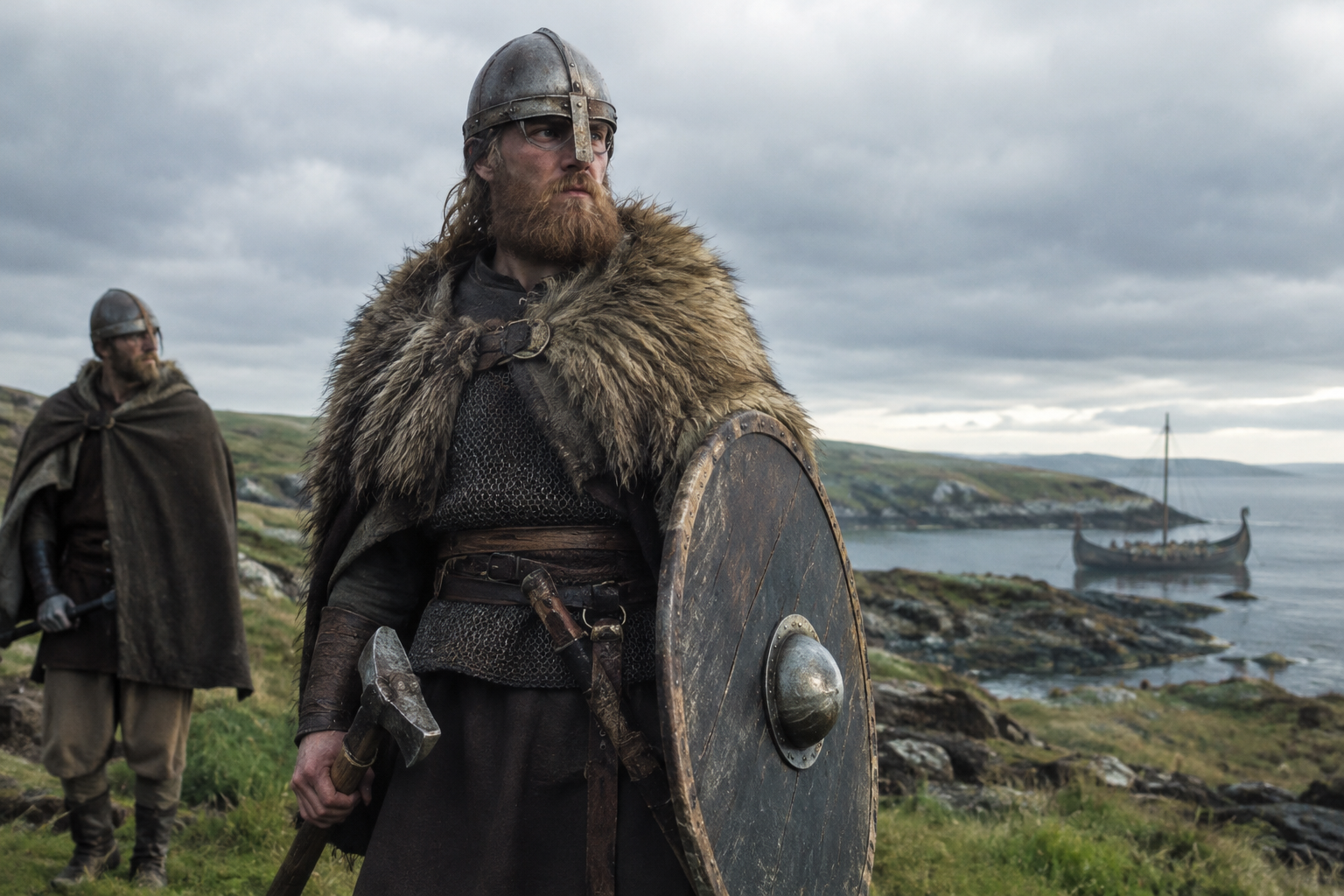
At Eyrephort in Ireland, an early medieval burial identified as VK543 puts a very specific Y-chromosome line, R1a1a1a1d1a1, into a Viking-world setting around AD 725. That is an arresting combination. Ireland in the 8th century was not yet the fully developed Hiberno-Norse world of the great port towns, but it was already part of the seaways that tied together Scandinavia, the North Atlantic, and the Irish Sea.
That matters because a haplogroup this narrow is not a grand label for an entire people. It is one paternal line, carried from father to son, and it tells only one part of a person's ancestry. Even so, when a branch like R1a1a1a1d1a1 appears in an early medieval individual described as a Viking warrior from Ireland, it gives us a sharp little point of contact between genetics and the archaeology of mobility in the North Atlantic world.
The strongest anchor for this branch here is the Eyrephort individual VK543. The date of around AD 725 places him at the threshold of what historians usually call the Viking Age. That alone should make us careful. Labels such as "Viking" can describe an archaeological context, a maritime sphere, or a later historical identity; they do not automatically tell us a man's birthplace, language, or complete ancestry.
Still, the location is highly suggestive. Western and northwestern Ireland sat on sea-lanes that would become central to Scandinavian expansion, raiding, settlement, and cultural exchange. A paternal line like R1a1a1a1d1a1 in this setting fits the broader picture emerging from ancient DNA: the Viking world was not a sealed ethnic box, but a connected zone of movement, alliance, and local incorporation.
An ancient DNA preprint on Viking Age populations, linked to this sample's research trail, helped establish just how varied these maritime communities could be: research on ancient genomes from the Viking world. Without over-claiming what that paper says about this one man in isolation, it is the right sort of scientific backdrop for understanding why an Irish Viking-context burial can illuminate a wider northern network rather than a single national story.
R1a1a1a1d1a1 is a very fine-grained branch within the wider R1a family, one of the major Y-DNA groupings found across large parts of Eurasia, both in the ancient and modern world. But that broad parent background should not be lazily pasted onto this exact subclade. A narrow branch can have a much more specific and historically recent pattern than the big umbrella above it.
In practical terms, this means the Eyrephort find is useful not because it proves some vast migration on its own, but because it shows that this paternal line was present within the Irish Sea world in the early medieval period. For someone researching this haplogroup today, that is often the most valuable sort of ancient evidence: not a myth of origins, but a real man in a real historical landscape.
And that landscape was one in which identities overlapped. A Y-chromosome lineage could move through migration, fosterage, mercenary service, marriage networks, slave-taking, or settlement. In the Viking Age especially, the sea joined places that modern maps tend to keep apart.
The date attached to VK543 is especially interesting because it sits so early. Dublin, Limerick, Waterford, and other Norse-linked urban centers belong mainly to the 9th and 10th centuries onward. An individual in Ireland around AD 725 therefore belongs to a phase when contacts across the sea may have been intermittent, exploratory, or embedded in smaller-scale movements that archaeology is still trying to map properly.
That does not entitle us to turn VK543 into a founding settler or a saga hero. But it does let us place R1a1a1a1d1a1 in a formative period, before the more familiar written history of longphorts and Norse dynasties in Ireland. In that sense, the sample is valuable precisely because it hints at an earlier texture of contact: movement before states, before chronicles become fuller, before identities harden into the labels later writers preferred.
Ancient DNA has increasingly sharpened this early medieval picture across northwestern Europe, showing that movement could be substantial even when texts are sparse. That broader pattern has also been explored on MyTrueAncestry in work on early medieval Britain and the North Sea world.
One of the great lessons of early medieval archaeology is that water does not merely divide. It connects. The Irish Sea linked Ireland to western Britain, the Hebrides, the Isle of Man, and, through longer routes, to Scandinavia itself. Ships, traders, raiders, clerics, captives, and families all moved through this zone.
Seen in that light, VK543 is less a lonely outlier than a signpost. A paternal lineage such as R1a1a1a1d1a1 appearing in this maritime setting fits a world where ancestry could be layered and local communities could absorb newcomers surprisingly quickly. Archaeology has long shown that the Viking Age produced hybrid material cultures; genetics now shows that people themselves could be hybrid in origin as well.
That is why it is so important not to confuse Y-DNA with identity. A man carrying R1a1a1a1d1a1 might be culturally Scandinavian, locally Irish with Scandinavian paternal ancestry, or part of some more complicated story entirely. The chromosome cannot tell us which language he spoke or how he described himself. What it does tell us is that this father-line was part of the human traffic of the Irish Sea world.
There is a temptation, when evidence is sparse, either to say too much or too little. In this case, one securely noted ancient individual is enough to say something useful. R1a1a1a1d1a1 was present in an early medieval individual from Eyrephort, Ireland, in a Viking-associated context. That places the lineage inside a historically important zone of contact at a pivotal time.
Single finds often become more meaningful as comparative evidence grows. Studies of early medieval populations around the North Sea, the Rhineland, and Scandinavia have repeatedly shown that these centuries were shaped by movement, resettlement, and mixed communities. A reader interested in how such patterns show up beyond Ireland might compare this with broader discussions of Germanic-language spread and early medieval population change.
That does not mean every R1a branch belongs to the same story, still less that every carrier of R1a1a1a1d1a1 descends from one medieval raider in Ireland. It means that the branch has at least one concrete archaeological foothold in the Viking-era Atlantic sphere, and that is a solid starting point for historical imagination disciplined by evidence.
The most distinctive thing about R1a1a1a1d1a1, on the evidence here, is not some sweeping claim about prehistoric destiny. It is that this paternal line turns up in VK543, an early medieval man from Eyrephort whose context belongs to the emerging Viking world in Ireland. For anyone exploring this haplogroup today, that is a modest but meaningful clue: your direct paternal line may intersect, at least somewhere in its history, with the mobile societies of the North Atlantic and Irish Sea.
That is how ancient DNA is most useful when handled carefully. Not as a shortcut to legend, but as a way of putting one lineage back among real places, real centuries, and real people.
Comments