Haplogroup R1a1a1a1d1a
– 5 min read


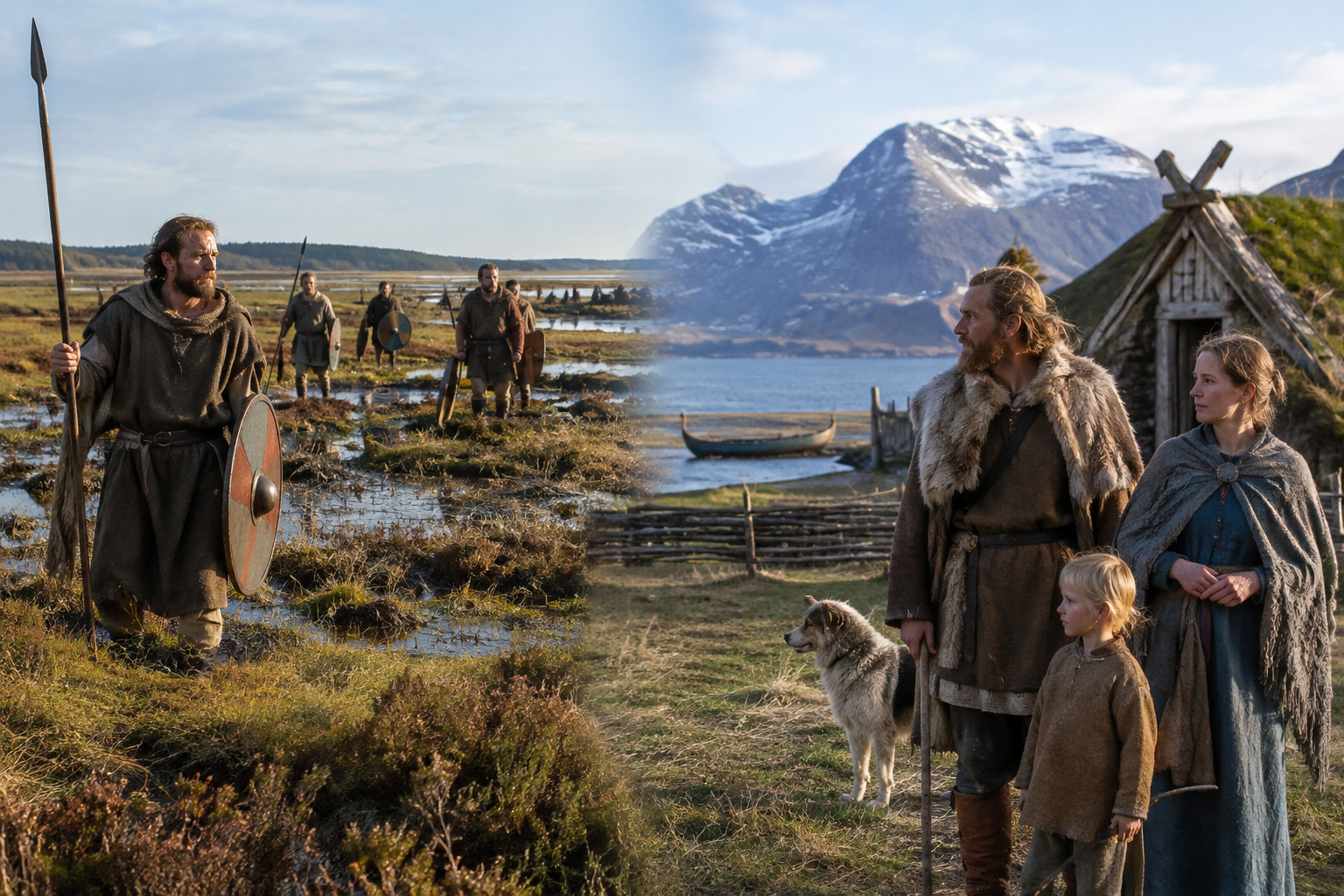
At Alken Enge in Jutland, the dead were not buried in a quiet family cemetery. They were deposited in a wetland landscape that has become one of the most unsettling windows onto violence in Early Roman Era Scandinavia. Among the men represented there is sample CGG019203, dated around AD 54, a find associated here with the Y-DNA haplogroup R1a1a1a1d1a.
That combination is what makes this lineage interesting. R1a is a very broad and ancient Y-chromosome family spread across large parts of Eurasia, but R1a1a1a1d1a is a much narrower paternal branch. A Y-DNA result traces one direct male line only, not a whole identity or ethnicity, yet when the same branch turns up in sharply different settings, it gives us a focused way to think about continuity, movement, and survival across time. In this case, the evidence points not to one grand dynasty, but to a northern story stretching from a violent Iron Age bog deposit to the Viking world of Greenland.
Alken Enge has become famous because it does not look like an ordinary burial ground. Archaeologists recovered the remains of many men, generally interpreted as the aftermath of a large-scale conflict in the Early Roman Iron Age. The site sits in eastern Jutland, in a zone deeply connected to the societies of southern Scandinavia just as the Roman Empire was reshaping political and military realities far beyond its frontiers.
Sample CGG019203, listed here as a Jute individual from Alken Enge around AD 54, belongs to that grim context. What matters is not that one skeleton can stand for an entire people; it cannot. What matters is that a paternal line associated with R1a1a1a1d1a appears in a site tied to organized violence, male group identity, and regional competition in Iron Age Denmark.
An ancient DNA study of Scandinavian populations and their long-term development has helped place such finds into a broader frame of mobility and continuity across the region, even when individual subclade assignments must be handled cautiously at the sample level; one relevant research lead is this study of ancient northern European genomes. The larger lesson is archaeological as much as genetic: paternal lines were embedded in real communities facing real conflict, not drifting labels on a map.
There is always a temptation to let a long haplogroup label do too much historical work. It should be resisted. The branch named here, R1a1a1a1d1a, sits inside the wider R1a family, but a narrow branch is not automatically a synonym for a language group, a tribe, or a named people from classical texts.
Still, narrow branches matter because they can reveal persistence within a region or across linked zones of migration. In northern Europe, especially around the Baltic and Scandinavian worlds, Y-chromosome variation often shows that some paternal lines remained in circulation through major cultural changes: Roman-period frontier pressures, Migration Period reorganizations, and the maritime expansion of the Viking Age. That is precisely the kind of pattern these two samples invite us to think about.
The safest reading is modest and useful. R1a1a1a1d1a appears here in two very different moments of northern history, suggesting that this paternal line could be part of the long male-line background of populations tied to the Scandinavian and North Atlantic sphere. That is more restrained, and more defensible, than pretending we can draw a neat genealogical line from one excavated man to another almost a thousand years later.
The second sample, VK513, comes from Brattahlid Farm in Greenland and is dated to about AD 990. That date places it at the beginning of the Norse settlement era in Greenland, the world associated with Erik the Red and the first generations of colonists who carried Scandinavian farming life into the North Atlantic.
Brattahlid is not just any Viking-Age name. It is one of the emblematic places of Norse expansion westward, where archaeology, saga tradition, and environmental history all intersect. A sample from this setting linked to R1a1a1a1d1a is therefore valuable because it shows the branch in a colonial frontier community at the far edge of the medieval European world.
That does not mean every Greenland settler shared that lineage, nor that this branch was somehow the signature of Viking expansion. What it does suggest is that the paternal diversity present in Scandinavia was carried outward into settlement zones across the North Atlantic. In other words, this branch was not trapped in one local Iron Age episode in Denmark; it was still moving within living populations during the Viking centuries.
The striking thing about these two samples is the contrast in their archaeological settings. CGG019203 belongs to a bog-war context in Jutland: violence, collective deposition, and the unstable politics of the Early Roman Iron Age. VK513 belongs to a Norse farm in Greenland: colonization, seaborne mobility, and the transplantation of Scandinavian life into a new environment.
Put together, they do not tell a simple tale of one family line marching unchanged through the centuries. They show something better: the durability of a paternal branch within historical populations that kept reorganizing themselves. Men carrying related Y-chromosome lines could be part of war bands in first-century Denmark and part of settler households in the Viking North Atlantic, even though the societies around them were very different.
This is also where archaeology keeps genetics honest. The bog dead of Alken Enge are evidence for conflict and group catastrophe; Brattahlid is evidence for settlement and adaptation. The same paternal branch appearing in both settings does not erase those differences. It anchors the lineage in real historical worlds rather than in abstract maps of haplogroup frequency.
R1a is often discussed in sweeping Eurasian terms, but the narrower historical question here is northern and maritime. By the first millennium AD, Scandinavian societies were not isolated. They were connected by warfare, exchange, marriage networks, ship travel, and eventually colonizing ventures that reached Iceland, Greenland, and beyond.
Research on Viking and pre-Viking populations has repeatedly shown that these communities were neither static nor genetically uniform. A useful research lead for the Greenland side of the picture is this ancient DNA study connected to Norse-era remains in Greenland. Even without overclaiming any single paper's contents, the broader archaeological point stands: Viking expansion carried a mix of Scandinavian paternal lines into new landscapes.
That matters for anyone exploring R1a1a1a1d1a. The branch is best understood here not as a badge of a single named people, but as part of the paternal texture of northern Europe, especially in settings tied to Denmark and the wider Norse world. It belongs, in the evidence presently discussed, to communities shaped by conflict, mobility, and long-distance settlement.
The most distinctive thing about R1a1a1a1d1a in this evidence is not sheer antiquity, but context. One sample places it among the dead of a violent Iron Age episode in Jutland; another places it among Norse settlers building a precarious new life in Greenland. For a modern tester, that is a useful clue. It suggests a paternal line that fits well within the long historical arc of Scandinavian and North Atlantic populations, while reminding us that every haplogroup is only one strand of a much larger ancestry.






Comments