Haplogroup Q1b2b1b2b2

– 5 min read


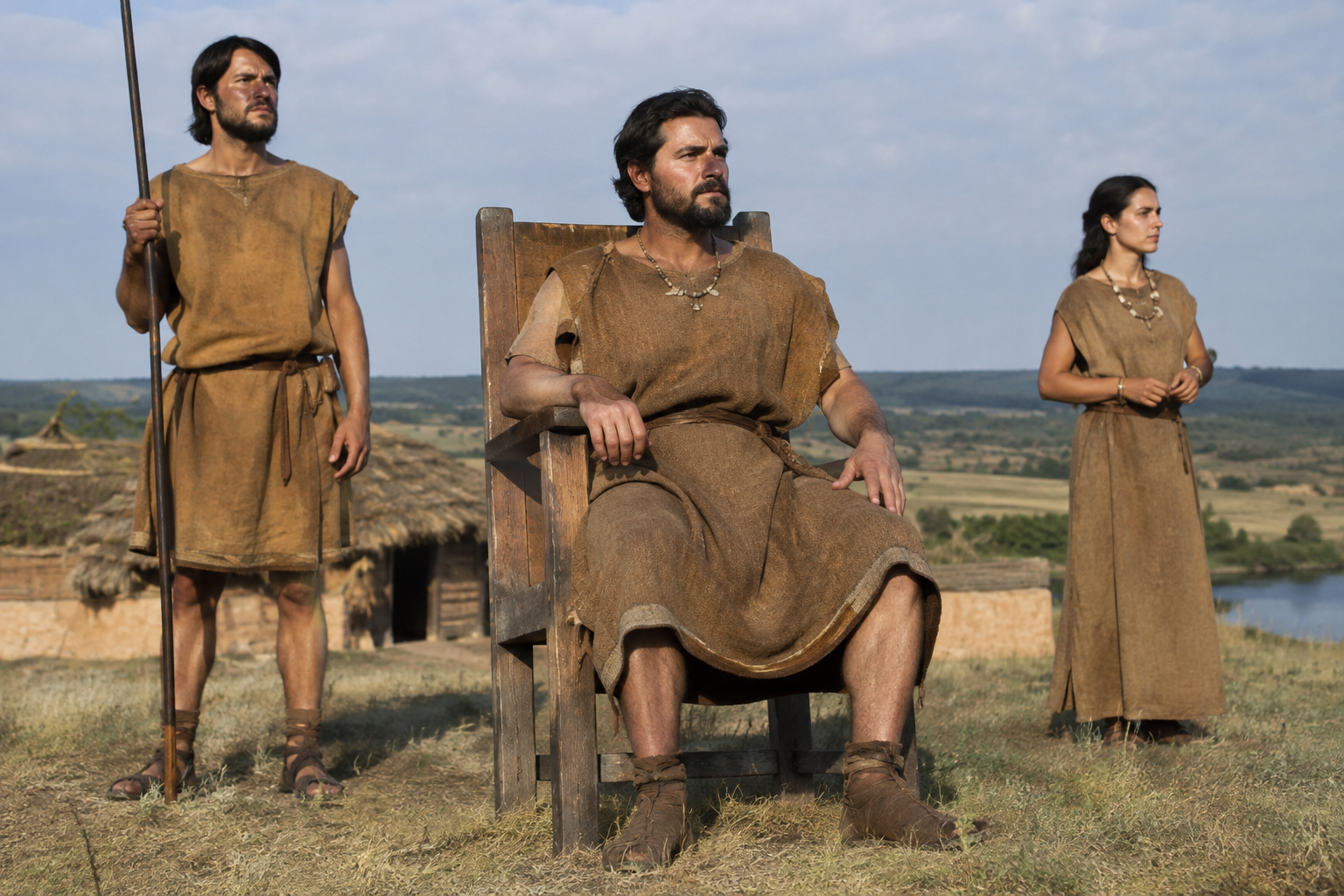
At Kapitan Andreevo in southeastern Bulgaria, near one of the great land corridors between the Balkans and Anatolia, a Middle Bronze Age man identified as I20182 offers a small but striking clue to the history of the Y-chromosome branch Q1b2b1b2b2. He is dated to around 1300 BC and comes from the site of Kyuchuk Chair, a landscape that sat in a zone of movement, exchange, and repeated cultural contact long before written history tells us who crossed it.
That matters because Q lineages are not what most readers expect to encounter in a Bronze Age burial from Bulgaria. Haplogroup Q is a broad paternal lineage with a deep history across Eurasia and, in some branches, the Americas. But the article's branch, Q1b2b1b2b2, is much narrower. Y-DNA tracks only one line of descent, from father to son, yet even that single line can reveal something important: not a whole people, and not an ethnicity, but the presence of particular male ancestries in places where archaeology already suggests long-distance connections.
Kapitan Andreevo is not just any dot on the map. It lies in the Maritsa valley, close to routes linking the Aegean, the Thracian plain, and the passage toward northwest Anatolia. By the Middle Bronze Age, this was already a busy world of farming communities, metal circulation, shifting local traditions, and far-reaching contacts. A lineage such as Q1b2b1b2b2 appearing here is therefore interesting less as a curiosity and more as a reminder that Balkan prehistory was never sealed off.
With I20182, caution is essential. We have a sample, a place, and an approximate period, but not a fully narrated biography of the dead man. No responsible historian should start inventing weapons in his grave, tribal names over his shoulder, or a dramatic migration story from a single Y-chromosome result. What we can say is simpler and more useful: this branch, or a close paternal ancestor carrying it, had reached the southeastern Balkans by the later Bronze Age.
An ancient DNA study on populations of the broader region, published in Science, has helped reshape how scholars think about southeastern Europe's long prehistory, especially its mixtures of continuity and incoming ancestry. That wider context is exactly where a sample like I20182 becomes meaningful.
Most Bronze Age discussions in the Balkans quickly turn to better-known paternal clusters, especially branches of R1a, R1b, I2, or J. Q is different. Its wider family tree stretches across northern Eurasia, Central Asia, and, through other branches, into the peopling of the Americas. That does not mean that every Q lineage found in Europe should be treated as exotic or recent. It means only that the paternal ancestry behind such a sample may point to older connections running eastward across the steppe world or through contact zones nearer the Black Sea.
For Q1b2b1b2b2 specifically, the evidence here is narrow, and that narrowness is part of the story. We are not looking at a mass cluster of dozens of men from one cemetery. We are looking at a rare signal, preserved in one Bronze Age individual from a strategically placed region. Rare lineages can be archaeologically valuable because they force us to pay attention to the edges of the pattern, where mobility and mixture often become visible.
In other words, I20182 does not rewrite Bronze Age Bulgaria by himself. He does, however, fit a picture in which southeastern Europe was entangled with wider Eurasian networks far earlier than older, tidier national histories once liked to imagine.
The location of Kapitan Andreevo is crucial. Southeastern Bulgaria sits close to the meeting ground of several historical spheres that later sources would separate into Europe, Anatolia, and the steppe. In the second millennium BC those neat categories are much less helpful. Communities here lived in a frontier zone in the best archaeological sense: not a hard border, but a region of contact.
That is why a paternal lineage like Q1b2b1b2b2 is best understood through geography as much as genetics. The Maritsa basin offered movement east-west and north-south. Metal, ideas, livestock practices, marriage ties, and people themselves could pass through such corridors unevenly, sometimes in large demographic shifts, sometimes through only a few families or individual men.
Archaeology often reveals these corridors first through pottery styles, exchange goods, burial customs, or settlement patterns. Ancient DNA then adds another layer. It does not replace the archaeology; it gives us one more way of seeing how connected these regions were. For a lineage as specific as Q1b2b1b2b2, the main lesson is not volume but placement: where it appears matters enormously.
It is tempting, when a rare Y lineage appears, to attach it immediately to famous historical movers: steppe riders, named tribes, or some imagined warrior from the east. The trouble is that 1300 BC is much earlier than most of the ethnic labels people reach for. The right comparison is not with later medieval or classical identities, but with the long Bronze Age history of interaction around the Balkans, the Black Sea, and the Eurasian interior.
By this time, Europe's eastern and southeastern regions had already experienced millennia of population change. Steppe-related ancestry had moved west in earlier periods; farming populations had spread long before that; and local hunter-gatherer ancestry persisted in varying degrees. A Y-chromosome branch like Q1b2b1b2b2 may represent one thread within those overlapping processes rather than a single dramatic event.
That is where many readers find ancient DNA most rewarding. It makes the past less simple, not more. Instead of a clean map with one culture in one color, we get evidence for local communities whose paternal lines could include both common regional branches and occasional rarer ones. The men buried in Bronze Age cemeteries were not all paternal copies of one another, even when they shared material culture.
This is also why language should be handled carefully. A Y lineage cannot tell us what language I20182 spoke, nor can it by itself identify him as Thracian, proto-Thracian, Anatolian, or anything else of that sort. What it can do is show that the paternal make-up of Bronze Age southeastern Europe included more variety than broad labels sometimes suggest.
Later Bulgaria's mixed origins
Because the sample evidence here is sparse, the most honest way to write about Q1b2b1b2b2 is to place I20182 within a larger Eurasian question: how often did paternal lines usually associated with more easterly regions enter the Balkans, and in what settings? Some arrivals may have come through gradual contact and intermarriage. Others may reflect older population movements whose traces survive only patchily in the ancient DNA record.
That makes every securely placed sample valuable. A burial from Kyuchuk Chair is not merely a point on a tree of mutations. It is a person in a real archaeological landscape at a real historical moment, one living in a period when the Balkans were part of a deeply connected world extending from the Aegean to the Black Sea and beyond.
As more Bronze Age and Iron Age genomes from southeastern Europe are studied, the significance of Q1b2b1b2b2 may sharpen. It may turn out to have been very rare, or locally clustered in ways we cannot yet see. For now, I20182 stands as a reminder that the paternal history of the Balkans was not composed only of the lineages that later became numerically dominant.
If your paternal line falls under Q1b2b1b2b2, the ancient evidence here points toward a branch that had reached southeastern Europe by the Middle Bronze Age, at least in one documented case from Kapitan Andreevo. That does not mean a direct descent from I20182, still less a neat claim about tribe or nationality. But it does suggest that this paternal line belonged to the kind of wide, connected Eurasian history that archaeology keeps uncovering in the Balkans: a history of corridors, contact zones, and families whose origins did not always stay within later political boundaries.






Comments