Haplogroup Q1b2b1

– 5 min read


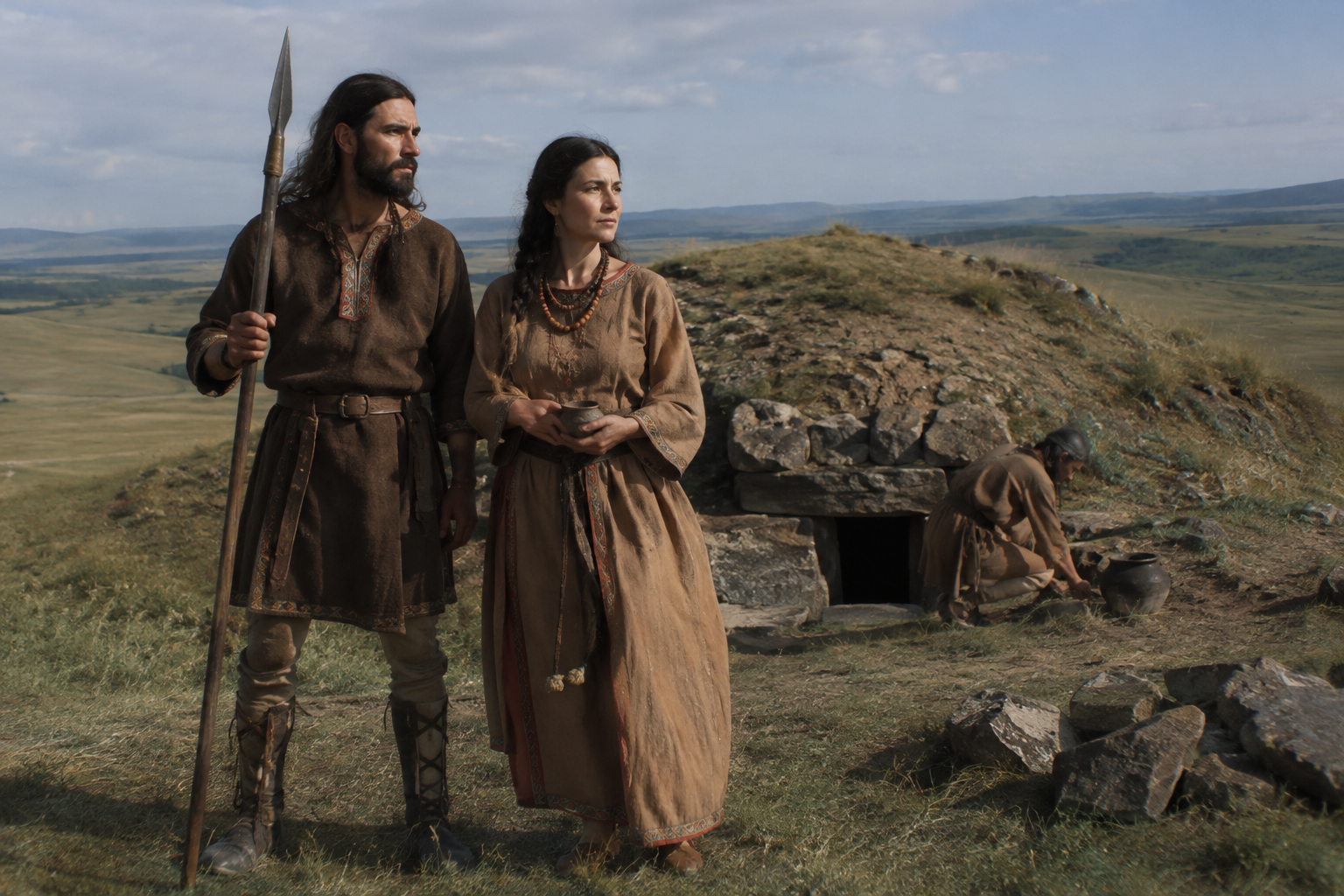
At Verkhni Askiz in Khakassia, in southern Siberia, two Bronze Age men have become unexpectedly important for anyone interested in Y-DNA haplogroup Q1b2b1. They are known in ancient-DNA datasets as RISE670, dated to around 2009 BC, and RISE673, dated to around 2350 BC. Both are associated with the Okunevo horizon, a culture of the Minusinsk Basin famous to archaeologists for its distinctive stone stelae, burial monuments, and striking visual world.
That matters because Q lineages are often discussed in very broad, almost careless terms, as if one mention of haplogroup Q explained everything from Siberia to the Americas. It does not. Q1b2b1 is a specific paternal branch, and these two men from Verkhni Askiz give it a concrete Bronze Age setting in the Yenisei region. Y-DNA tracks one direct male line only, but when that line appears in securely dated archaeological remains, it helps anchor family history in real landscapes and real periods.
Khakassia sits in a part of Inner Asia that has long been a meeting ground: steppe, forest-steppe, river corridors, mountain edges. In the Bronze Age, the Okunevo cultural sphere flourished here, broadly in the early to middle 3rd millennium BC. The two Verkhni Askiz individuals show that the paternal history of this region was not a simple matter of one incoming population replacing another in a single sweep.
Sample RISE673, at roughly 2350 BC, is the earlier of the two; RISE670, at roughly 2009 BC, belongs to the same broad cultural setting a few centuries later. Even with only sparse sample notes, that pairing is useful. It suggests that the paternal branch linked here with Q1b2b1 was present in the same archaeological world across time rather than appearing as an isolated one-off.
That kind of repetition is exactly what ancient DNA is good at. A single grave can be intriguing, but two individuals from the same site and cultural horizon begin to hint at local continuity, or at least a recurring male-line presence, within the Okunevo population.
Haplogroup Q has deep importance across northern Eurasia, but its branches did not all travel together or remain concentrated in one place. That is why it is better to begin with the evidence we actually have. For Q1b2b1, the clearest ancient anchor in this article is not a medieval dynasty or a famous conqueror, but two Bronze Age men from the Yenisei zone.
The Okunevo archaeological record has long attracted attention because it does not fit neatly into old-fashioned historical boxes. Its material culture has prompted debates about local development, outside contacts, and population mixture. Ancient DNA has sharpened those debates by showing that Bronze Age southern Siberia contained lineages and ancestries that cannot be reduced to a single later ethnic label.
So the value of Q1b2b1 here is not that it lets us pin these men to a named tribe from much later texts. It is that it places this paternal branch in a documented Bronze Age community of the Minusinsk Basin, among people living more than four thousand years ago in one of Eurasia's great crossroads.
Archaeologists have long known that the Minusinsk Basin was a region of movement and connection. It links the Sayan-Altai zone, the upper Yenisei, and the wider steppe world. Populations here could draw on influences from different ecological and cultural spheres without losing their local character.
The Verkhni Askiz finds fit that larger pattern. A paternal lineage such as Q1b2b1 appearing in Okunevo-associated burials reminds us that Bronze Age Siberia was not peripheral to Eurasian prehistory. It was one of the places where populations met, mixed, persisted, and sometimes left descendants detectable thousands of years later.
That point is especially important for modern testers. Many people expect paternal history to follow tidy civilizational maps: European, Iranian, Turkic, Slavic, and so on. Ancient DNA keeps spoiling that habit. In the Bronze Age, long before most historically recorded peoples of Inner Asia emerged, the region already contained a complicated mosaic of ancestry and male lines.
Research associated with these ancient Siberian genomes can be traced through this ancient DNA project record, which is relevant because it links the Verkhni Askiz material to the broader study of prehistoric populations in the region. Even without over-claiming details from that research, the existence of these sampled individuals is enough to make Q1b2b1 archaeologically visible.
Steppe and North China Contacts
There is a temptation, whenever a haplogroup appears in ancient remains, to turn it instantly into a grand migration tale. Better not. RISE670 and RISE673 do not by themselves prove the full origin of Q1b2b1, nor do they show where every later carrier of the branch must have gone. They do, however, establish something sturdier than speculation: this paternal line was present among Bronze Age people of Okunevo-associated Khakassia.
That is already quite valuable. Ancient lineages become meaningful when they are tied to time and place. Here, the place is Verkhni Askiz; the broader region is Khakassia in southern Siberia; the period is the Bronze Age; the archaeological context is Okunevo. For a branch like Q1b2b1, that gives us a historical foothold rather than a cloud of generalities.
It also invites a sensible comparison with other ancient-DNA work across northern Eurasia. Again and again, studies show that paternal branches can persist locally, recur in neighboring sites, or appear in mixed communities whose cultural identities were never biologically uniform. The story is rarely one of pure continuity or total replacement. It is usually messier, and much more interesting.
One reason these Khakassia samples are so useful is that the Okunevo culture has often sat at the center of arguments about who Bronze Age Siberians were, where they came from, and how they related to surrounding populations. Ancient DNA does not solve every one of those arguments, but it has made one thing plain: archaeological culture and paternal lineage are not the same thing.
A man carrying Q1b2b1 in an Okunevo context is not simply a walking label for an entire people. He belonged to a community with its own burial customs, artistic traditions, and local history. His Y-chromosome tells us about one direct male line inside that larger human picture.
That is exactly why ancient DNA is most useful when kept close to archaeology. The Verkhni Askiz men are not abstractions. They were members of a Bronze Age population in a specific region whose monuments and graves have been studied for decades. Their value lies in joining the genetic record to that archaeological ground truth.
If your Y-DNA falls under Q1b2b1, these Verkhni Askiz individuals offer a serious and rather evocative point of reference: a Bronze Age paternal presence in southern Siberia, within the Okunevo world of Khakassia. That does not make every modern carrier "Okunevo," still less does it map an unbroken paper genealogy back to RISE670 or RISE673. But it does show that this branch was part of the human landscape of Inner Asia more than four thousand years ago.
For family historians, that is often the most useful kind of ancient connection: not a fantasy pedigree, but a securely placed horizon where your direct paternal line, or a close ancestral branch of it, was already present in the archaeological record.

Comments