Haplogroup Q1b2a1a1

– 4 min read


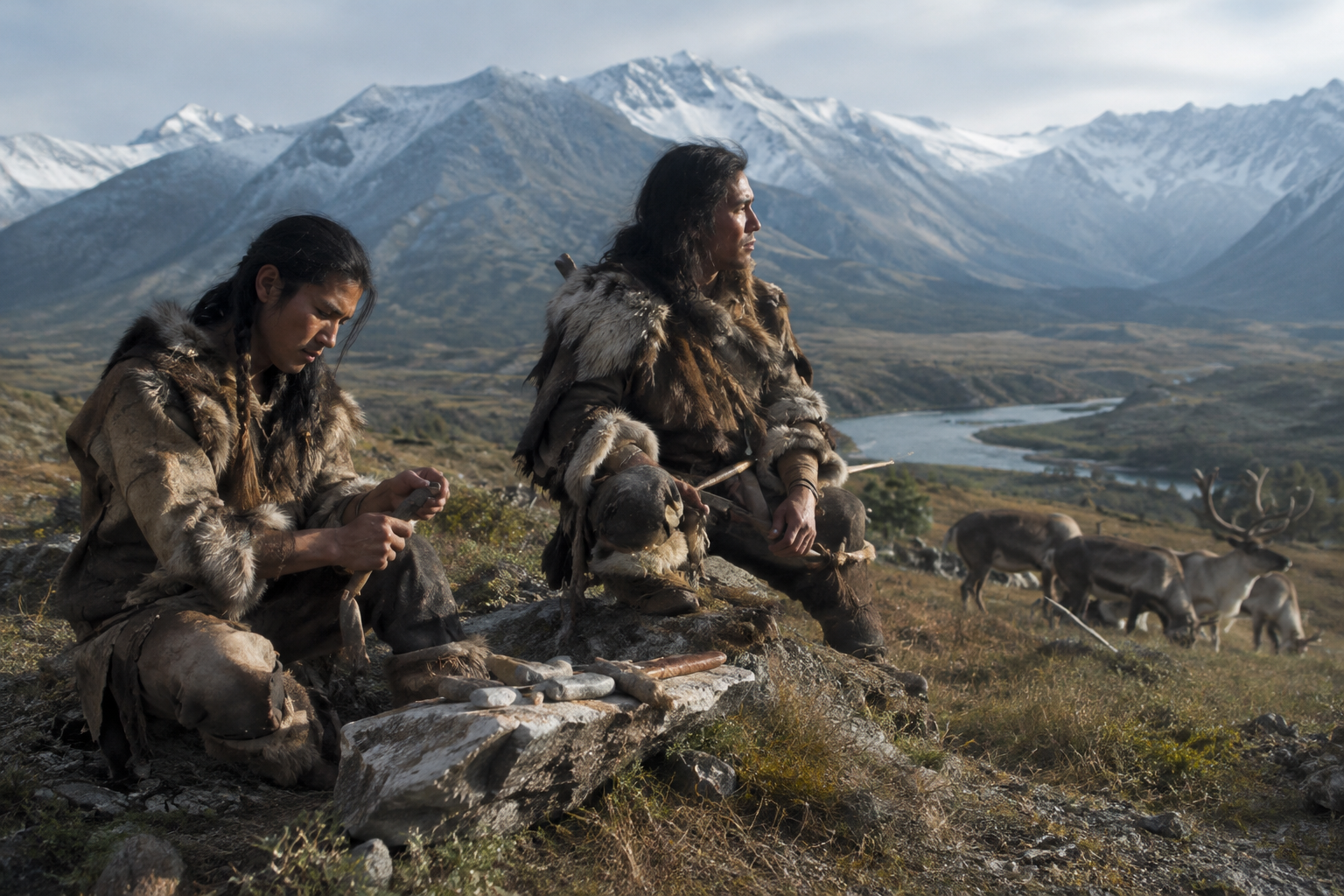
In the Altai Mountains, two Early Bronze Age men - sample I3950, dated around 2850 BC, and sample I6714, dated around 2550 BC - place the Y-DNA haplogroup Q1b2a1a1 in a setting that has become central to Eurasian prehistory. Both are associated with the Afanasievo horizon, the striking pastoral culture that appeared in the Altai at the dawn of the Bronze Age with material customs closely resembling those of steppe groups much farther west.
That matters because Q lineages are often discussed in very broad terms, stretching from Siberia to the Americas, but a branch as specific as Q1b2a1a1 has to be handled more carefully. Here, the important point is not a sweeping claim about all of haplogroup Q. It is that this particular paternal line is represented in two Afanasievo-related males from the Altai, placing it within one of the earliest archaeological settings tied to large-scale steppe expansion into Inner Asia.
The Afanasievo culture has long fascinated archaeologists because it seems to arrive in the Altai already formed, with a package of mobile herding lifeways and burial practices that link it to western steppe populations. Ancient DNA transformed that debate. Research on Bronze Age Eurasia, including the study linked here, helped show that Afanasievo individuals were genetically very close to Yamnaya-related steppe groups, even though they lived far to the east.
Within that larger picture, I3950 and I6714 are useful not because they stand for all Afanasievo men, but because they show that Q1b2a1a1 was present among them. That immediately complicates any simple idea that the Altai Bronze Age was carried only by one paternal lineage. Steppe expansions were real, but they were not genetically monochrome.
Sample I3950 comes from the Altai Mountains and is dated to about 2850 BC, making it one of the earlier markers in this small cluster. In historical terms, this is the moment when the Afanasievo phenomenon was newly established in the region. A man carrying Q1b2a1a1 at this date tells us that the paternal makeup of these communities was already varied at the beginning of the local Bronze Age sequence.
It is tempting to turn any early sample into a founder, but that would go beyond the evidence. What I3950 really offers is a fixed point: by the late fourth to early third millennium BC, this lineage was present in an Afanasievo context in the Altai. For anyone tracing Q1b2a1a1 today, that is a solid archaeological foothold rather than a legend.
The second sample, I6714, is also from the Altai Mountains and is dated to about 2550 BC, again in an Early Bronze Age Afanasievo setting. The value of I6714 lies in repetition. One sample can be an outlier; two related finds from the same broad cultural world begin to look like a pattern.
That pattern is still modest, and it should stay modest. Two men do not define an entire population. But taken together, I3950 and I6714 suggest that Q1b2a1a1 was not an isolated one-off in the Altai Afanasievo horizon. It had some presence there across several centuries.
The broader historical interest of these two men lies in the position of the Afanasievo culture itself. The Altai was not a remote cul-de-sac. It was a meeting ground between the western steppe world and Inner Asia. When a paternal line like Q1b2a1a1 appears in that environment, it becomes part of a much larger question: how did migrating herders, local populations, and emerging Bronze Age societies combine?
Ancient DNA has made one point very clear. Archaeological cultures are not the same thing as Y-DNA lineages. Afanasievo describes a material and cultural horizon; Q1b2a1a1 describes one direct paternal line. A man may belong to an Afanasievo burial population without that meaning every Afanasievo male shared his Y chromosome. That distinction is basic, but it is exactly where good history begins.
It also helps explain why Q1b2a1a1 should not be read through the later fame of haplogroup Q elsewhere. The parent haplogroup has a very wide history across northern Eurasia and the Americas. These Altai samples do not turn Q1b2a1a1 into the sole marker of any migration, language, or people. What they do show is that one branch of that wider family was embedded in an Early Bronze Age community at the eastern edge of the great steppe world.
There is an old habit in history of treating the Altai as peripheral. Archaeology has spent the last generation correcting that. The region was a corridor, a contact zone, and at times a powerhouse of cultural change. Afanasievo communities there were part of the earliest Bronze Age transformation of Inner Asia, bringing herding economies and steppe-linked ancestry deep into new landscapes.
Seen in that light, Q1b2a1a1 is interesting precisely because it appears in this frontier zone. It places a paternal lineage within a formative experiment in long-distance mobility. The men represented by I3950 and I6714 were not standing outside history; they were living in one of the places where Eurasian prehistory was being remade.
Ancient Y-Chromosome Migrations
For a modern tester with Y-DNA haplogroup Q1b2a1a1, the strongest ancient signal here is an Early Bronze Age Altai connection within the Afanasievo world. That does not mean a direct descent from either sampled man, and it does not assign an ethnicity, language, or tribe. But it does place this paternal branch in a real and important archaeological setting: mobile herding societies on the eastern steppe around the third millennium BC.
That is quite enough to make the lineage historically vivid. Q1b2a1a1 is not floating in abstraction. In the ancient record we can already see it among men living in the Altai during one of Eurasia's great turning points, when steppe populations, new economies, and long-distance connections were beginning to reshape the Bronze Age world.

Comments