Haplogroup Q1b1b

– 5 min read


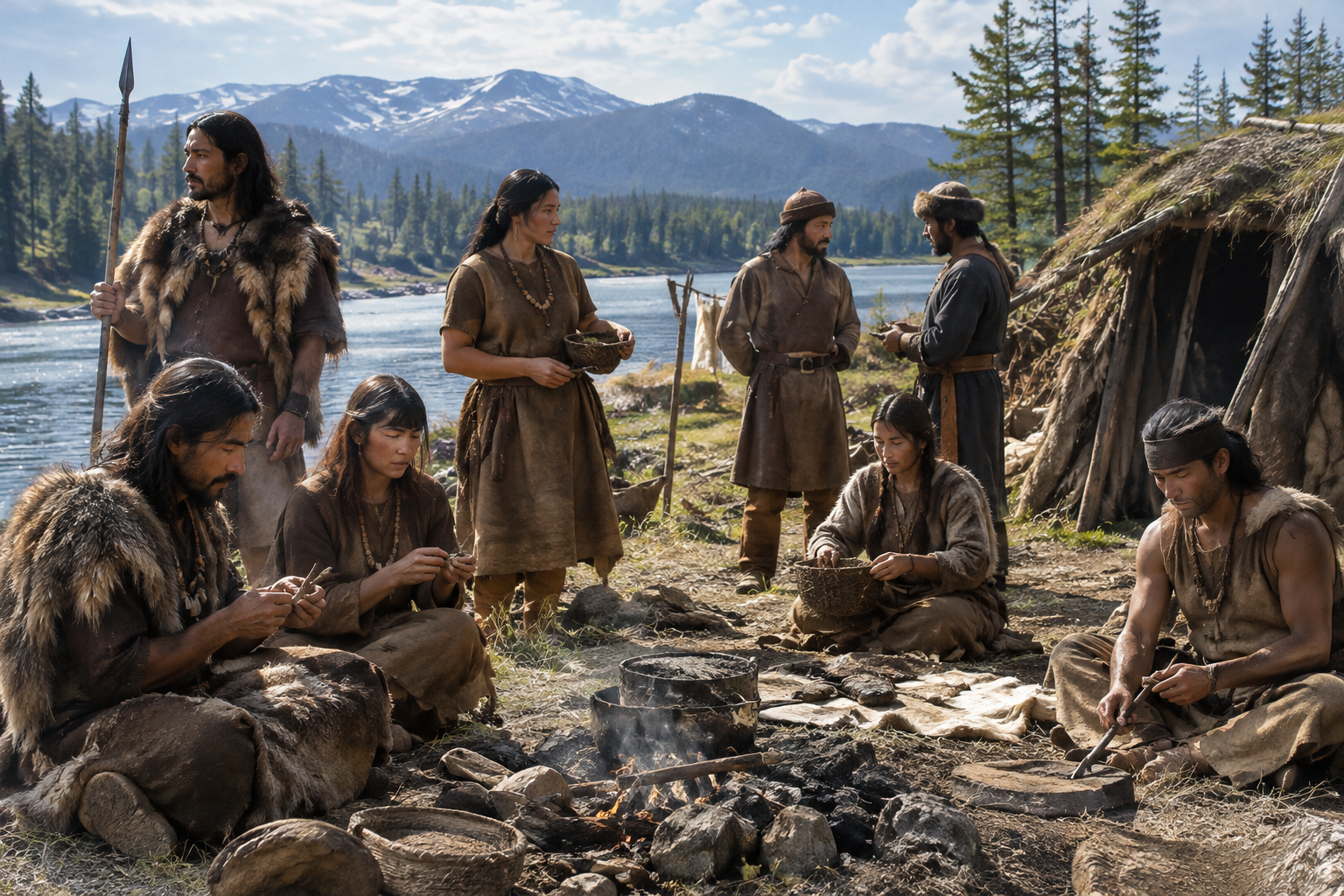
At Obkhoy on the western side of Lake Baikal, one ancient man dated to around 2898 BC, sample I1001, gives us a particularly useful glimpse of Y-DNA haplogroup Q1b1b. He belonged to the Glazkovskaya horizon of Neolithic eastern Siberia, in a region that has become one of the great testing grounds of ancient DNA because its cold conditions preserve genetic material unusually well. That matters, because lineages like Q1b1b are often discussed in sweeping terms, while the real evidence comes from very specific people in very specific landscapes.
What makes Q1b1b interesting here is not grandeur but pattern. The samples linked with this branch in the present evidence cluster around the Baikal and Trans-Baikal world, and then, much later and much farther away, appear in an ancient Native American individual from Nevada. Y-DNA traces one direct paternal line only, not a person's whole ancestry, but even that narrow line can illuminate very large movements when the archaeology is secure.
The Baikal region has long been central to debates about population history in northern Eurasia. Hunter-gatherers, pastoral communities, and later Bronze Age groups moved through an enormous zone of forests, river corridors, and steppe margins. Ancient DNA has shown that this was not an isolated backwater but one of the places where deep northern Eurasian ancestries remained visible for millennia.
For Q1b1b, the most concrete starting point in this article is that Baikal-area cluster. The Obkhoy individual I1001 sits early in the sequence, in the late Neolithic. Then comes I5280 from Bronze Age Irkutsk, Sergushkin 3, dated to around 2779 BC. These are not the same community frozen in time, but they do suggest that a paternal line associated with Q1b1b was present in the wider Baikal world across a long stretch of prehistory.
A major ancient DNA study of northern East Asia and the Americas, published in Science, helped establish just how important this broader north Asian zone is for understanding later population dispersals. That does not mean one grave at Obkhoy is the ancestor of later peoples; it means the region itself repeatedly appears in the deeper background of populations on both sides of Beringia.
Haplogroup Q is one of the great paternal branches of northern Eurasia and the Indigenous Americas. But the article branch here is not haplogroup Q in general; it is the narrower designation Q1b1b. That distinction matters. A broad parent haplogroup can spread over huge distances and long periods, while a sub-branch may have a much more particular history that ancient sampling only partly captures.
With the evidence at hand, the safest point is that Q1b1b, or a reported association with it, appears in ancient males from eastern Siberia and the Trans-Baikal region, and also in one later ancient individual from North America. That is enough to make Q1b1b historically interesting. It is not enough to assign it to one archaeological culture, one language family, or one single migration event.
The most striking feature of the sample list is repetition. Four individuals from the Bronze Age Trans-Baikal region, all dated around 1000 BC, are reported here under the same branch association: irk036, irk076, irk025, and irk061. Even without over-interpreting them as a dynasty or a close family, that recurrence matters. It suggests that this paternal line was not an isolated curiosity but part of the male landscape of the eastern Siberian interior in the later Bronze Age.
Archaeologically, the Trans-Baikal zone is exactly the sort of place where one would expect long-term continuity mixed with periodic change. It lies at a crossroads between the Baikal basin, the Mongolian steppe, and routes leading eastward and southward. Ancient DNA work on the wider steppe and forest-steppe has repeatedly shown that these regions were shaped by interaction rather than by any simple replacement story.
Research on ancient populations of eastern Eurasia has increasingly underlined that point. A newer regional study in Nature adds to the growing picture of East Asian and Inner Asian population structure through time, even if any one paper must be used carefully for the specific samples discussed here. For Q1b1b, the lesson is modest but important: this branch belongs in the long prehistoric history of the northeast Asian world, not as a footnote but as part of its durable paternal diversity.
The geographical leap in this evidence is dramatic. Sample Lovelock4, a Native American individual from Nevada dated to around AD 150, is also associated here with Q1b1b. That does not mean the Nevada man had any recent connection to Bronze Age Trans-Baikal communities in the everyday historical sense. It means that his direct paternal line belonged to a broader northern lineage complex whose deep roots lay in northeast Asia before the peopling of the Americas.
This is where readers can easily be tempted into overstatement, so it is worth being precise. The presence of Q-related paternal lines in the Americas has long been one of the strongest genetic clues linking Indigenous American paternal ancestry to populations of northern Asia. But a subclade label in one ancient individual is not a map of the entire settlement of the Americas. It is a single, valuable point in a much larger pattern.
Still, Lovelock4 matters. He shows that the history of Q1b1b is not confined to Siberia, and that branches of this paternal heritage survived and diversified far from their ancient north Asian background. In human terms, that is the remarkable thing: a lineage visible near Lake Baikal in the 3rd millennium BC is also visible in pre-Columbian North America many centuries later.
Ancient Genomes of the Americas
Ancient DNA articles often end up chasing the most glamorous graves, but Q1b1b is better served by a quieter kind of evidence. Obkhoy, Sergushkin 3, and the Trans-Baikal samples together offer something rarer than prestige: repeated observations in a coherent region over a long time span. From the late Neolithic into the Bronze Age, the Baikal world preserves a thread of paternal continuity that can be followed without pretending the story is simpler than it was.
That also helps explain why Siberia matters so much in archaeogenetics. Northern Eurasia was not merely a corridor to somewhere else. It was a homeland in its own right, full of communities that adapted to severe climates, shifting economies, and wide exchange networks. Haplogroup Q1b1b sits inside that history.
Northern Eurasia and Ancient DNA
For someone researching haplogroup Q1b1b today, the strongest supported insight is that this paternal branch has a real prehistoric footprint in the Baikal and Trans-Baikal regions of Siberia, with a later ancient appearance in Native North America. That does not turn one modern test result into a fixed ethnic label. But it does place Q1b1b within one of the most consequential chapters in human history: the long population history of northern Eurasia and the deep ancestral background of the Americas.






Comments