Haplogroup Q1b1a3
– 5 min read


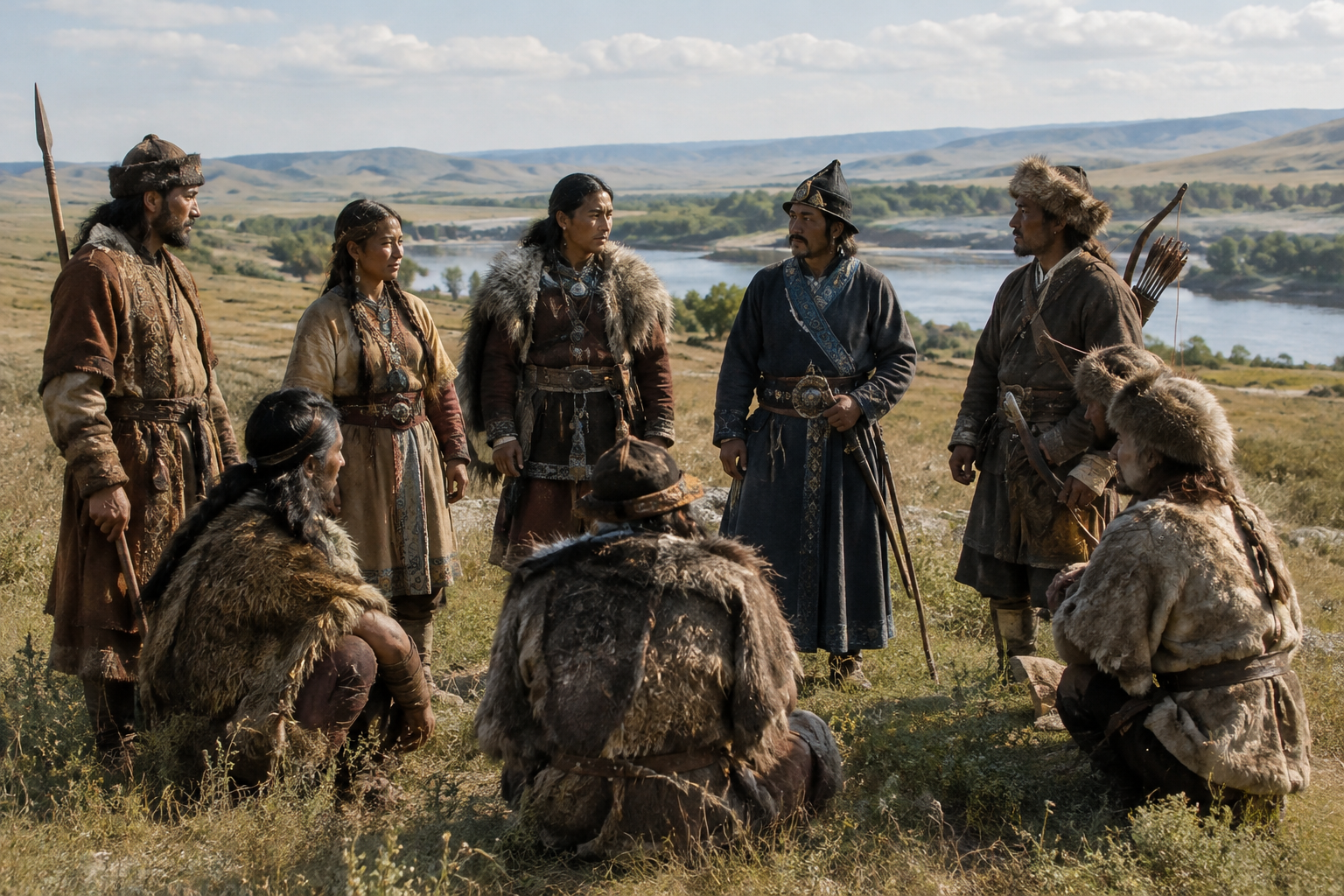
Haplogroup Q1b1a3 is one of those paternal lineages that reminds us how large Eurasian history really is. It does not sit neatly inside the tidy boxes of modern nations, nor does it belong to a single famous people. Instead, it appears in a striking arc of ancient DNA evidence stretching from the Baikal region and Mongolia to the Kazakh steppe and, by the Iron Age, into the north Pontic world of the Scythians. That makes it historically interesting at once: a Y-DNA branch whose story is tied to mobility, steppe networks, and the long movement of men, families, and herding societies across enormous distances.
As ever with Y-DNA, it is worth stating the basics plainly. A Y-chromosome haplogroup traces one direct paternal line only: father to son, back through time. It is not a person's whole ancestry, and it cannot by itself prove identity, ethnicity, or descent from a noble house. But when ancient burials begin to show the same broader paternal branch in widely separated places and periods, they let us watch part of history in motion. In the case of Q1b1a3, the evidence points us toward northern Eurasia and the eastern steppe as an important setting for its earlier history, before later appearances much farther west.
Haplogroup Q as a wider Y-chromosome family is most often associated with northern Asia and with lineages that spread across both Siberia and, in other branches, into the Americas. Q1b1a3 is a much narrower twig on that larger tree, so we must be careful not to assign to it the full history of all Q lineages. Still, the supplied ancient samples make one broad point hard to miss: this paternal branch, or very close related branches, had a presence in eastern and central Eurasia long before the classical world wrote about Scythians, Saka, or Xiongnu.
The geography matters. The Baikal region, Mongolia, and the Kazakh steppe were not isolated edges of the world. They were linked zones of movement, marriage exchange, animal herding, and sometimes violent expansion. Over centuries, paternal lines could travel astonishing distances without any need for a single dramatic migration event. Some moved with small kin groups; others may have spread through elite dominance, alliance networks, or the repeated reshaping of steppe confederations.
Explore East Asian Paternal History
The earliest supplied evidence here comes from the Baikal world. I20309, from Ancient Russia Glazkovskaya Sosnovy Mys 2 dated to 2675 BC, and DA339, from Early Bronze Age Cis Baikal Russia Shamanka II dated to 2089 BC, place this paternal signal deep in the archaeological landscapes east of the Urals. These are important anchors because they show that lineages relevant to Q1b1a3 were present in regions often central to discussions of northern Eurasian population history long before the Iron Age steppe empires.
Then the trail continues into later steppe contexts. ARS011, from Late Bronze Age Arbulag Soum Mongolia dated to 1060 BC, and IMA004, from the Late Xiongnu Period Ilmovaya Pad Mongolia dated to 25 AD, suggest that this paternal background remained part of the eastern steppe world across many centuries. That does not mean one uninterrupted dynasty or one unbroken tribe. It means something more interesting in a way: paternal continuity within landscapes that were politically changing all the time.
By the Iron Age, the evidence appears farther west among steppe groups conventionally described as Scythian or Saka. SRK003, from a Scythian Grave Tasmola Iron Age Serekty Central Kazakhstan dated to 700 BC, and ESZ007, from a Scythian Grave Eleke Sazy East Kazakhstan dated to 550 BC, place this lineage in classic steppe archaeological settings associated with mounted elites, kurgan burial traditions, and far-reaching exchange networks.
And then the story pushes right into the western steppe. UKR113, from Scythian Iron Age Ukraine Mala Rogozianka Kharkiv dated to 600 BC, and UKR109, from the Scythian Ukraine Forest Steppe Dnipro River dated to 350 BC, show related paternal ancestry in the north Pontic region. That is an extraordinary east-to-west spread in archaeological terms, running from Baikal and Mongolia to Ukraine.
None of these individuals should be called direct ancestors of later historical families on haplogroup alone. But together they show that paternal lines associated with Q1b1a3 belonged to the human fabric of the steppe world across a very long chronology.
What makes these finds so compelling is that they connect named historical worlds that are often treated separately. We tend to imagine Scythians in the Black Sea zone, Saka in Central Asia, and Xiongnu in Mongolia as different chapters. Ancient DNA increasingly shows that steppe history does not respect our neat filing system. People moved, mixed, and reassembled politically across vast distances.
For Q1b1a3, the present sample set fits that broader picture well. The eastern evidence in Baikal and Mongolia suggests an early northern Eurasian and eastern steppe context. The later finds in Kazakhstan and Ukraine show how related paternal branches were part of the networks linking the inner Asian steppe to the Pontic frontier. Written sources describe horseback warriors, mobile elites, and contacts between far-flung groups; genetics now gives us a paternal-line glimpse of the men within those systems.
If you want to place these Ukrainian Scythian finds in a wider regional frame, the north Pontic zone is especially important. It was not just a frontier between "Europe" and "Asia," but a zone where herders, farmers, traders, and raiders met repeatedly over millennia.
In this case, the supplied field for associated noble families and castles is blank. That absence is actually worth acknowledging rather than papering over. Not every haplogroup article can responsibly leap from Bronze Age burials to a named medieval dynasty with a photogenic fortress on a hill. Sometimes the evidence is strongest in prehistory and antiquity, and Q1b1a3 is one of those cases.
That does not make the story thinner. If anything, it makes it cleaner. The historical power of this lineage lies in its appearance among ancient populations spanning the Baikal region, Mongolia, Kazakhstan, and Ukraine. Before one gets anywhere near heraldry, family seats, or late medieval pedigree rolls, there is already a remarkable tale of movement across the Eurasian steppe.
It is also a useful reminder that written genealogy and genetic history are not the same thing. Noble houses preserve names, titles, and estates; ancient DNA preserves something else entirely, fragments of biological kinship and population history often from periods where no family chronicle survives. When the two can be connected securely, that is exciting. When they cannot, the honest thing is to say so.
Read About Huns and Xiongnu Links
Q1b1a3 offers a particularly vivid example of why ancient paternal DNA matters. It can reveal long-range continuities and movements that no single text records. A burial such as DA339 at Shamanka II or I20309 at Sosnovy Mys 2 tells us that relevant paternal ancestry was present in the Baikal sphere in deep antiquity. Finds like ARS011 and IMA004 show its place in later Mongolian steppe history. And the Scythian-era burials SRK003, ESZ007, UKR113, and UKR109 show related paternal lines spread across the central and western steppe.
That is not proof of one people, one language, or one ruling clan. It is better than that: evidence of a durable paternal thread running through multiple archaeological horizons and historical settings. It helps explain how the steppe worked, not as a sequence of sealed ethnic boxes, but as a connected world of circulation and reassembly.
For anyone who carries Q1b1a3 today, the most responsible conclusion is not "I am Scythian" or "I descend from a steppe king." It is that one direct paternal line belongs to a branch with deep roots in northern Eurasia and a documented presence in ancient steppe populations stretching from Mongolia to Ukraine. That is already a grand enough piece of history.
Upload your DNA to MyTrueAncestry and explore whether your results show links to ancient individuals like UKR109, DA339, or IMA004, and to the wider populations that shaped Eurasian history. Ancient DNA matches can open fascinating windows onto your past, even when they do not prove direct descent from any particular ancient person or later dynasty.






Comments