Haplogroup Q1b1a1a
– 5 min read


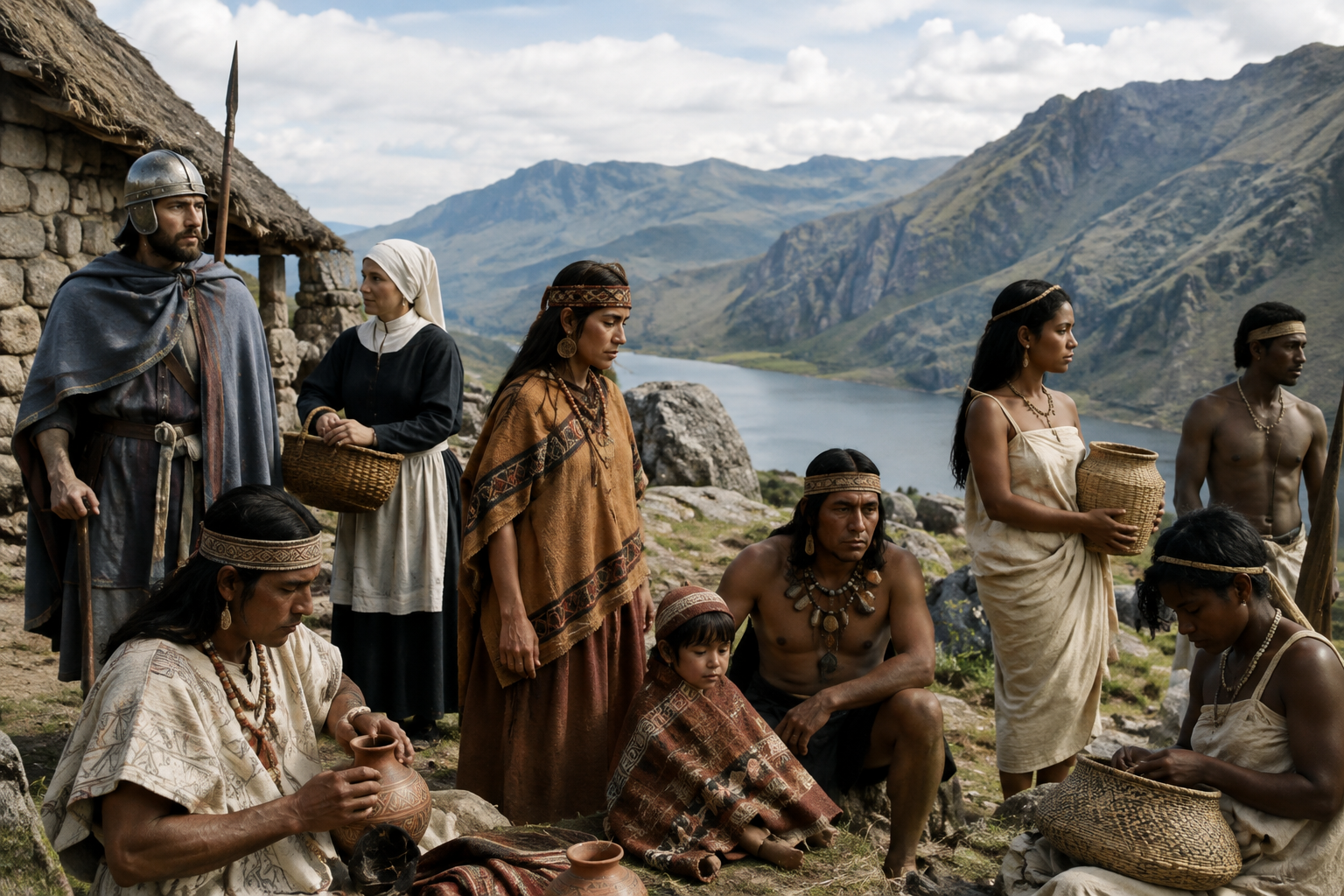
Haplogroup Q1b1a1a is one of those Y-DNA lineages that immediately reminds us how misleading our historical instincts can be. Many readers will know haplogroup Q as a paternal branch strongly associated with the peopling of the Americas, and that is indeed a major part of its story. But when a narrower branch such as Q1b1a1a turns up in places as different as Lombard-era northern Italy, late medieval London, the Andes, Chile, Peru, and the pre-Columbian Caribbean, the result is less a neat family tree than a map of human movement, survival, and historical surprise.
As always with Y-DNA, we are looking at only one line of descent: the direct paternal line, father to son to son across many generations. That can be historically illuminating, but it is not the same thing as a person's total ancestry. Still, paternal lineages matter. They can show how male lines persisted, moved, and occasionally appeared in unexpected cultural settings. Q1b1a1a sits within the broader Y-chromosome haplogroup Q tree, and its story is best approached carefully: not as a badge of ethnicity, and certainly not as proof of belonging to any later dynasty, but as one thread in a much larger human past.
The broader haplogroup Q has deep roots in northern Eurasia and is especially famous because some of its descendant branches became central to the paternal history of Indigenous peoples of the Americas. That larger background matters here, but we should not simply project the full history of all Q lineages onto the more specific branch Q1b1a1a. Subclades often have their own distinct histories, and ancient DNA is constantly showing that broad labels can hide very different regional stories.
What makes Q1b1a1a so interesting is that the ancient individuals supplied here do not point to a single tidy homeland in the historical period. Instead, they show the branch appearing in very different worlds: one in early medieval Italy, another in late medieval England, and several across pre-Columbian and early colonial-era Indigenous communities of the Americas. That spread suggests not one single recent migration event, but a much older branching history followed by local survival in very different regions.
For readers wanting a broader grounding in how archaeogenetics tackles exactly these kinds of questions, the MyTrueAncestry community has a useful overview in Ancient DNA and the Rise of Archaeogenetics.
The most startling European appearance in this sample set is COL_130b, from Lombard Era Collegno Northern Italy, dated to 580 AD. Collegno, near Turin, belongs to that fascinating post-Roman world in which old imperial structures, incoming groups, local populations, and shifting identities were all jostling together. A Q-lineage in this setting is a reminder that early medieval Europe was not genetically uniform, and that the Lombard world was shaped by mobility, mixture, and regional complexity rather than simple tribal boxes.
That point becomes even more interesting when set beside other work on Italy in the MyTrueAncestry community, especially Genetic ancestry of ancient Amiternum from Roman to early medieval Italy, which explores how genetic continuity and change overlapped in the peninsula.
Then there is LM21, from St Marys Spital Late Medieval London, dated to 1450 AD. Medieval London was a magnet for migrants from across England and beyond, a city of trade, disease, clerics, laborers, strangers, and the dead. A paternal lineage such as Q1b1a1a appearing there does not tell us that London was somehow full of Q-line men; it tells us instead that individual lives in medieval cities could carry unexpectedly far-flung paternal histories. Written records rarely capture this. DNA does.
But the strongest pattern in the supplied evidence lies in the Americas. LDC020a, from the Intermediate Period Peru Chachapoyas Culture Laguna de los Condores, dated to 1455 AD, places the lineage in the cloud-forest world of the Chachapoyas. Aconcagua, the Incan Child Mummy Andes, dated to 1580 AD, anchors it in the high Andes. I1752, from Pre Columbian Conchali Santiago Chile, dated to 1355 AD, shows it farther south along the Pacific edge of South America.
The Caribbean adds another dimension. I15601, from Pre-Columbian La Caleta Dominican Republic, dated to 725 AD, and the two Lavoutte samples from St. Lucia, LAV010 and LAV004, both dated to 1491 AD, show this paternal branch in island societies before or at the very threshold of European disruption. These are not footnotes. They are evidence that Q-associated paternal lines had real depth and breadth across Indigenous American populations.
Readers interested in that island context may want to continue with Ancient DNA Preservation in the Caribbean, which helps explain both the promise and the difficulty of recovering this history.
Discover Caribbean Ancient DNA
If we stand back, the pattern is not one of a single people marching across a map under one banner. It is much more human than that. In the Americas, these samples fit the larger understanding that branches of haplogroup Q became deeply established in Indigenous populations after the initial settlement of the continents. In Europe, the isolated but significant appearances in Italy and London suggest that some Q-derived paternal lines also persisted or arrived there through older Eurasian histories, later migration, or both.
That is exactly why one must resist easy labels. A shared haplogroup does not make a Lombard-era man from Collegno and a Chachapoyas individual from Laguna de los Condores members of the same historical population in any meaningful cultural sense. It simply means their direct paternal lines join somewhere deeper in the phylogenetic tree. The cultural worlds they inhabited were completely different.
For a broader American frame, one of the most relevant community pieces is Ancient Migrations from North Asia to South America and Their Lasting Impact on Human Diversity. It helps place lineages like Q into the immense timescale of settlement in the New World.
Explore Ancient American Migrations
In this case, the supplied field for associated noble families and castles is effectively empty. That absence is worth stating plainly, because it highlights something important about responsible historical genetics. Not every haplogroup can or should be tied to a neat roll call of titled houses, baronial seats, and stone keeps. Sometimes the evidence draws us instead toward cemeteries, burial caves, hospital grounds, and mountain shrines.
And, frankly, that is often more revealing. Castles preserve family memory, but graves preserve people. A child on an Andean peak, a burial from La Caleta in the Dominican Republic, a Londoner from St Marys Spital, a man in Lombard-era Collegno: these are not heraldic abstractions. They are individuals whose remains let us glimpse how paternal lines endured across societies with entirely different languages, religions, and political systems.
If future evidence links particular noble or regional lineages to this branch more specifically, that would deserve careful treatment. But without that evidence, it would be irresponsible to imply that Q1b1a1a proves descent from any medieval house, still less from every family ever associated with the broader haplogroup Q world. Genetics can enrich genealogy; it should not be turned into costume drama.
Q1b1a1a matters because it shows the power of ancient DNA to disrupt historical laziness. It refuses to stay in one familiar box. It appears in Indigenous American contexts where the broader Q story is expected, but it also turns up in medieval and early medieval Europe in ways that remind us how much paternal diversity has existed in the past. It invites us to think in branches rather than stereotypes, and in evidence rather than myth.
For MyTrueAncestry users, that is the real excitement. A Y-DNA haplogroup can connect you to broad patterns of deep paternal history, but ancient DNA comparisons add another dimension. They can place your results beside real excavated individuals from particular times and places. That does not prove direct descent from COL_130b, LM21, LDC020a, I1752, I15601, LAV010, LAV004, or Aconcagua. What it can do is show that your paternal ancestry belongs to a historical landscape far older, wider, and more complicated than any modern identity label.
If you want to explore whether your DNA shares links with ancient individuals, historical populations, and deep paternal lineages like Q1b1a1a, MyTrueAncestry offers a remarkable way to place your results in the long human story.






Comments