Haplogroup Q1b1

– 5 min read


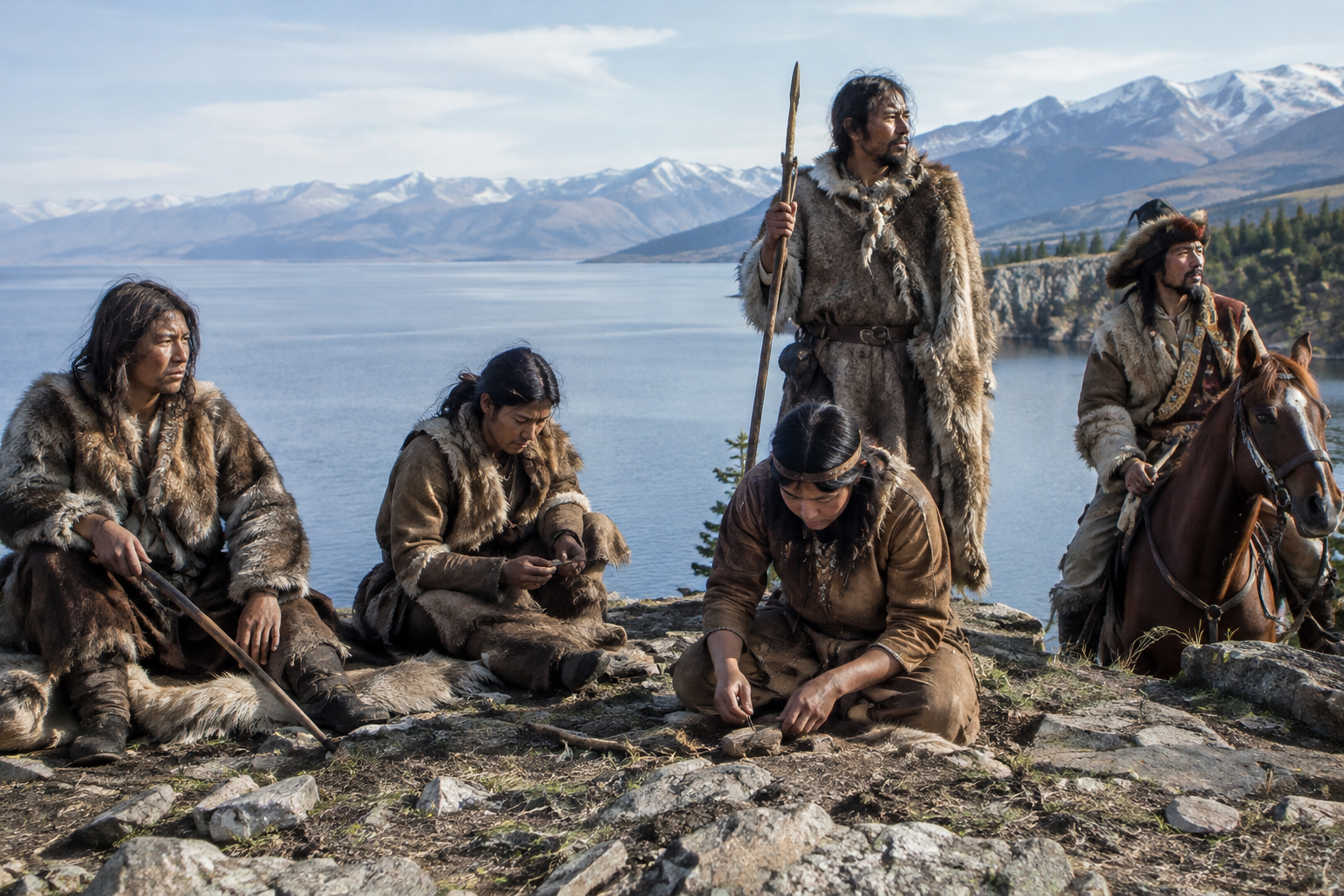
At Lake Baikal in southern Siberia, one of the most revealing ancient paternal lineages turns up very early indeed. Sample I8501, dated to around 5725 BC and described as an East Siberian hunter-gatherer from Neolithic Russia, is associated here with Y-DNA haplogroup Q1b1. That matters because it places this paternal branch, or at least a reported association with it, in one of the great long-lived hunter-gatherer landscapes of northern Eurasia.
Q is a wider Y-chromosome family with deep roots in northern Asia and an important place in the population history of both Siberia and the Indigenous Americas. Q1b1 is a much narrower branch within that larger tree. Y-DNA tracks one direct paternal line only, so it does not summarize a whole person's ancestry, culture, or language, but when the same branch appears across several archaeological settings, it can still tell us something striking about continuity and movement.
The Baikal region is one of the most important testing grounds in ancient DNA because its burials and settlements preserve evidence from communities living through major climatic and cultural changes. In this case, I8501 gives us an early anchor point for Q1b1 in the Neolithic of eastern Siberia. Rather than a late arrival carried in by historic nomads, the lineage appears tied to populations already established in the forest-steppe and lake zone thousands of years before the Iron Age.
Another sample strengthens that impression. I2143, from Ust Shamanka-1 near Irkutsk and dated to around 2535 BC, shows the same branch associated with a Bronze Age individual from the wider Baikal world. The significance is not that one man "founded" later peoples, still less that a single haplogroup defines a culture. It is that the same paternal line is found in this region across a very long span, from Neolithic hunter-gatherer contexts into the Bronze Age.
That long Baikal sequence has become even more interesting as researchers have explored disease and population structure in the area. A study of prehistoric Lake Baikal hunter-gatherers published in Nature highlights how this region can preserve not just ancestry signals but wider clues about ancient lives and pressures on those communities. Even without treating one paper as proof of every haplogroup assignment, the broader point stands: Baikal was not peripheral to Eurasian prehistory. It was one of its major laboratories.
The second early find in this set comes from Vaskovo-4 in Kemerovo, western Siberia. Sample I2075, dated to around 5369 BC, is another Neolithic individual associated with Q1b1. This is useful precisely because it is not the same locality as Baikal. It suggests that the branch was not confined to one isolated shoreline community but was present across a broader Siberian world.
That wider geography matters. Southern Siberia is not a single uniform zone; it includes taiga, river corridors, open steppe, and mountain-fringed basins, each shaping contact differently. When a paternal lineage appears in both the Baikal area and farther west in Kemerovo during the Neolithic, the simplest defensible reading is that Q1b1 belonged to some of the male lines circulating among northern Asian populations well before the famous steppe confederations of later millennia.
In other words, Q1b1 in these early contexts is not just an "Iron Age nomad marker." The archaeology pushes it back into a far older Siberian setting, among communities whose economies and social worlds were very different from those of later mounted elites.
By the Bronze Age, the old Siberian genetic landscape had not vanished, but it had become more complicated. New mixtures, new mobility patterns, and new cultural horizons spread across the steppe and forest-steppe. Sample I2143 from Ust Shamanka-1 is valuable here because it sits after the earliest Neolithic examples yet still in the broader Baikal sphere, showing that the paternal presence associated with Q1b1 did not disappear as local societies changed.
This is exactly the kind of pattern archaeogenetics handles best when used carefully. A lineage can persist through major shifts in material culture and ancestry. Pottery styles, exchange networks, and burial customs may change faster than a single paternal branch does. So the presence of Q1b1 in both Neolithic and Bronze Age Siberia does not mean stasis; it means continuity within change.
The most historically recognizable sample in this group is CSP001, dated to around 300 BC and identified as a Saka Scythian individual from the Tian Shan. Here the story shifts from Siberian prehistory to the mobile Iranian-speaking or partly Iranian-speaking steppe world known from Classical sources, archaeology, and now ancient DNA. A Q1b1-associated male in this setting shows that the branch was still present far to the south and west of the Baikal heartland in the Iron Age.
It would be a mistake to turn that into a simple ethnic label. "Scythian" and "Saka" describe archaeological and historical groupings with considerable internal diversity, not a single bloodline. But the appearance of Q1b1 in a Saka context is still revealing. It suggests that paternal lines with deep northern Asian histories were part of the human mix in steppe societies that linked Siberia, Central Asia, and the mountain corridors around the Tian Shan.
Research on Iron Age populations of Central Asia has repeatedly shown these communities to be genetically varied, combining local ancestry with steppe-derived and eastern components in different proportions. An ancient DNA study in Science Advances helped underline just how mixed and regionally varied these steppe populations could be. Q1b1 fits that world rather well: not a lone signal, but one thread in a broad web of mobility stretching across Inner Asia.
Put these finds together and a clear pattern emerges. The branch appears in Neolithic Siberia at Lake Baikal and Kemerovo, continues into the Bronze Age near Irkutsk, and then turns up in an Iron Age Saka individual in the Tian Shan. That is not a tidy royal pedigree or a single migration arrow on a map. It is something better: a real archaeological record showing a paternal line present across different landscapes and periods of northern Eurasia.
For someone who belongs to Q1b1 today, the most responsible historical picture is one of deep northern Asian roots with later participation, directly or through related populations, in the mobile societies of Inner Asia. The oldest evidence in this set points toward ancient Siberian populations rather than a narrowly recent or purely steppe-age origin. The later Saka appearance shows that this paternal branch was still part of the human story when mounted cultures dominated the great corridors between Siberia and Central Asia.
What makes Q1b1 distinctive is not sheer frequency or dynastic glamour, but reach through time. In the evidence here, it belongs first to the ancient north: Neolithic and Bronze Age Siberia, especially the Baikal world, before reappearing in the Iron Age networks of the Tian Shan. For family historians, that is a useful clue. It suggests that this paternal line is part of the long population history linking Siberian foragers, later Inner Asian communities, and the broad human traffic of the Eurasian steppe.






Comments