Haplogroup Q1a2a
– 6 min read


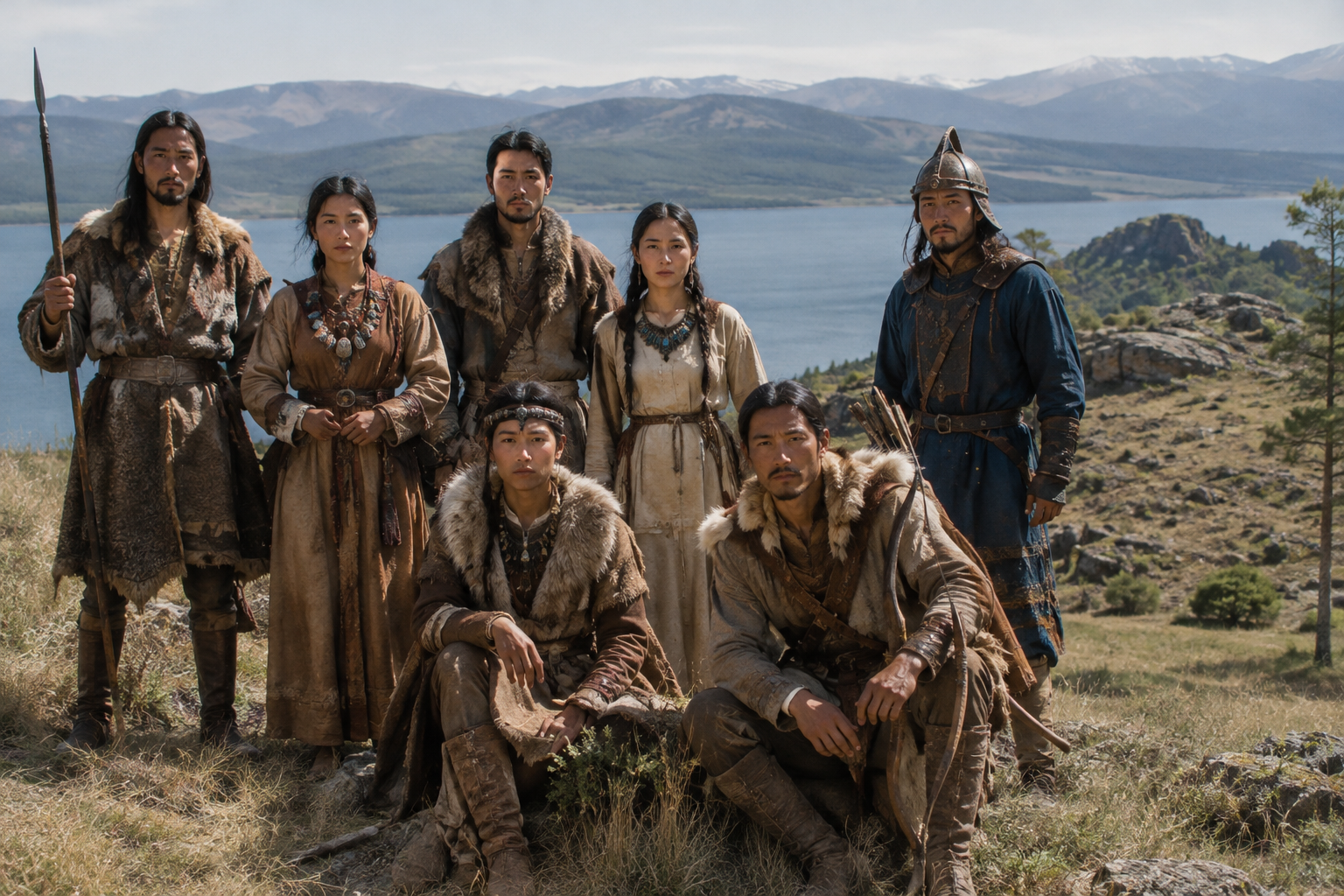
There are some Y-chromosome lineages that seem to belong to one neat historical chapter. And then there is Q1a2a, which insists on a much larger stage. This paternal haplogroup opens onto the deep history of northern Eurasia, from Neolithic Siberia to Bronze Age Mongolia and into the world of later steppe peoples. It is the sort of lineage that reminds us that the past was not arranged in tidy national boxes. Men carrying related paternal lines moved across forests, river systems, mountain corridors, and grasslands long before written chronicles began to describe them.
As ever with Y-DNA, a caution comes first. A Y-chromosome haplogroup traces only one line of descent: the direct paternal line, father to son across generations. It does not describe a person's whole ancestry, culture, language, or identity. But that narrow line can still be extraordinarily revealing. In the case of Q1a2a, ancient DNA has made it possible to watch one paternal branch appear in widely separated places across Inner Asia, helping us reconstruct parts of a story that archaeology alone could only sketch.
Haplogroup Q is one of the major Y-chromosome lineages of northern Eurasia and the Americas, with deep importance for understanding ancient populations of Siberia and beyond. Q1a2a is a more specific branch within that wider tree, and for that reason we have to be careful not to lazily assign to it every chapter in the history of haplogroup Q as a whole. Still, the evidence supplied here places Q1a2a firmly in a broad northern Eurasian setting, especially across Siberia, the Baikal region, Mongolia, and adjacent steppe worlds.
What is striking is the geographical logic. These are not isolated dots on a map. They lie across zones that were, in prehistory, linked by movement: southwestern Siberia, the Cis-Baikal region, Mongolia, and the steppe corridors reaching toward Central Asia. Rather than imagining one single dramatic migration, it is often more realistic to think in terms of repeated mobility, local continuity in some areas, and the constant reshaping of populations through contact, marriage, and seasonal movement.
Explore Ancient East Asian Y-DNA
This is also why Q1a2a matters for public history. It gives us a paternal thread linking some of the great archaeological landscapes of Inner Asia. If you want the wider context for how ancient paternal lines help reconstruct movement across East Asia, the MyTrueAncestry community article on ancient Y chromosomes and migration patterns is an excellent next stop.
The oldest sample in the material provided is I0996, from Neolithic Southwestern Siberia Altai Krai Firsovo Firsovo-11, dated to 5344 BC. Even at a glance, this is important. It places this paternal branch, or a closely related assignment, deep in the Neolithic of southwestern Siberia. That matters because the Altai region has long been one of the great crossroads of Eurasian prehistory, where forest, mountain, and steppe populations interacted. A lineage found there that early is not an incidental late arrival to Inner Asia; it is part of the region's very old human story.
Then we move east and slightly later to the Baikal world. Four individuals from Early Bronze Age Cis Baikal Russia Shamanka II are listed here: DA335 dated 2250 BC, DA337 dated 2378 BC, DA338 dated 2250 BC, and DA336 dated 2250 BC. One can almost hear the archaeologist's excitement in that cluster alone. A single sample might be chance; four from the same broad site and period suggest something more substantial about the paternal makeup of that local population.
Shamanka II, in the Cis-Baikal region near Lake Baikal, belongs to a landscape already famous in archaeogenetics. This is a place where burials, diet, mobility, and even ancient disease have transformed our understanding of prehistoric northern Eurasia. Q1a2a appearing repeatedly here hints at either strong local continuity in paternal lines or a social structure in which certain male lines were especially visible in burial contexts. It does not prove kinship between all four men, nor direct descent to any later historical group, but it does show that this paternal lineage had a durable place in Early Bronze Age Baikal communities.
Read About Lake Baikal Ancient DNA
Readers interested in the Baikal region more generally may want to explore the community article on prehistoric plague in Lake Baikal hunter-gatherers. It offers a vivid sense of just how scientifically productive this region has become for ancient DNA research.
By the Late Bronze Age, Q1a2a also appears in Mongolia: ARS007 and ARS025, both from Arbulag Soum Mongolia and dated to 1060 BC. This is exactly the sort of evidence that stops us thinking of ancient populations as static. The paternal line is now visible in a steppe setting to the southeast of Baikal, in a period when exchange networks, herding economies, and regional interaction were reshaping the eastern степpe world. It would be rash to claim one simple directional spread, but the distribution strongly suggests that related paternal lines were established across a broad Inner Asian zone.
Finally there is CHN003, from Wusun Uyuk-Sagly Chandman Mountain, dated to 25 AD. That date takes us into the historical era, and the Wusun association is especially suggestive because it touches the interconnected steppe and Central Asian worlds described in early written sources. Here Q1a2a appears not merely in prehistory but in a society operating within the political and mobile landscape of the early centuries AD. This is precisely the sort of sample that helps bridge archaeology and history: not a direct ancestor of named dynasties, but evidence that such paternal lines persisted into the era when states, confederations, and cross-continental exchange became more visible in texts.
Explore DNA of the Mongolian Steppe
Put these samples together and a pattern emerges. Q1a2a is not represented here as a fleeting, one-period phenomenon. It appears in the Neolithic Altai, the Early Bronze Age Baikal region, the Late Bronze Age Mongolian steppe, and the early historic Wusun sphere. That long span is the real point. Ancient DNA is showing us continuity of paternal branches across landscapes where archaeologists have long suspected deep population connections, but where the scale and texture of those links were hard to pin down.
This does not mean one unbroken tribe, one ethnicity, or one language. Quite the reverse. The same Y-DNA branch can pass through communities speaking different languages, practicing different burial customs, and participating in very different political systems. A haplogroup is a lineage, not a civilization. But lineages do travel through civilizations, and that makes them useful historical witnesses.
Q1a2a is also a reminder that Inner Asia was not peripheral. From a European perspective, it is easy to treat Siberia and Mongolia as remote margins. In reality these were central arenas in human prehistory, where ancient lineages survived, diversified, and connected enormous regions. For readers interested in that bigger frame, the MyTrueAncestry article on Ancient DNA Unlocks the Mysteries of Northern Eurasia complements this story particularly well.
In this case, the supplied field for associated noble families and castles is empty. That is worth saying plainly rather than papering over it. Not every haplogroup article can, or should, force a connection to a named medieval house, a baronial pedigree, or a surviving fortress. Sometimes the most honest story is older and wider than heraldry.
And in truth that is no disappointment. Q1a2a belongs, in the evidence provided here, to a world before stone keeps and genealogical rolls: cemetery grounds near Lake Baikal, Neolithic communities in the Altai, Bronze Age burials in Mongolia, and steppe-linked populations of the early historical period. If later noble or clan associations are investigated in future through documented Y-DNA studies, those would need to be treated with care. Sharing a broad haplogroup with an ancient sample would not by itself prove descent from a specific ancient individual, still less membership in a particular dynasty.
Discover Northern Eurasia's Ancient Peoples
The value of Q1a2a lies in its range across time and space. With I0996, DA335, DA337, DA338, DA336, ARS007, ARS025, and CHN003, we can see a paternal lineage appearing again and again across northern and Inner Asia. That does not hand us a neat family tree. What it gives us is something better suited to real history: evidence of persistence, movement, and regional connection over thousands of years.
For anyone who carries Q1a2a today, that can be a fascinating clue. It may point toward deep paternal roots somewhere in the vast arc stretching across Siberia and the eastern steppe. But DNA works best when paired with humility. Ancient matches illuminate context; they do not automatically certify identity, ethnicity, or descent from famous houses. They help place your paternal line in the human past, which is often more interesting than any tidy legend.
If you want to explore whether your own DNA shows links to ancient individuals like those from Shamanka II, Firsovo-11, Arbulag Soum, or the Wusun world, MyTrueAncestry can help you compare your results with archaeological DNA from across history. It is a remarkable way to see how one small part of your ancestry may connect with real ancient people, while remembering that genetic similarity is not the same thing as a documented family tree.






Comments