Haplogroup O1b2a

– 5 min read


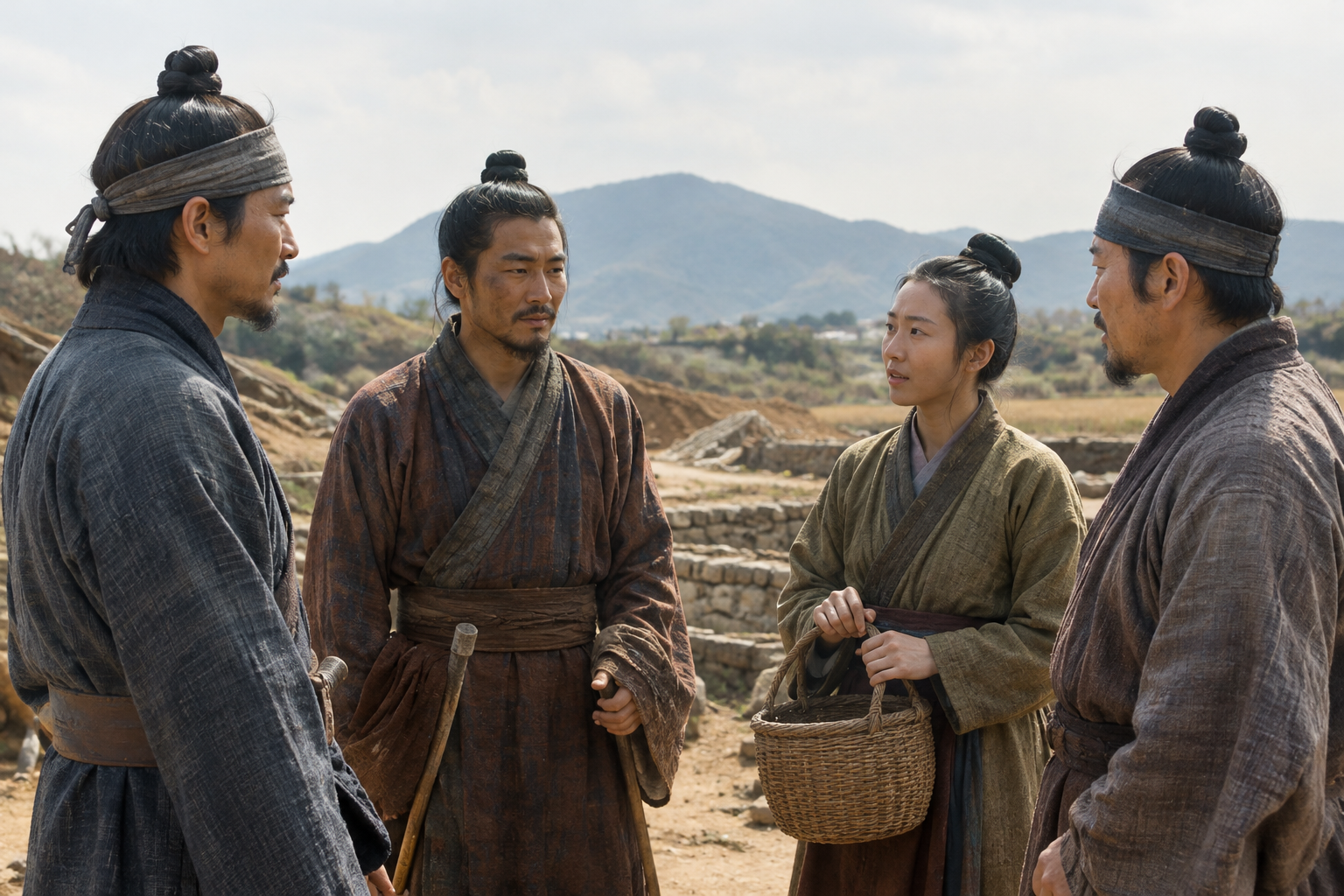
At Joyeong-dong in Gyeongsan, in southeastern Korea, ancient DNA has begun to put names and lineages back into the otherwise silent world of the Three Kingdoms period. Among the burials dated to around AD 500, two men, JOY118 and JOY123, were reported with the Y-DNA haplogroup O1b2a. That matters because it gives us not just a broad East Asian genetic signal, but a specific paternal branch appearing in a historically important Korean community at a time when kingdoms, local elites, and kin-based networks were shaping the peninsula.
Those two Joyeong-dong men are not alone. Nearby, at Imdang-dong, also in Gyeongsan and also dated to around AD 500, two more individuals, IMD031 and IMD001, are associated with the same haplogroup. Four samples from two neighboring cemetery landscapes do not define all of ancient Korea, of course. But they do offer something more useful than grand speculation: a small, concrete window onto how one paternal line appeared repeatedly within a real archaeological setting of the Silla world.
Gyeongsan was not a random rural backwater. In the Three Kingdoms period, this region lay within the orbit of Silla, one of the major Korean polities competing for power on the peninsula. Archaeologists have long treated the Imdang-dong and Joyeong-dong burials as important evidence for local society in this era, because cemetery clusters like these speak to status, family organization, and the integration of communities into larger political systems.
The genetic evidence sharpens that picture in a modest but valuable way. When the same Y-DNA branch appears in multiple males from neighboring sites of the same period, it suggests that O1b2a formed part of the local paternal landscape in southeastern Korea by the late 5th or early 6th century AD. Y-DNA tracks only a direct father-to-son line, not a person's whole ancestry, but that single line can still be historically revealing when it recurs in an archaeologically coherent setting.
The pair from Joyeong-dong, JOY118 and JOY123, are especially useful because they anchor the article in one site rather than in a vague regional average. Both are dated to around AD 500 and both are linked to O1b2a. Even without embellishing their graves with unverified details, that repetition is important. It hints that this paternal line was not an isolated arrival represented by a single outsider, but part of the male ancestry present in the community using the cemetery.
That is precisely where ancient DNA is at its best. It does not replace archaeology, and it certainly does not turn every burial ground into a tidy family tree. What it can do is show that lineages recurring in historical populations were already established in particular places, among particular communities, at datable moments. In Joyeong-dong, O1b2a is not an abstract modern statistic; it appears in two actual men buried in the same broad historical horizon.
A broader ancient DNA research effort tied to these burials is linked through genetic work on the Gyeongsan Three Kingdoms material. Even where one cannot safely claim more than the sample-level assignments provided, the pattern itself is historically suggestive: repeated paternal continuity within a regional cemetery complex associated with Silla-period society.
If Joyeong-dong gives us one cluster, Imdang-dong gives us another. The samples IMD031 and IMD001, also from Gyeongsan and also dated to around AD 500, are likewise associated with O1b2a. Archaeologically, that matters because Imdang-dong is not simply the same grave copied twice; it is another site in the same regional landscape, adding weight to the case that this lineage had a real foothold in the area.
This kind of repetition across neighboring cemeteries is often more informative than a single spectacular burial. It suggests a local population pattern rather than a one-off curiosity. We should not leap from that to claims of a ruling dynasty or a single extended patriline controlling the region; the evidence is too limited for that. But the recurrence does fit well with what historians and archaeologists expect from early state societies, where local communities were structured through durable kin ties and inherited social position.
O1b2a belongs to a wider Y-chromosome landscape that is deeply important in East Asia, especially in parts of Korea and Japan. But it is worth being careful here. The broader parent branches of haplogroup O have long and complicated histories, and one should not casually pour the whole story of East Asian population history into a narrower label like O1b2a without sample-specific evidence.
What these Gyeongsan burials allow us to say is simpler and stronger. By around AD 500, men associated with O1b2a were present in southeastern Korea in more than one burial context. That places the lineage securely within the human fabric of the Three Kingdoms period, not merely in later historical populations. For men who carry this haplogroup today, that is a meaningful point of connection: not proof of descent from these individuals, but evidence that their paternal branch was part of Korean history during an era of political consolidation and regional identity.
This also helps correct a common misconception in popular genealogy. Haplogroups are not ethnic badges frozen in time. A man with O1b2a in the Silla world would have belonged to a social and historical community defined by language, politics, family alliances, and local custom, not by a DNA label alone. The haplogroup is one thread in the fabric, not the entire garment.
Ancient cemeteries are often read first through objects, tomb form, and chronology. Genetics adds another layer by asking whether some of the men buried in the same place or region also shared paternal ancestry. In Gyeongsan, the answer for these four individuals is yes at the level of the reported haplogroup: JOY118, JOY123, IMD031, and IMD001 all connect to O1b2a.
That does not automatically mean all four men were close relatives. They may have been, or they may have belonged to different branches of a lineage that had been locally established for generations. Either way, the repeated signal matters because it shows that a paternal line could persist across more than one burial community within the same historical zone. That is exactly the kind of pattern archaeogenetics is increasingly good at detecting.
There is also a wider comparative value here. Across Eurasia, ancient DNA studies often show that maternal and paternal histories do not behave in exactly the same way. Some communities show striking continuity in one line and more diversity in another. The Korean Three Kingdoms evidence belongs in that larger conversation about how households, marriage practices, and political communities were organized, even if these four samples by themselves cannot answer every question.
The most distinctive thing about O1b2a in this case is not a mythical origin story or a grand imperial pedigree. It is something more grounded: this haplogroup appears repeatedly in real men from Joyeong-dong and Imdang-dong in Gyeongsan, around AD 500, within the world of Three Kingdoms Korea. For anyone researching this paternal line today, that offers a sober but satisfying historical anchor. It places the lineage within the lived communities of early Korean state formation, where family continuity and regional identity were being written not in chronicles alone, but in the cemeteries archaeologists now study with DNA.
Comments