Haplogroup N1a1a1a2

– 5 min read


At Brody in the Cis-Ural region of Russia, one ancient male dated to around AD 300 stands out for a very particular reason. Sample Brody1 is associated here with the Y-DNA haplogroup N1a1a1a2, a branch whose importance lies less in royal legend than in geography: it turns up in exactly the kind of northern Eurasian borderland where forest, steppe, and river routes met and mixed.
That makes Brody1 a useful starting point. Y-DNA follows one direct paternal line only, not a person's whole ancestry, but even that narrow line can be historically revealing when it appears in places where populations were mobile and identities were layered. With N1a1a1a2, the evidence supplied here points not to a single kingdom or famous dynasty, but to a long northern arc running from the Urals toward the Mongolian world.
The Cis-Urals are one of those regions that historians have learned not to underestimate. They look peripheral on maps drawn from Rome, Persia, or China, yet archaeologically they sit in a zone of contact between European and Inner Asian worlds. A man like Brody1, placed around AD 300, belongs to precisely that era when late ancient Eurasia was full of movement, alliance, and local continuity all at once.
What makes this sample especially interesting for N1a1a1a2 is that it anchors the haplogroup in a region often discussed in connection with Uralic-speaking and other northern Eurasian populations. That does not allow us to assign Brody1 a language or ethnicity from Y-DNA alone. But it does show that this paternal branch was present in the western side of the great trans-Eurasian corridor well before the late medieval empires that later dominated written history.
A genetic study connected with ancient populations of this broader zone, published in Scientific Reports, helped underline how valuable such frontier burials can be for reconstructing population history. In places like the southern and western Ural sphere, even a single male lineage can illuminate contacts that archaeology had long suspected but could not always trace biologically.
Southern Urals and early Hungarians
Haplogroup N is a major northern Eurasian Y-chromosome family with a wide and complicated history. The branch named here, N1a1a1a2, is much narrower than that larger umbrella. That matters, because it is very easy to slide from "this is a branch within haplogroup N" to "therefore everything ever said about haplogroup N applies here." It does not.
For this article, the safer point is more modest and more useful. The supplied ancient evidence places this branch, or an association with it, in two very different settings: the Cis-Urals in late antiquity and Mongolia in the late medieval period. That spread suggests durability across northern Eurasia, but it does not by itself prove one uninterrupted political people, one language family, or one migration event.
In other words, N1a1a1a2 is best understood here as a paternal thread visible in more than one historical world. The thread is real; the temptation to turn it into a grand single-origin epic should be resisted.
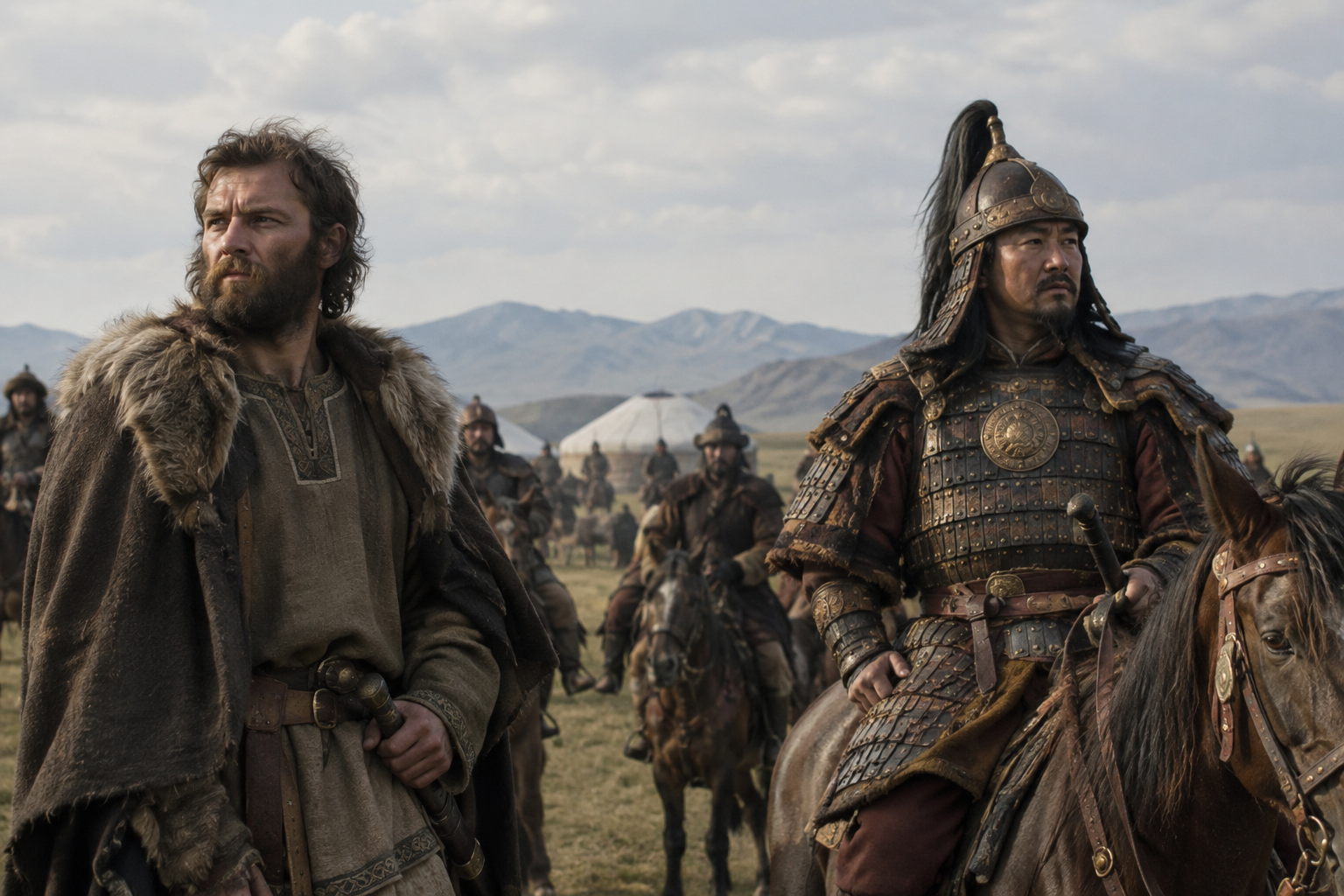
The second ancient sample is a long way east in both space and historical context. Bay2, from Bayan Khairkhan and dated to around AD 1300, is identified as a Late Medieval Mongol individual. That is already enough to make the pairing with Brody1 striking: the same named haplogroup appears not only in the Ural contact zone, but also in the Mongolian sphere during the centuries after the rise of the Mongol Empire.
Now, one must be careful here. A Mongol-period burial carrying N1a1a1a2 does not mean this was "the Mongol haplogroup," nor does it identify Bay2 with any famous lineage. The Mongol world was genetically diverse, and imperial expansion drew in peoples from an enormous range of backgrounds. What Bay2 does show is that this paternal branch was part of that late medieval eastern Eurasian landscape as well.
That matters because Mongolia in the 13th and 14th centuries was not some isolated core but the center of a gigantic political network. A paternal line found there could reflect local continuity, earlier regional connections, or the layering together of different Inner Asian populations. The archaeological point is not celebrity ancestry but historical placement: N1a1a1a2 sat within a world of riders, herders, envoys, and camp societies linked across the steppe.
Put Brody1 and Bay2 side by side and the most interesting feature is not sameness, but range. The Cis-Urals around AD 300 and Mongolia around AD 1300 are connected by Eurasian geography, yet they belong to very different archaeological and historical settings. One lies in a frontier world of late antiquity; the other in the orbit of the Mongol centuries.
That broad distribution fits a larger pattern seen again and again in ancient DNA from northern Eurasia: paternal lineages can persist through major cultural changes while the communities carrying them shift language, political allegiance, and lifestyle. Archaeology has long shown that the steppe and forest-steppe were not empty transit belts but lived-in regions with deep local histories. Y-DNA now lets us see a little of how some paternal lines endured within those changing worlds.
The supplementary materials linked from a bioRxiv study are associated with one of the ancient sample records used here, and they reflect the increasingly detailed way researchers map such populations across time. Even when a paper is not mined for every grave detail, this kind of work has transformed our ability to place lineages in real archaeological landscapes rather than in vague ethnic legends.
Eastern roots of Uralic ancestry
Two ancient samples are not a population census. Still, these are not random dots with no meaning. They place N1a1a1a2 in two historically revealing settings that help define the branch's archaeological character: a western northern-Eurasian contact zone and a later Inner Asian imperial zone.
For members of MyTrueAncestry, that is often the sweet spot where ancient DNA becomes genuinely helpful. It does not hand you a named tribe, a coat of arms, or a guaranteed medieval pedigree. What it can do is place your paternal line in a believable historical arena. In this case, that arena is the long belt of northern Eurasia where communities of the Urals, the forest-steppe, and the eastern steppe interacted over many centuries.
Northern Eurasia in ancient DNA
N1a1a1a2, on the evidence here, is a paternal lineage with a documented ancient presence from the Cis-Urals to late medieval Mongolia. That does not make it the badge of one people. It does make it a lineage worth thinking about in the context of northern Eurasian mobility, persistence, and the deep human traffic between forest and steppe. If this is your haplogroup, the most responsible historical picture is not a single heroic origin story, but a durable paternal line moving through some of Eurasia's most connected frontier worlds.
Comments