Haplogroup N1a1a1a1a1a1a1b

– 5 min read


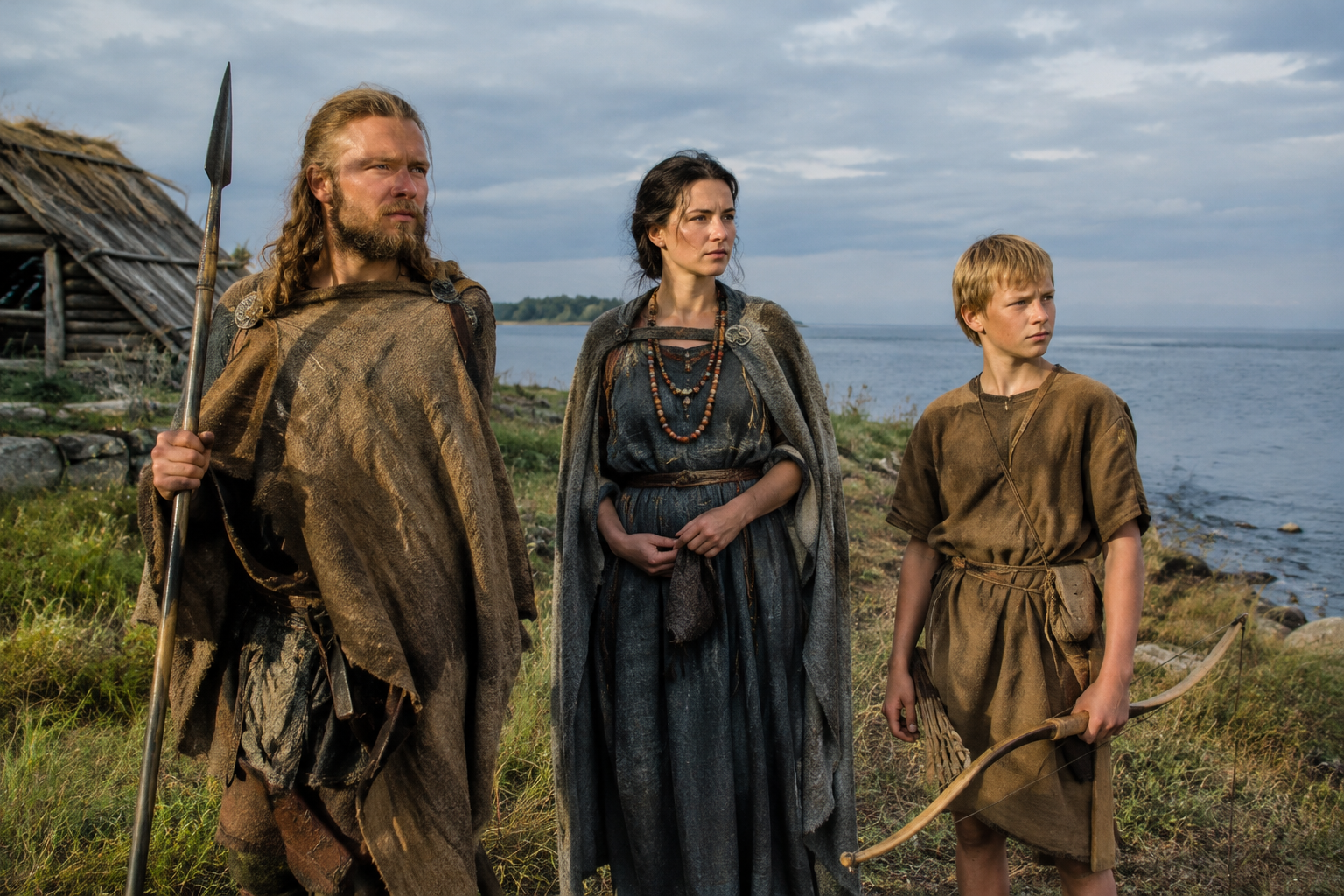
On the island of Oland, in the ringfort of Sandby borg, archaeologists uncovered one of the most unsettling snapshots of the Migration Period in Scandinavia: a community caught in catastrophe and left unburied. Among the individuals from this 5th-century massacre site is sample snb014, dated to about AD 475 and associated here with the Y-DNA haplogroup N1a1a1a1a1a1a1b. That very long label is a reminder that ancient DNA can sometimes follow one narrow paternal thread through very different worlds.
In this case, the thread is especially intriguing because it turns up not once but across a wide Baltic and eastern Scandinavian arc: Late Bronze Age Estonia, Migration Period Oland, and Vendel Age Saaremaa. Y-DNA traces one direct paternal line only, not a person's whole ancestry, but even that narrow line can be historically revealing when it appears in several places linked by sea, exchange, and mobility.
Sandby borg is not interesting because it offers a neat family story. Quite the opposite. Its importance lies in the violence of the site and in what that violence tells us about the fractured politics of the Baltic in the later 400s. The fort on Oland belongs to a period when Roman power in the west had collapsed and local elites around the Baltic were negotiating status, alliance, and conflict in a much more unstable landscape.
Sample snb014 places this haplogroup within that world. The point is not that one man "represents" Oland, still less all of Scandinavia, but that this paternal branch was present in an island society deeply tied to Baltic exchange networks. Oland was never isolated. It sat in the middle of maritime routes linking eastern Sweden with Gotland, the Baltic islands, and the eastern shorelands beyond.
A broad ancient DNA study of prehistoric Europe and nearby regions helped frame how much mobility and mixture lay behind such communities, even when their material culture looks locally grounded. For Sandby borg, the archaeological lesson and the genetic one fit together rather well: local histories were being shaped in a connected sea zone, not inside sealed ethnic boxes.
The oldest sample in this small cluster is VII4, from Late Bronze Age Estonia, dated here to about 580 BC. That matters because it pushes the story of this paternal branch in the eastern Baltic well back before the Viking Age, before the Vendel period, and indeed before the written history of the region becomes at all usable.
Late Bronze Age Estonia was part of a northern world of coastal movement, exchange, and regional variation. We should be careful not to turn one Y-line into a named people, but the presence of N1a1a1a1a1a1a1b in this context is a useful signpost. It suggests that this paternal ancestry was already established somewhere in the eastern Baltic sphere centuries before we meet it again across the sea in Sweden.
That is precisely the sort of pattern archaeogenetics is good at recovering. Instead of beginning with later medieval identities and projecting them backward, it lets us see long-term continuities and relocations in a more measured way. A branch that later becomes associated in many studies with northern and northeastern Europe was already part of Baltic prehistory in the first millennium BC.
For a wider look at how these eastern Baltic and Finnic-zone histories develop in the early medieval period, this related article offers a useful parallel.
The third sample, VK550, comes from Salme II-D on Saaremaa, dated here to about AD 725, in the Vendel Age. Salme has become famous because the burials belong to a dramatic maritime setting in the eastern Baltic, one that has often been discussed in connection with warrior groups moving across the sea-lanes between Scandinavia and the islands of present-day Estonia.
Here again the value of the haplogroup is not that it solves the identity of every man at Salme. It does something subtler and, in its way, more interesting. It places the paternal branch N1a1a1a1a1a1a1b within the same connected Baltic world seen at Oland and in earlier Estonia, but now in a 8th-century context on the eve of the Viking Age.
A study focused on the Salme material brought this site to wide attention as one of the clearest pieces of evidence for high-mobility armed groups operating in the eastern Baltic before the classic Viking Age fully begins; see https://www.cell.com/current-biology/fulltext/S0960-9822(19)30424-5/. That does not mean every shared lineage marks a single expeditionary family, but it does underline the historical setting: these waters carried people, alliances, and conflict over considerable distances.
Salme is especially helpful because it stops us telling too tidy a national story. Estonia here is not merely a receiving shore, and Scandinavia is not a single unit pushing outward. The eastern Baltic was a zone of constant interaction, and this paternal line appears within that interaction over many centuries.
The exact article haplogroup is N1a1a1a1a1a1a1b, a very specific downstream branch. With ancient material, though, there is an important practical caution: the broader parent lineage may be clearer than the finest terminal resolution, and not every publication reports the same depth of assignment. So the safest historical reading is that these men belong within a paternal tradition associated with this narrow branch, rather than pretending every ancient call is equally precise.
Even with that caution, the pattern is striking. The branch appears in three settings that are not random dots on a map but parts of one maritime region: the eastern Baltic shore, the islands in between, and eastern Scandinavia. The dates, from roughly 580 BC to AD 725, suggest endurance through major cultural changes rather than a brief single migration event.
This fits a larger picture emerging from research on northern Eurasia and the Baltic-Finnic world, where paternal lineages linked to haplogroup N often appear in histories of movement, settlement, and language contact across forest and coastal zones. One preprint exploring those long northern connections is here: https://www.biorxiv.org/content/10.1101/703405v1. It is best used as background context, not as a shortcut to overconfident claims about any one individual in this article.
If there is one historical point worth holding onto, it is that the Baltic was not a border in the modern sense. For the people represented by VII4, snb014, and VK550, it was a corridor. Boats, trade, marriage, raiding, fosterage, and seasonal movement all made these coasts and islands part of a single busy zone.
That is why this haplogroup is more interesting here than it would be as an isolated laboratory label. It appears in a Bronze Age Estonian context, in a Swedish fort destroyed during the upheavals of the Migration Period, and in Vendel Age Saaremaa with its unmistakable martial and maritime implications. Those are very different settings, yet all belong to one long northeastern European conversation.
For someone who carries N1a1a1a1a1a1a1b today, the most defensible insight is not a claim to one tribe or one heroic people. It is something both humbler and more solid: this paternal line is documented in the Baltic world across more than a millennium, from Late Bronze Age Estonia to Migration Period Sweden and Vendel Age Saaremaa. In other words, it belongs to an old northern network of coasts and islands where ancestry, movement, and local history were intertwined for a very long time.






Comments