Haplogroup L3e1e
– 4 min read


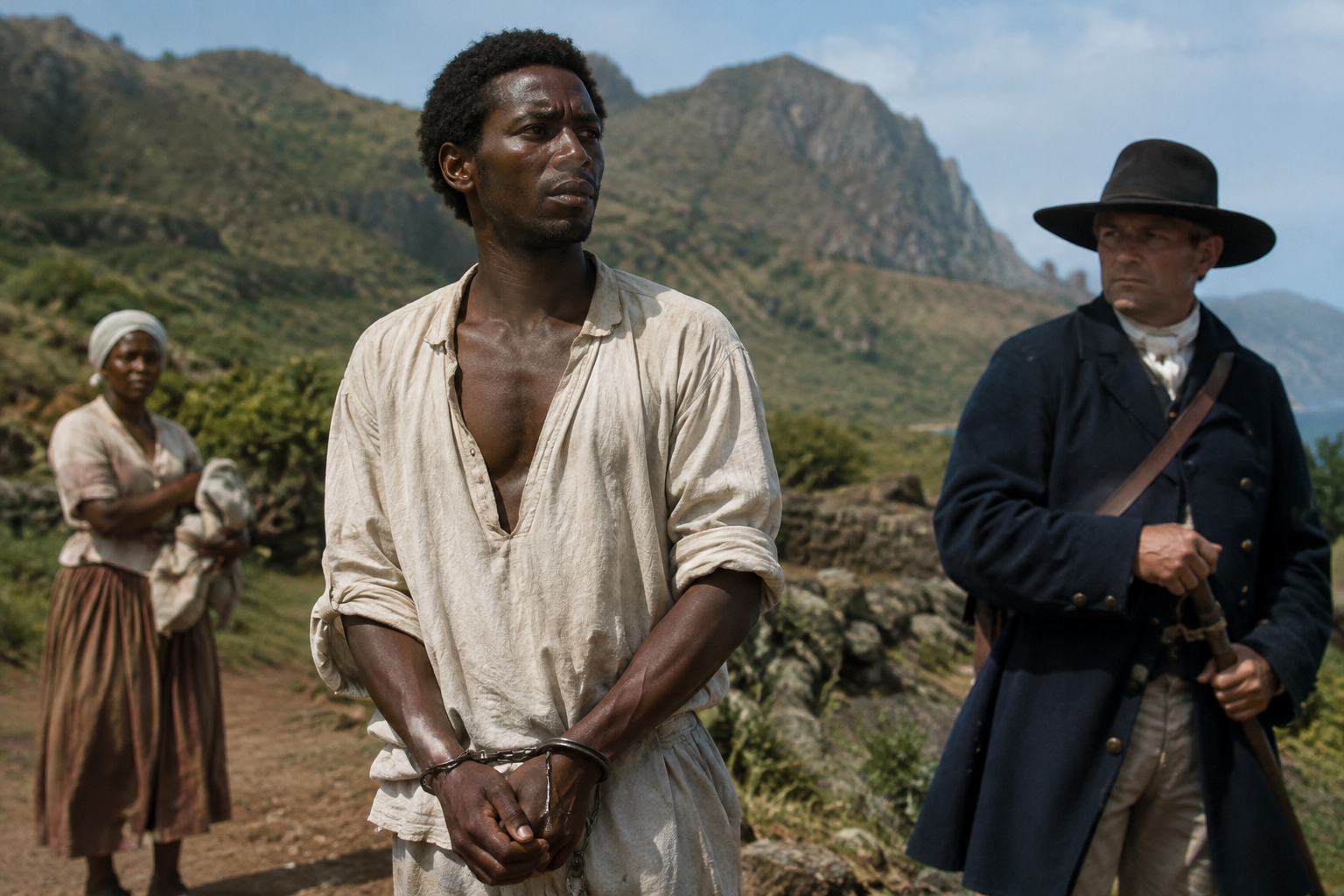
One of the clearest ancient anchors for haplogroup L3e1e is not a king in a stone tomb, nor a warrior beneath a barrow, but a man caught in the machinery of the 19th-century slave trade. The individual labeled STH_281, buried in Ruperts Valley on St. Helena and dated to 1848 AD, was one of the so-called liberated Africans removed from slave ships by the Royal Navy and brought to this remote South Atlantic island. His DNA matters because it places L3e1e in a documented historical tragedy where archaeology, archives, and genetics meet.
That immediately tells us something important about this article's lineage. L3e1e is a mitochondrial haplogroup, tracing a direct maternal line rather than a Y-chromosome paternal one. In other words, it follows mothers, daughters, and their daughters across time. That distinction matters, especially here, because the St. Helena burials have become one of the most powerful case studies for recovering lost African origins from people whose names, homes, and family histories were violently stripped away.
Ruperts Valley on St. Helena is one of those sites where the archaeology is inseparable from imperial history. After Britain outlawed the transatlantic slave trade, the Royal Navy intercepted slave ships at sea. Thousands of enslaved Africans, often in catastrophic physical condition, were landed on St. Helena in the 19th century. Many died soon after arrival and were buried there.
The individual STH_281 belongs to that setting. The date of 1848 places him in the last phase of the illegal Atlantic trade, when slaving had not disappeared but had instead become more furtive and brutal. In this context, the identification of L3e1e is not merely a genetic label. It is part of a larger attempt to reconnect people in the St. Helena burial ground to African population histories that written records obscured or erased.
A widely reported ancient DNA investigation into these St. Helena burials drew attention to the diverse African origins represented at the site, showing how genetics can recover broad regional affinities even when individual biographies remain fragmentary. A summary of that research can be found here: https://www.sciencedaily.com/releases/2023/09/230907130348.htm.
L3e1e sits within the broader African mitochondrial haplogroup L3, one of the major maternal branches in human population history. More specifically, L3e and its sub-branches are strongly associated with African maternal diversity, especially in western and west-central parts of the continent. That broader context fits well with what is known about the regions most heavily targeted by the later Atlantic slave trade.
But caution is essential. The presence of L3e1e in STH_281 does not, by itself, identify a precise ethnic group, language, or home village. Mitochondrial DNA tracks only one ancestral line out of many. A person with L3e1e could have had ancestors from several regions and communities, and the forced movements of the slave trade further complicate any neat one-to-one mapping between lineage and identity.
Still, maternal haplogroups can be especially revealing in African and African-diaspora archaeology because they illuminate lines of descent often neglected in older historical narratives. In a burial ground like Ruperts Valley, where family names and local affiliations are largely absent, even a single lineage assignment can help restore some structure to a shattered human record.
There is something unusually stark about St. Helena. Many ancient DNA studies deal with prehistory or with elite burials where the dead were memorialized. Here, by contrast, the dead were victims of an international trade whose logistics were meticulously documented, while the people themselves were made anonymous. Archaeology and genetics reverse that imbalance, at least in part.
For St. Helena, the scientific value lies in scale and context. This was not a random cemetery. It was created by a specific historical process: the interception of slave ships after abolition, the landing of survivors, and the burial of those who did not recover. That gives the genetic evidence unusual interpretive power. It lets researchers compare biological ancestry with shipping patterns, embarkation zones, and the changing geography of the illegal slave trade in the 19th century.
In that sense, L3e1e in STH_281 is valuable not because it is aristocratic or rarefied, but because it belongs to a precisely dated, historically legible population. The lineage becomes part of a much bigger question: how do we reconstruct African histories when the archive was built by traders, naval officers, and colonial administrators rather than by the people who endured the crossing?
One of the more sobering lessons of the St. Helena burials is that recent history can be harder to humanize than prehistory. A Bronze Age grave may preserve local customs, family clusters, and grave goods. The cemetery at Ruperts Valley instead reflects dislocation, disease, and administrative sorting. That makes lineages like L3e1e all the more poignant. They are among the few surviving signals that point back across the ocean.
For descendants and family historians, this does not produce a simple answer such as "your line came from one exact people." What it can do is situate a maternal line within the deep and varied genetic landscape of Africa, and in this case within a documented diaspora context created by the 19th-century slave trade. That is historically substantial. It connects personal ancestry to one of the most consequential forced migrations in the modern world.
The St. Helena evidence also reminds us that African genetic diversity was never peripheral to world history. It was central to the making of the Atlantic world, to plantation economies, to abolitionist policing, and to the long afterlives of enslavement in Africa, the Americas, and Europe.
If your result connects you with L3e1e, the most responsible historical reading is not to leap straight to a single modern nationality or ethnic label. Rather, it is to recognize that this branch belongs to a long African maternal history and, in the case of STH_281, appears in a burial context shaped by the final illegal phase of the Atlantic slave trade. That is a powerful piece of evidence, even if it remains broad rather than pinpoint.
What makes L3e1e distinctive here is precisely that combination of depth and immediacy. It is an African maternal lineage with roots far older than modern states, yet one of its best documented ancient matches comes from a cemetery tied to a grimly specific historical moment in 1848. That is often how archaeogenetics works at its best: not by promising fantasy pedigrees, but by restoring real human context to people history tried to flatten into cargo.
Comments