Haplogroup K2
– 6 min read


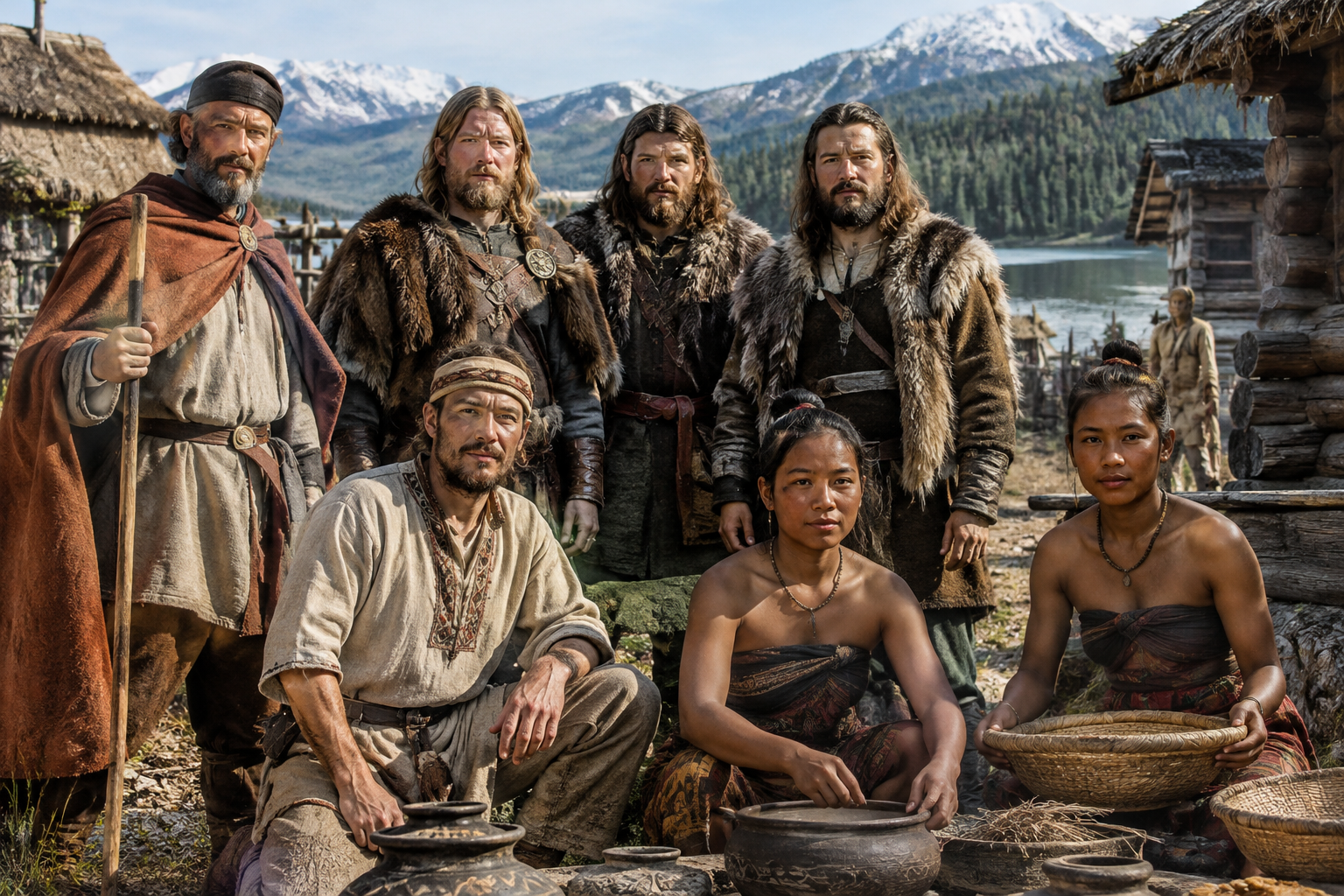
Haplogroup K2 is one of those Y-chromosome lineages that reminds us how deep paternal history can go. Not deep in the sense of a neatly documented family tree with coats of arms and obliging parish registers, but deep in the older, stranger sense: a paternal branch sitting high in the human Y-DNA tree, ancestral to many later lineages spread across Eurasia and beyond. In other words, K2 matters not because it points to one people, one kingdom, or one noble house, but because it sits near a major branching point in the story of human male ancestry.
That also makes K2 slightly awkward in the best possible way. It refuses to behave like a tidy ethnic label. Y-DNA haplogroups trace one direct paternal line only, father to father to father, and do not represent a person's whole ancestry. With a broad lineage such as K2, that caution matters even more. What ancient DNA can show us is not a single tribe on the march, but a set of paternal threads turning up in very different landscapes: Bronze Age mainland Southeast Asia, the forest-steppe zones around the Urals, and medieval Corsica in the Mediterranean.
In the phylogeny of the Y chromosome, K2 belongs to a very important stretch of the tree, because many later paternal branches ultimately descend from it. That does not mean every man with a later descendant lineage should be casually described as "K2" in any meaningful historical sense; it means that K2 marks an ancient branching structure from which much later diversity emerged.
For historians and archaeogeneticists, broad haplogroups like this are often most useful when they appear in securely dated ancient burials. They can help map where major paternal branches were present, and they can show that the same high-level lineage was distributed across widely separated regions long before medieval states, surnames, or castles existed. The pattern visible here suggests a lineage with a very wide prehistoric footprint, later surviving in very different local populations.
Explore East Asian Paternal History
Two of the most striking samples in this set come from Ban Chiang in Thailand: I8977 and I8970, both dated to 1500 BC. Ban Chiang is one of the great archaeological names in mainland Southeast Asia, associated with Bronze Age communities whose burials and material culture have long been central to debates about technological change, exchange, and local development in the region.
Finding K2 in Bronze Age Ban Chiang is historically interesting because it places this paternal lineage, or a branch classified at that level, within an early farming-metalworking society far from the European and West Eurasian settings many readers may instinctively expect from Y-DNA discussions. It is a useful corrective. Human paternal history was never confined to one civilizational corridor.
These Thai samples do not prove a single migration event all by themselves, and they certainly do not allow us to draw a straight line from prehistoric Thailand to later populations elsewhere. But they do show that K2-related paternal ancestry was present in Bronze Age Southeast Asia, embedded in real communities with their own local histories.
That wider Asian context makes related MyTrueAncestry reading especially worthwhile, particularly on the long development of eastern paternal lineages and their archaeological setting.
Discover Ancient DNA at the Ningxia Crossroads
If Ban Chiang gives us one horizon of K2, the Ural region gives us another. Several supplied samples cluster around the early medieval and late first-millennium world of the Trans-Ural and Cis-Ural zones: Uyelgi15, Uyelgi14, Uyelgi1, and Uyelgi3 from Uyelgi, Trans-Ural Russia, 900 AD, alongside Sukhoy4 from Late Nevolino Sukhoy Log, Cis-Ural Russia, 705 AD.
This is a fascinating region for ancient DNA because it sits between Europe and Asia without being merely a corridor between them. The Urals were home to communities with their own local traditions, while also participating in wider movements of goods, people, and perhaps languages. By the early medieval period, this was a zone entangled with steppe politics, forest networks, and the shifting worlds that later fed into the histories of Uralic-speaking peoples, Turkic expansions, and the movements associated with the early Hungarians.
The cluster at Uyelgi is especially evocative because multiple male individuals from the same broad place and time carry this paternal signal. That does not automatically mean they were close kin, nor does it prove a single dominant clan. But it does suggest that K2-classified paternal lines were not a one-off curiosity there. They were part of the lived population of the Trans-Ural world around 900 AD.
Readers interested in how this region intersects with larger questions of mobility and ethnogenesis may want to follow that trail further.
Read About the Southern Urals and Early Hungarians
Then the story takes an apparently sharp turn west and south. The sample individual_T31 from Medieval Corsica Borgo, 1030 AD places this broad paternal lineage in an island setting at the heart of Mediterranean history. Corsica in the 11th century was no isolated backwater. It sat amid the political pressure of Italian maritime powers, local lordship, ecclesiastical reform, and the afterlives of Roman and early medieval population change.
Now, one medieval Corsican sample does not mean K2 was a defining Corsican paternal lineage. It does mean that by the High Middle Ages, a branch classified within this haplogroup could be found in the western Mediterranean as well as in the Ural zone and much earlier in Southeast Asia. That geographical spread is the point. Broad Y-DNA lineages can persist across enormous distances and very different historical settings, not because one empire planted them everywhere, but because human history is old, mobile, and messy.
For readers drawn to island histories and Mediterranean paleogenomics, there is a natural comparison here with broader work on ancient Italian islands and their shifting populations across time.
Explore Ancient Italian Island DNA
In this case, the supplied noble family and castle field is effectively empty, which is itself worth saying plainly. There is no responsible way to invent a medieval dynasty, attach a romantic fortress to it, and declare it a "K2 house." Genetics is not improved by heraldic wishful thinking.
That absence, though, tells us something useful about method. Written genealogy and ancient DNA work on different scales. Noble families and castles belong to the historical surface of the past: charters, marriages, lordship, property, memory. Haplogroups such as K2 belong to the much deeper structure underneath. Sometimes the two can be linked, especially when named lineages are genetically tested. Sometimes they cannot. And when they cannot, the honest answer is not a weakness. It is the whole point of doing careful history.
So rather than forcing a castle into the story, it is better to notice how K2 appears in places that later did produce fortified landscapes and noble houses: the Mediterranean island world, the Ural frontier, and the wider Asian sphere of Bronze and early medieval societies. Ancient DNA provides the long background against which later named families eventually emerge.
K2 is historically compelling precisely because it is broad. It is not the badge of a single nation or elite bloodline. It is a reminder that paternal ancestry can reach back to very ancient branching events, and that those branches later turn up in communities separated by huge distances in both geography and time.
The samples here sketch that point beautifully: I8977 and I8970 in Bronze Age Thailand, Sukhoy4 in the Late Nevolino context of the Cis-Urals, the Uyelgi males in the Trans-Urals around 900 AD, and individual_T31 in medieval Corsica by 1030 AD. None of these individuals proves direct descent from another. None by itself defines an ethnicity. Together, though, they show how one paternal framework can persist through very different archaeological worlds.
That is where ancient DNA is at its most interesting. It does not replace history, and it does not magically identify your medieval surname. What it does is widen the frame. It lets us see that behind the chronicles, behind the frontiers, behind the noble houses that eventually dominate written records, there were older paternal lineages moving through the human past in ways no chronicler ever recorded.
If you want to explore whether your own DNA shows links to ancient individuals, populations, and deep paternal histories like these, MyTrueAncestry can help you compare your results with real archaeological samples. Those matches can offer remarkable historical context, even when they do not prove direct descent from a specific ancient person or later noble family.






Comments