Haplogroup K
– 5 min read


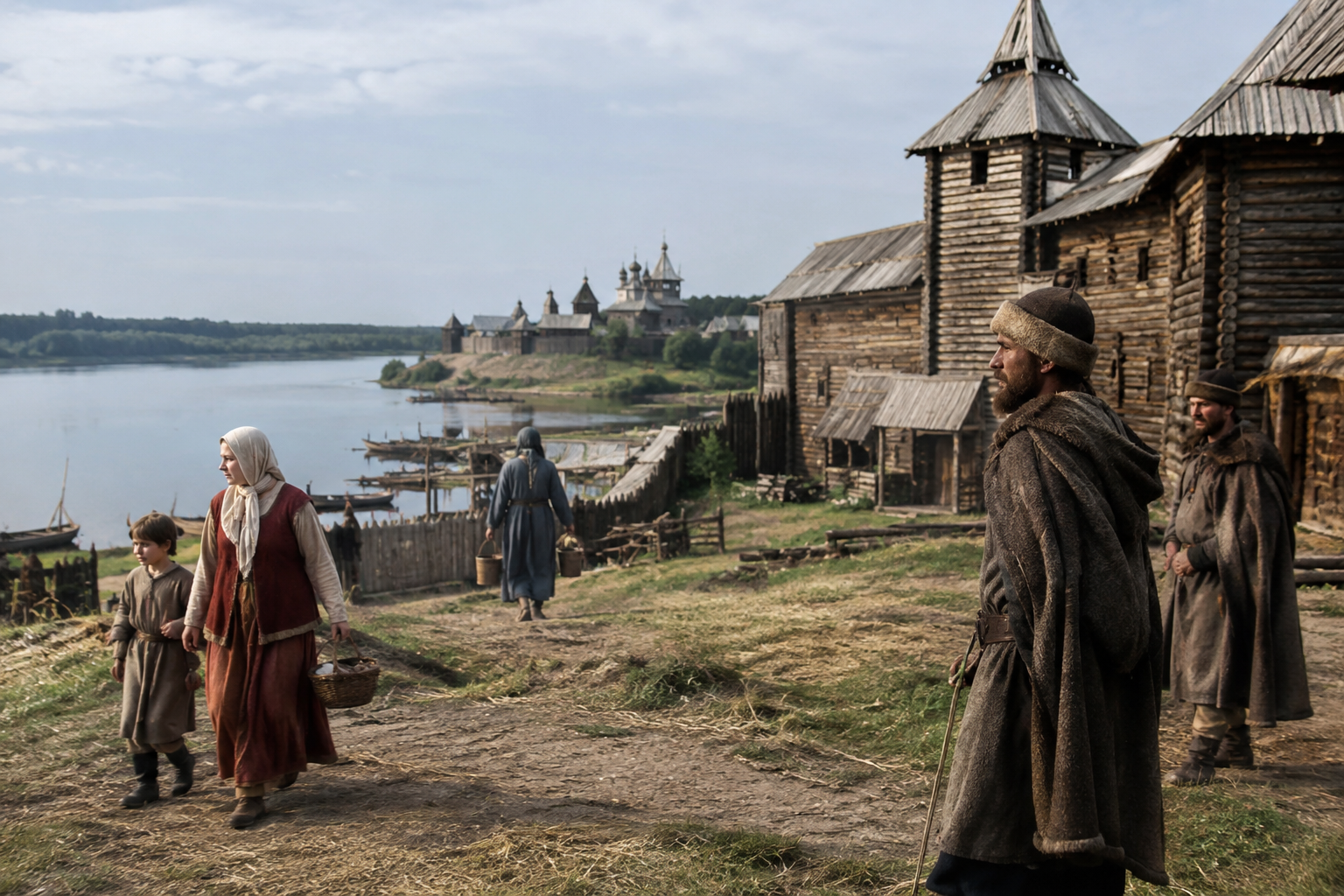
At Gorokhovets in medieval Russia, one man identified as GOS003 offers a small but intriguing glimpse into a very large paternal story. Dated to around AD 1200, he lived in a northern Rus' world of river routes, forest frontiers, princely towns, and long-distance contacts. His reported Y-DNA assignment connects him to haplogroup K, a lineage so deep in the human paternal tree that its historical interest lies less in one dynasty or one people than in the way its descendants branch across enormous stretches of Eurasia and beyond.
That is exactly what makes GOS003 interesting. When a medieval individual from Vladimir-Suzdal territory is placed under such a broad paternal umbrella, it reminds us that Y-DNA works on several scales at once: the intimate scale of one father-to-son line, and the vast scale of prehistoric branching tens of thousands of years old. In this case, the ancient individual is historically local, but the haplogroup itself belongs to one of the great trunk lineages of non-African paternal ancestry.
Haplogroup K is best understood as a major ancestral branch rather than a neatly bounded medieval ethnic marker. Many well-known later Y-lineages descend from it. So if a sample is reported simply as K, that does not mean we can jump straight to a specific recent population history. It means the available evidence places that man somewhere on a very old paternal branch whose descendants later spread widely through Asia, Oceania, Siberia, Europe, and the Americas through different downstream lines.
That matters because readers often meet a broad haplogroup label and understandably want a crisp historical answer. But broad labels are rather like saying someone lived somewhere in the Roman Empire without yet knowing whether it was York, Antioch, or Carthage. The category is real and important, but the precision is limited. For GOS003, the safe conclusion is that his direct paternal line was assigned to haplogroup K at a broad level, not that he can be made to stand for all medieval Russians or for every later branch descending from K.
Ancient DNA and Archaeogenetics
Gorokhovets lies in the wider historical zone shaped by the medieval Rus' principalities, a region where waterways mattered enormously. By around AD 1200, northeastern Rus' was not an isolated backwater but part of a connected world extending toward the Volga, the Baltic, the forest zone, and the steppe margins. People, goods, beliefs, and marriage networks all moved through this landscape.
That wider setting makes a broad lineage like K plausible without making it mysterious. Medieval Russian populations were products of long earlier processes: Eastern European hunter-gatherer ancestry, steppe-linked expansions, contacts with Uralic-speaking populations, Slavic expansions, and movements through the Volga trade zone. A single Y-chromosome result cannot disentangle all of that, but it can mark the survival of one paternal branch inside a socially and genetically mixed medieval population.
A genetic study of medieval burials from this region, including material associated with the Vladimir-Suzdal area, has helped place such individuals into a firmer archaeological and biological framework through ancient DNA research on medieval Russia. For our purposes, the crucial point is modest but valuable: GOS003 is not an abstract lineage label floating in space, but a real medieval person from a documented archaeological context.
There is a temptation, when confronted by a very ancient parent haplogroup, to imagine survival as something rare or exotic. In fact, that is not how paternal trees work. Old branches persist because they generate younger branches, and some ancient samples or low-resolution calls still sit high up on the tree when the evidence does not allow a more terminal assignment. So the presence of K in a medieval burial does not mean a man somehow carried an untouched relic of prehistory. It means his direct paternal line belongs within that old branching system.
In historical terms, that is a useful corrective. Medieval identity in Rus' was shaped by language, religion, lordship, settlement, and local political allegiance, not by haplogroup labels. A man buried near Gorokhovets around AD 1200 may have participated in the life of a Christian principality, spoken an East Slavic language, and moved in local kin networks, while his Y-chromosome still traced back into a paternal structure whose deepest roots lay far beyond the medieval horizon.
Paleogenetics of Medieval Rus'
If haplogroup K feels unusually broad, that is because it is. In the deeper human Y-chromosome tree, K sits upstream of numerous later branches that became important in very different regions. Some descendants of K are central to later histories in Siberia and the Americas; others to East, Southeast, and South Asia; others to Oceania; and still others to parts of Europe through downstream branches. That is why writing about K requires caution. One cannot simply lift the later fame of one descendant branch and paste it onto every sample labelled K.
Still, the breadth of the lineage is precisely what gives GOS003 his wider significance. A medieval burial in Russia becomes a reminder that Eurasian history was never tidy. Populations in the forest zone were not sealed units. Over millennia, paternal lines moved, divided, expanded, and sometimes dwindled, while languages and political worlds changed around them. One direct male line could be biologically ancient, historically local, and culturally medieval all at once.
This wider perspective sits well alongside other MyTrueAncestry discussions of eastern Europe and northern Eurasia, where ancient DNA has repeatedly shown that regions often imagined as stable and self-contained were anything but static.
It is easy to dismiss a lone medieval sample as too slight to say much. Yet isolated finds are often valuable precisely because they complicate the neat stories we tell. GOS003 shows that even within a well-known medieval setting, paternal diversity can appear in ways that do not fit popular expectations. Not every man in medieval Russia belonged to the same handful of lineages that dominate modern summaries of eastern European Y-DNA.
That does not make GOS003 an outlier in any dramatic sense, nor does it turn him into a representative of some lost people. Rather, he is a useful archaeological witness. He reminds us that the medieval north of the Rus' lands was populated by individuals whose paternal histories reached back through much older layers of Eurasian population history than any chronicle could record.
For readers interested in the broader northern setting, the medieval and early medieval genetic record across the Baltic and forest zones has become increasingly revealing.
For someone researching haplogroup K today, the most responsible lesson from GOS003 is not a romantic tale of one people or one migration. It is that your paternal line belongs to a very deep branch of the human story, and that even in a concrete medieval setting like Gorokhovets around AD 1200, that deep ancestry could still surface in the record only at a broad resolution. The reward of such a result is perspective: one medieval man in Russia can point not to a simple ethnic label, but to the immense time depth and geographical reach of human paternal history.






Comments