Haplogroup J2b2b1

– 4 min read


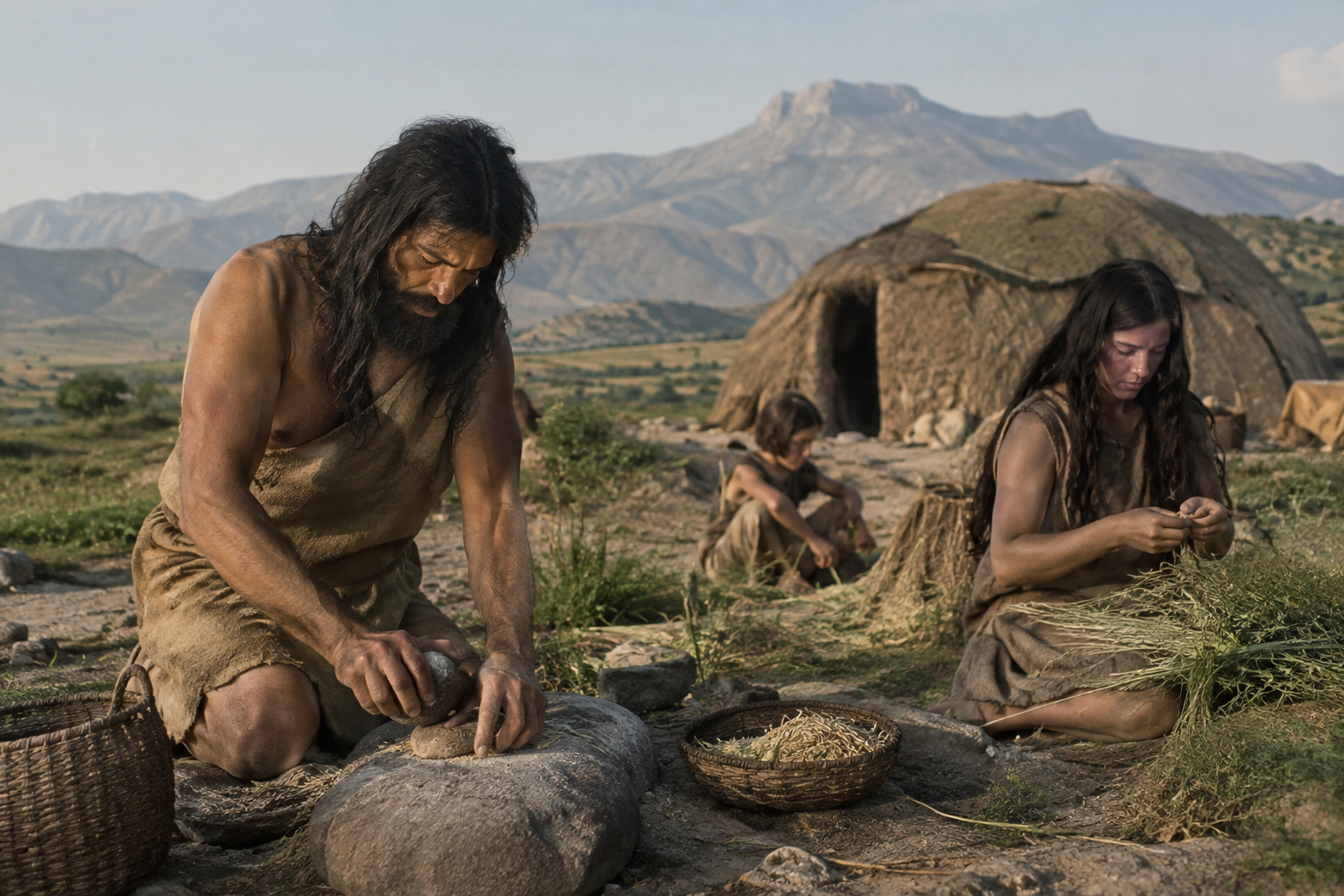
At Hajji Firuz in northwestern Iran, archaeologists uncovered one of the most revealing windows onto early village life in the Zagros foothills. Among the ancient people from this Neolithic settlement is individual I4241, dated to about 5950 BC and associated here with the Y-DNA haplogroup J2b2b1. That is an arresting place to begin, because Hajji Firuz is not some shadowy stop on the margins of prehistory. It sits in a region central to the story of early farming communities, household economies, and the long reshaping of western Eurasia.
For anyone exploring this paternal branch today, that matters. Y-DNA traces one direct male line only, not a person's whole ancestry, but it can still anchor that line in a very old and very specific human setting. In this case, the setting is Neolithic Iran: settled communities, cultivated landscapes, and the social worlds that developed after farming had taken root.
Hajji Firuz Tepe is best known as a village of the later Neolithic in the Lake Urmia region, a landscape that linked the Zagros, the Iranian plateau, and routes leading west toward Anatolia and Mesopotamia. By the sixth millennium BC, this was already an old agricultural world. People were not inventing farming from scratch here; they were living inside a mature village tradition, one with houses, storage, craft activity, and local histories built up over generations.
That makes I4241 especially useful. The individual is not simply "ancient Iranian" in a vague sense, but part of a settled Neolithic population in a region long recognised as important for the spread and development of food production. Research on ancient genomes from the broader Near East has helped clarify just how deep and regionally structured these early farming populations were, rather than reducing them to a single homogeneous source. One influential study of this wider transformation can be found here.
The haplogroup name here is very specific: J2b2b1. That is important, because broad labels can mislead. Haplogroup J2 as a whole has a long and complex history across western Asia, the eastern Mediterranean, and parts of Europe, but a narrower branch like J2b2b1 should not automatically be given the full geographic or historical biography of every other J2 lineage.
What the Hajji Firuz evidence does suggest is that this paternal line, or a closely connected ancestral branch, belonged to the male population of Neolithic communities in the Iranian world. That is a firm and useful point. It places the lineage in a landscape of early village societies, long before later empires, language expansions, and medieval identities changed the political map again and again.
In public discussions of ancestry, there is often a temptation to jump straight from a haplogroup label to a grand migration map. Archaeology is usually more stubborn than that. One early sample does not prove an unbroken march from one site to every later appearance of a branch. What it does provide is a documented ancient foothold, and for J2b2b1, Hajji Firuz offers precisely that.
It is worth pausing over geography. Northwestern Iran was never an isolated pocket. The Zagros and adjacent basins formed a zone of movement and exchange between the Mesopotamian lowlands, the South Caucasus, Anatolia, and the interior plateau. That does not mean every lineage found there radiated neatly in all directions, but it does mean that paternal lines present in these communities were situated in one of the great connective tissues of Old World prehistory.
By the sixth millennium BC, villages in this region were embedded in networks of contact involving materials, techniques, and probably marriage ties extending well beyond one valley. Ancient DNA has steadily reinforced what archaeology had long suspected: early western Eurasian populations were structured, local, and yet never wholly sealed off from one another. A lineage linked with Hajji Firuz therefore belongs to a human world that was both rooted and connected.
With only one named ancient individual in view here, the sensible question is obvious: how much can one sample really tell us? Quite a lot, if we are careful about the scale of the claim. I4241 does not stand for all Neolithic Iranians, and certainly not for all later bearers of J2b2b1. But he shows that this branch is at home in a very early agricultural context in Iran, and that is historically meaningful.
Ancient DNA works best when it pins a lineage to a real person in a real archaeological setting. Hajji Firuz provides that setting in unusually strong terms because the site has long been central to discussions of Neolithic lifeways. This is not a stray bone from an uncertain horizon. It belongs to one of the classic village landscapes of the ancient Near East.
That also changes the emotional texture of the haplogroup story. Instead of imagining paternal ancestry as a string of abstract letters and numbers, we can place one branch of it among mud-brick homes, cultivated fields, and the social routines of a community nearly eight thousand years ago. That is not romance; it is precisely what archaeology is for.
Modern men carrying J2b2b1 may live anywhere now, and their more recent family histories may run through entirely different societies. Over the millennia, paternal lines moved through trade, migration, warfare, marriage, and local population growth. Iran itself later became a meeting ground for Elamites, Mesopotamians, steppe-related groups, imperial networks, and Islamic-era population movements. None of that should be flattened into a single origin tale.
Still, the Hajji Firuz connection gives this branch an unusually early anchor in one of the formative regions of western Eurasian prehistory. If your paternal line belongs to J2b2b1, one defensible historical possibility is that part of its deeper story lies among the settled farming populations of the Iranian Neolithic, rather than only in the better documented classical or medieval worlds that tend to dominate popular history.
The most distinctive thing about J2b2b1 in this case is not a royal claim or a dramatic conquest narrative. It is something older and, in many ways, more interesting: a documented connection to the village world of Neolithic Iran through I4241 of Hajji Firuz, around 5950 BC. For family historians, that does not provide a named chain of descent, but it does place one paternal branch in a foundational human setting where farming, settlement, and long-term regional histories were already transforming everyday life.






Comments