Haplogroup J2b2a1a1a

– 5 min read


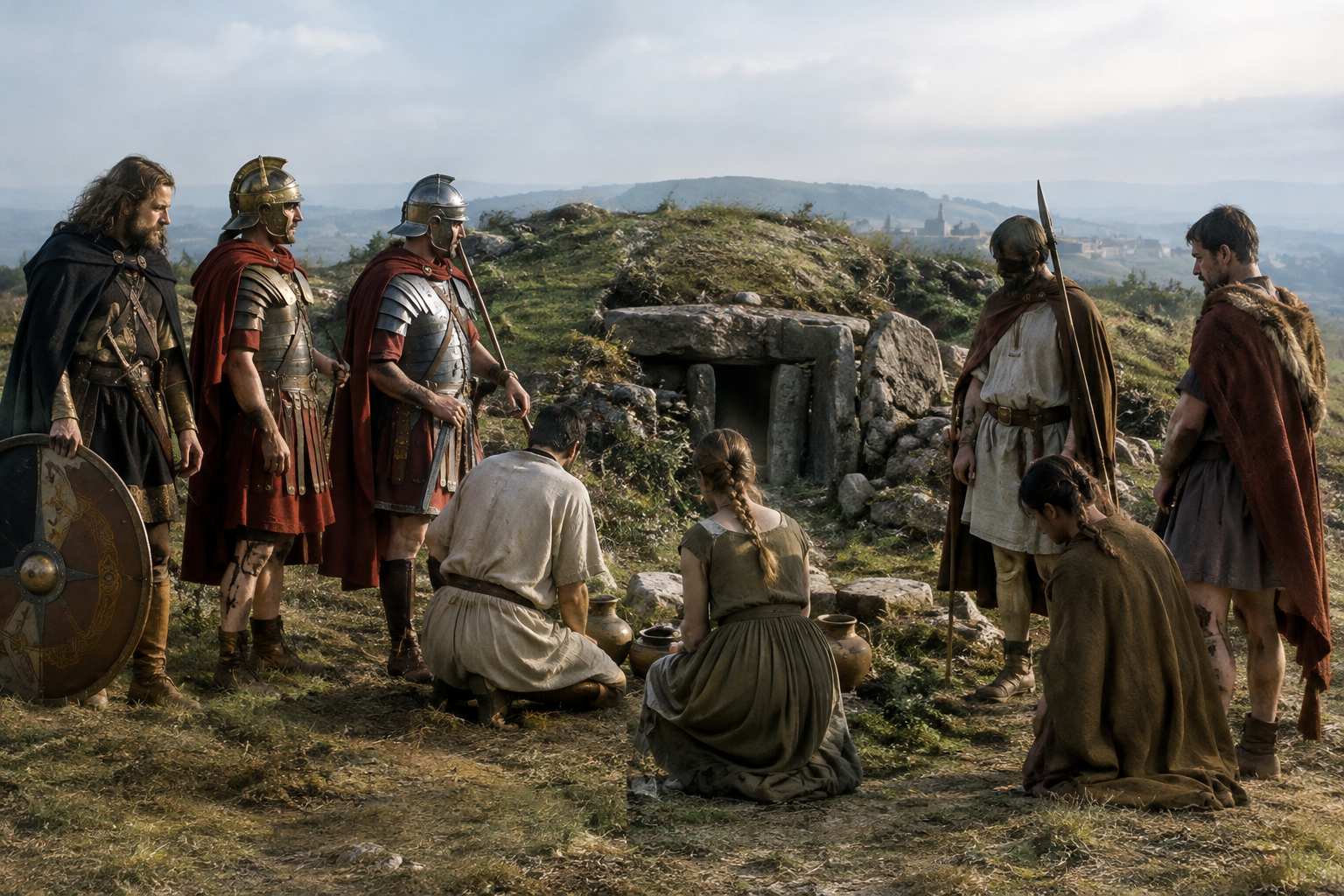
At Magdalenenberg near Villingen-Schwenningen in southwest Germany, one of the most famous Early Celtic burial landscapes in Europe has yielded an individual identified as MBG006, dated to around 530 BC. That matters here because this is one of the clearest early markers in the evidence trail for the Y-DNA haplogroup J2b2a1a1a in a high-status Iron Age context north of the Alps. Not a legend, not a dynastic pedigree, but an excavated person from a real cemetery whose paternal line can now be compared with men buried centuries earlier and centuries later across the Balkans and the Roman world.
The intriguing thing about J2b2a1a1a in this set of ancient samples is not that it belongs to one people only. Quite the opposite. The line appears in an Early Bronze Age burial in Serbia, in Iron Age Slovenia, in a major Celtic burial setting in Germany, and then again in Roman and early medieval contexts further south-east. Y-DNA follows one direct paternal line rather than a person's whole ancestry, but even that narrow thread can reveal something historically important: this branch moved through long-connected zones of Europe, especially the Danube-Balkan world and its links to Central Europe.
MBG006 comes from the Magdalenenberg tumulus complex, an elite burial landscape associated with the Early Iron Age in southwest Germany. Even without embellishing the grave, the context itself is enough to make the sample notable. This was not an obscure corner of Europe. It belonged to the broader cultural world often linked to Hallstatt-period power, exchange, and social ranking.
Finding J2b2a1a1a in that setting is a reminder that Iron Age Central Europe was never genetically sealed off. The Celtic archaeological horizon was a cultural formation, not a single biological tribe. A paternal line now classified as J2b2a1a1a appearing in an elite burial in Germany suggests that by the 6th century BC, this lineage had already become part of the male population participating in high-status communities far from the eastern Mediterranean, where broader J lineages are often discussed in older popular writing.
That older habit of treating any J-lineage as automatically "Mediterranean" or "Near Eastern" is too blunt to be useful. The narrower branch in this article is defined by its own history, and the ancient evidence here places it firmly inside European archaeological settings over a very long span.
The earliest sample in this group is MOK15 from the Mokrin Necropolis in Serbia, dated to around 1950 BC. Mokrin is an important Early Bronze Age cemetery, and its significance lies precisely in chronology: it shows that a paternal line associated here with J2b2a1a1a was present in the Balkans long before the Roman Empire and long before the historically documented Celts of Central Europe.
That does not mean every later bearer descends from MOK15 in any direct genealogical sense we could reconstruct. Archaeology is not a family tree in that simple way. But it does mean the Balkans are not a late or incidental backdrop for this branch. They are part of its securely documented ancient landscape.
A major ancient DNA study of southeastern Europe and neighboring regions helped establish just how complex these long population histories were, with repeated layers of continuity and mixture rather than a single replacement event. For readers interested in the broader genetic background against which lineages like this moved, see this ancient DNA research on the region.
Another valuable marker is I5691 from Kapiteljska njive in Slovenia, dated to around 665 BC. This is a useful sample because it sits geographically between the Balkans and the Alpine-Central European zone. In historical terms, that middle Danube and eastern Alpine corridor was not peripheral at all. It was one of the great connective belts of later prehistory and early history.
Placed alongside MOK15 and MBG006, the Slovenian evidence suggests that J2b2a1a1a was part of populations living along the routes that linked the Balkans, the eastern Alps, and the emerging Iron Age societies farther west. This does not give us a neat arrow on a map, and it should not. What it gives us is something better: a pattern of presence in real communities across several centuries.
That kind of pattern matters because archaeologists have long known that goods, styles, and people moved through these zones in ways that written history barely captures. Ancient DNA now lets us see that some paternal lines did as well.
Iron Age mobility in Celtic Europe
The Roman-period samples are especially revealing because they show J2b2a1a1a not in one isolated grave, but in a chain of imperial provinces. Two individuals, BBC008 and BBC012, come from Karlovac in Roman Pannonia Savia in Croatia and are dated to around AD 275. Another, I15546, comes from Timacum-Minus-Slog in the Zaje ar District, Knja evac Ravna, Serbia, dated to around AD 395.
That is an important spread. Pannonia and Moesia were not sleepy backwaters. They were militarized, connected, taxable, and thoroughly entangled with imperial movement. Men serving in the army, attached to logistics, born locally, or drawn from nearby regions could all end up in these landscapes. A Y-line appearing in both Croatia and Serbia during the imperial period fits what we know of the Roman Balkans: they were crossroads, but they were also places of durable local continuity.
We should resist the temptation to label these men too narrowly as "Roman" in an ethnic sense. Roman is first of all a political and imperial framework. A man buried in Roman Pannonia might be local, migrant, soldier, civilian, or descended from families long rooted in the region. What the evidence does show is that J2b2a1a1a was present inside provincial Roman society along the Danube-connected world.
This is where the haplogroup becomes historically vivid. Not because it proves a famous name, but because it sits exactly where the archaeology says people were mixing, moving, and serving empire while still carrying older regional lineages forward.
The sequence does not stop with the empire. Sample VEM015 from Velim-Velistak in Croatia, dated to around AD 750, places the same haplogroup in the early medieval Adriatic hinterland. That is useful because the centuries after Rome are often presented as if whole populations simply appeared and vanished under new names. Ancient DNA usually tells a more interesting story.
In this case, J2b2a1a1a persists into the early medieval western Balkans, suggesting that at least some paternal lines bridged the change from imperial administration to post-Roman societies. That does not mean uninterrupted identity in a cultural sense. Languages, loyalties, and burial customs can change dramatically while paternal lines continue. But it does underline a stubborn fact of European history: political rupture is not the same thing as population erasure.
Research on ancient Croatia has been particularly helpful in showing long-term maternal continuity alongside shifts and variety in paternal lineages. For a related discussion of the region's deeper genetic history, see this article on ancient DNA from Croatia.
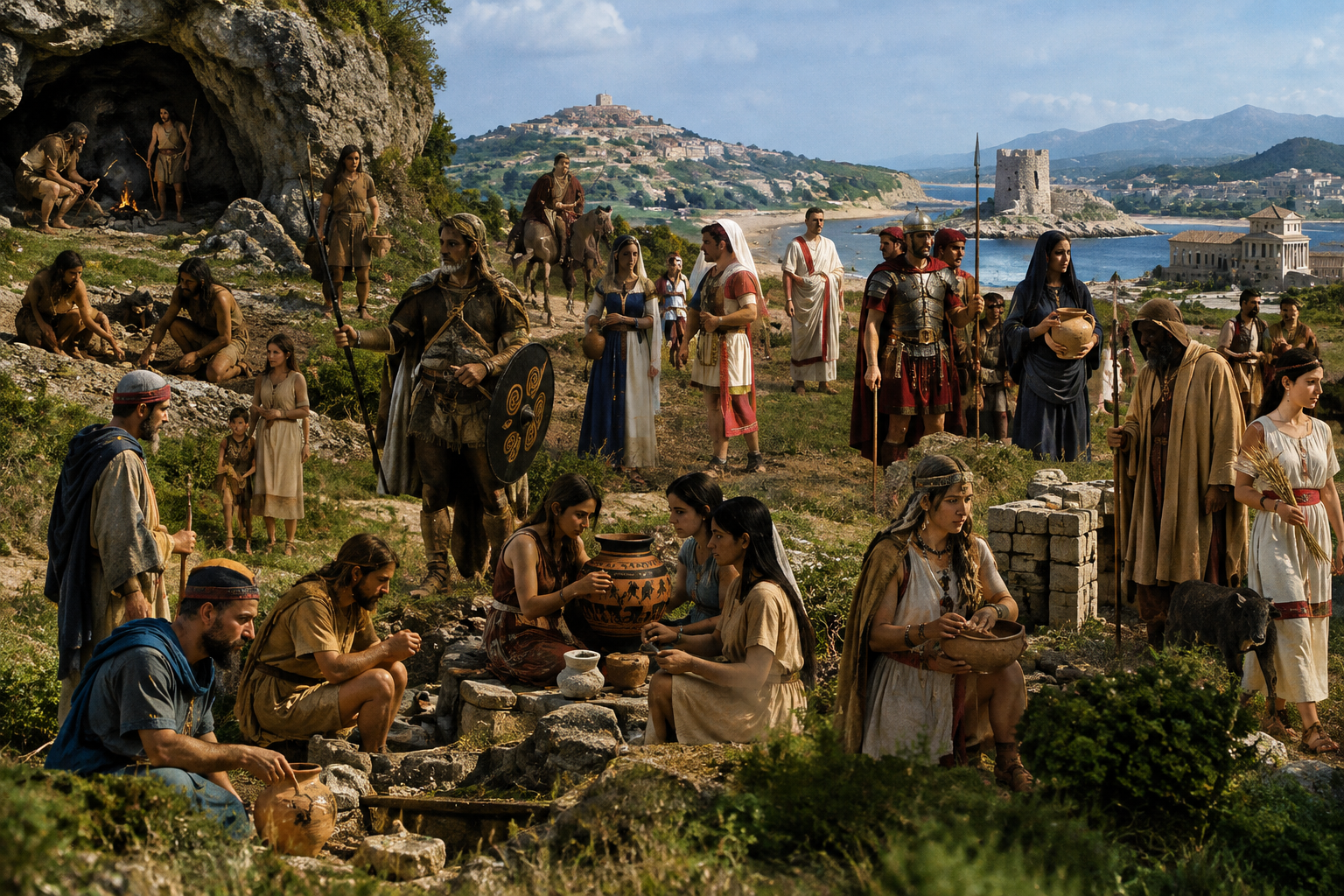
If there is one distinctive lesson in this evidence, it is that J2b2a1a1a is not appearing here as the badge of one short-lived tribe or a single imperial migration. Instead, it turns up in an Early Bronze Age Serbian cemetery, an Iron Age site in Slovenia, an elite Celtic burial context in Germany, Roman provincial burials in Croatia and Serbia, and an early medieval Croatian site. That is a long, grounded record across the connected worlds of the Balkans, the Danube corridor, and Central Europe.
For someone researching this paternal haplogroup today, that makes the branch historically rich even if it is not easily reduced to one identity label. Its ancient carriers belonged to different archaeological and political worlds, yet the line itself remained present through them. That is often how real history looks: less like a tidy origin myth, more like continuity carried through changing societies.
Comments