Haplogroup J2b2a
– 6 min read


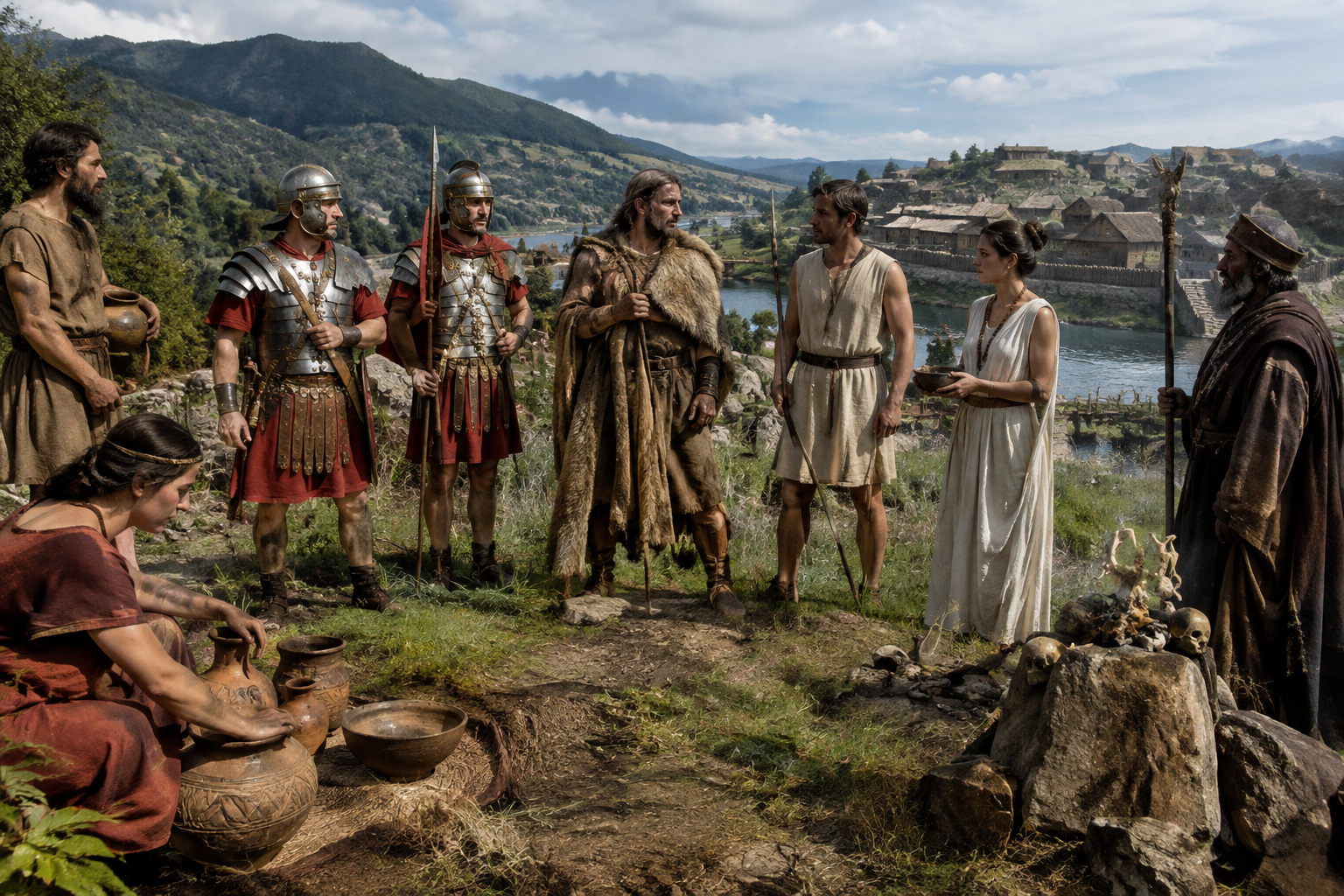
Haplogroup J2b2a is one of those paternal lineages that invites us to think less in terms of neat ethnic boxes and more in terms of movement: men crossing mountain corridors, serving in imperial frontiers, settling coastal towns, and appearing in burials scattered from the South Caucasus to the Balkans, southern Italy, and beyond. That is what makes it so interesting historically. Its story is not a single march of a people, but a series of appearances in places where trade, warfare, herding, and local continuity all met.
As a Y-DNA lineage, J2b2a traces a direct paternal line only: father to father to father. It does not describe a person's full ancestry, culture, language, or identity. Still, when ancient DNA places this lineage in real archaeological settings, it gives us something wonderfully concrete. We are no longer talking about an abstract branch on a phylogenetic tree. We are looking at actual men buried in Bronze Age caves, Iron Age communities, Roman provinces, and even an early medieval outlier linked to the Alans.
J2b2a belongs within the broader Y-chromosome haplogroup J family, a major lineage with deep roots in western Eurasia. For J2b2a specifically, the ancient DNA evidence supplied here points above all to a historical geography stretching across the South Caucasus, the Balkans, and the Adriatic-Mediterranean world. That does not prove a single homeland for every branch or a simple one-way expansion. But it does suggest that this paternal line was at home in some of the great contact zones of Old World history.
One especially striking early appearance comes from the South Caucasus: XXX001_A19279, from Early Bronze Age Georgia Kura-Araxes Balitshi-Dzedzvebi, dated to 3000 BC. The Kura-Araxes horizon matters because it connected uplands, valleys, and wide exchange networks across the Caucasus and neighboring regions. A J2b2a-associated sample in that setting reminds us that the lineage was present very early in a region long known as a crossroads rather than a cul-de-sac.
From there, the later finds do not show a straight line so much as a broad arc: west into the Balkans, south along the Adriatic and Ionian worlds, and into peninsular Italy. That pattern fits what archaeologists already know of Bronze and Iron Age mobility in these regions: not mass replacement every century, but repeated contacts, local persistence, and small-scale movements layered over long periods.
Explore South Caucasus DNA History
The archaeological spread of the supplied samples is what gives J2b2a its particular texture. In Croatia, I18088 from Pre Illyrian Bronze Age Croatia Bezdanjaca Cave, dated to 1000 BC, places the lineage in a cave-burial setting in the eastern Adriatic world. Caves are never just holes in the ground in prehistory; they can be storerooms, ritual places, refuges, and places of the dead. A paternal lineage found there hints at communities rooted in the landscape long before the Roman map of provinces was drawn.
Then there is I17633 from Iron Age Albania Cinamak Kukes District, dated to 550 BC. This is a particularly useful marker for the western Balkans. Albania and its neighboring uplands were never isolated from the wider Mediterranean, but neither were they simply passive recipients of outside influence. A J2b2a line in Iron Age Albania helps anchor the haplogroup in a region where mountain routes, tribal politics, and coastal exchange all mattered.
Southern Italy adds another layer. Two men from Daunian Salapia Apulian Foggia Italy, SAL001 and SAL010, both dated to 500 BC, show the lineage in a Daunian context. The Daunians occupied a landscape of Adriatic connections, indigenous Italic traditions, and contact with Greeks across the sea. One should not turn a Y-haplogroup into an ethnic label, of course. But these Apulian samples show J2b2a present in exactly the kind of connected coastal zone where paternal lines could endure while cultures changed around them.
By the Roman period the picture becomes even more revealing. Two samples, BBC032 and BBC029, from Imperial Roman Croatia Karlovac Pannonia Savia, dated to 275 AD, place the lineage in a provincial Roman setting. This is classic Roman history in miniature. The empire did not just move legions; it moved families, merchants, administrators, laborers, and camp followers. A Y-lineage appearing in Roman Pannonia might represent local continuity, inward mobility, or some combination of the two. Ancient DNA cannot by itself tell us which biography is correct, but it can show us that the imperial frontier was populated by men whose paternal origins linked into wider southeastern European and eastern Mediterranean patterns.
Discover Croatia's Ancient Lineages
The most geographically surprising sample in the set is I3351, described as Skeleton Lake Alan Outlier Worshipper, dated to 830 AD. The Alans are a reminder that steppe-connected peoples were never sealed off from the worlds to their south. By the early medieval period, networks of movement stretched from the Caucasus into Central and South Asia. A J2b2a-associated Alan outlier does not mean the lineage was somehow "Alan" in essence; rather, it shows how paternal lines can travel through confederations, alliances, military service, and migration far beyond the places where we first spot them archaeologically.
That wider context matters. J2b2a is not a label for one civilization. It appears instead in regions that repeatedly served as hinges between worlds: Caucasus and steppe, Adriatic and Balkans, Italy and the eastern Mediterranean, Rome and its provinces. That is why its history can look scattered if one expects tidy boundaries, and perfectly logical if one thinks in terms of corridors, ports, uplands, and empires.
Ordinarily, this is where one might move from ancient burials to medieval noble houses and their castles. But in this case, the supplied field for associated noble families and castles is blank. That absence is worth saying plainly rather than papering over with invention. We do not have article-specific evidence here linking J2b2a to a named dynasty, clan, or ancestral stronghold, and it would be irresponsible to manufacture one.
Still, the gap itself makes an important historical point. Written genealogy and genetic history are not the same thing. Medieval noble pedigrees preserve names, marriages, properties, and claims to status. Ancient DNA preserves biological fragments from people who usually left no written records at all. Most paternal lines never belonged to kings or barons; they belonged to ordinary men, some of whose descendants may later have entered every level of society, including the aristocracy. But without direct evidence, a shared broad haplogroup is only context, not proof of descent.
So if a later noble family from the Balkans, southern Italy, or the Caucasus were ever found to carry a downstream branch related to J2b2a, the proper comparison would be geographical and historical first, genealogical only if the evidence became very specific indeed. The castles and chronicles of later centuries preserve regional memory. Ancient DNA shows that the male lines in those same regions often run much deeper than the surviving documents.
Learn How Archaeogenetics Works
What J2b2a reveals, above all, is continuity with complication. It appears early in the South Caucasus, turns up in Bronze and Iron Age Balkan contexts, is present among Iron Age Daunians in Apulia, appears again in Roman Croatia, and later surfaces in an Alan-associated context at Skeleton Lake. That is not the history of a frozen people. It is the history of paternal lines persisting through changing archaeological cultures and political worlds.
For anyone carrying J2b2a today, ancient DNA offers a remarkable kind of perspective. Your direct paternal line may connect, broadly speaking, to the same macro-regions where these ancient men lived: Caucasian uplands, Balkan interiors, Adriatic zones, Roman provinces, or steppe-linked frontiers. But the honest phrase is broadly speaking. None of these individuals can be claimed as a proved direct ancestor simply because they share a haplogroup. The value lies in context: the places, periods, and populations in which your paternal line has been found.
That is one of the great pleasures of archaeogenetics. It does not flatten the past into modern identity slogans. It restores complexity. A single Y-line can belong, over time, to a man in a Kura-Araxes world, a cave-burial community in Croatia, an Iron Age Albanian setting, a Daunian town in Apulia, a Roman provincial cemetery, and an Alan outlier centuries later.
If you want to explore whether your own DNA shows links to ancient populations like these, MyTrueAncestry can help you compare your results with archaeological samples and historical datasets from across the ancient world. Those matches can open fascinating windows onto your ancestry, even when they do not prove direct descent from any one ancient individual or later family.






Comments