Haplogroup J2a2a1a1a2

– 5 min read


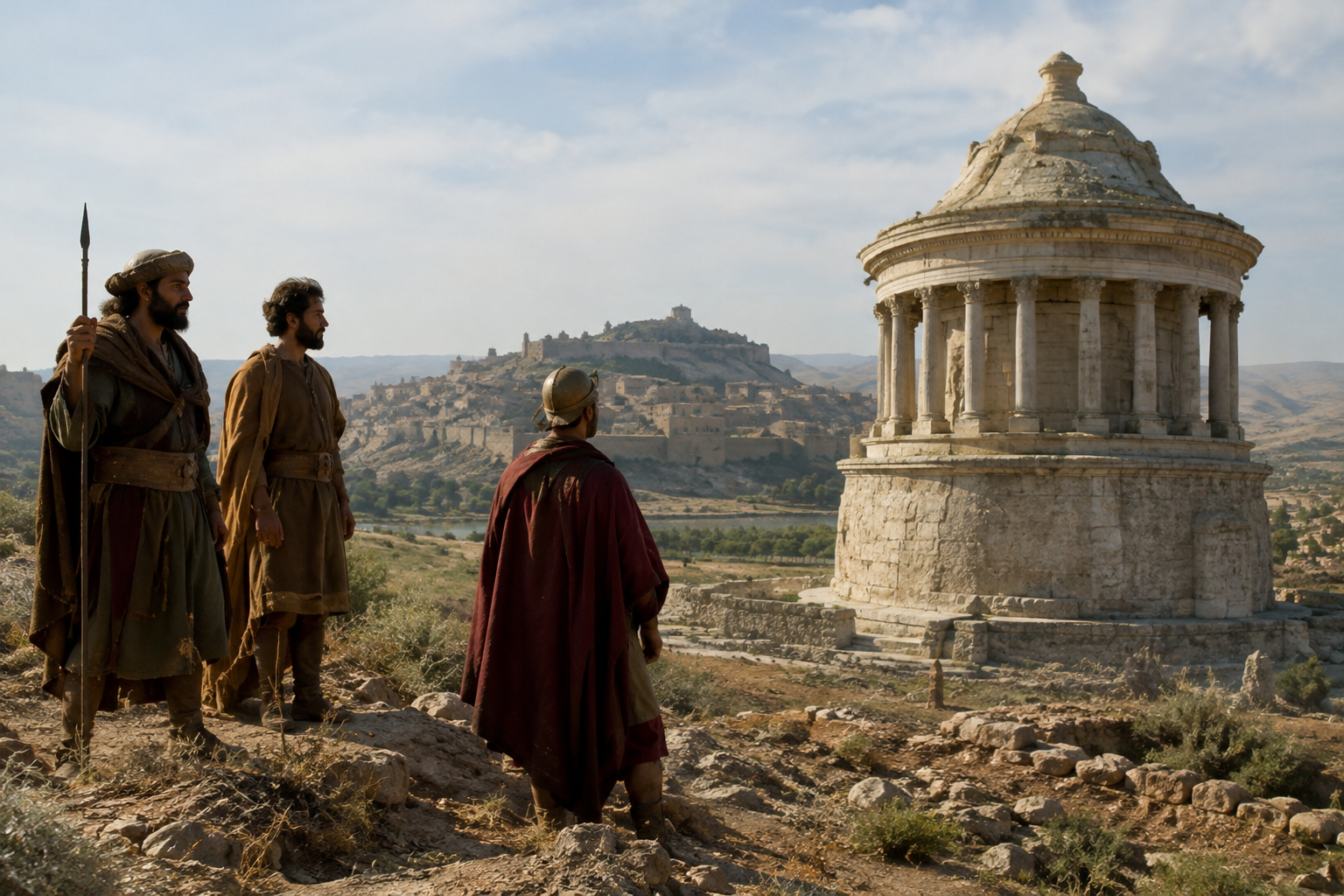
At Epila, at Las Lomas del Molino near Zaragoza, one man dated to around AD 574 stands out for anyone tracing the Y-DNA haplogroup J2a2a1a1a2. He appears in the record as sample I30931, from post-Roman medieval Spain: a period when Iberia was no longer Roman in government, but still full of Roman habits, older local traditions, and new movements of people. That is exactly the sort of setting where a paternal line like this becomes historically interesting.
The fascination here is not that one grave "proves" a grand migration on its own. It is that this lineage also appears in much earlier and quite different settings: in Iron Age Iran at Hasanlu, where sample I6428 is dated to about 1250 BC, and in a later Roman context at the Mausoleo Augusto in Rome, where sample R34 is dated around AD 500. Put those points together and J2a2a1a1a2 begins to look less like a local curiosity and more like part of a long eastern Mediterranean and western Asian story that eventually became woven into the Roman and post-Roman worlds.
Y-DNA follows one direct paternal line: father to son, and so on. That makes haplogroups powerful for tracking the history of a male lineage, but not for reducing a whole person, let alone a whole people, to a single label. In this case, J2a2a1a1a2 is a narrow branch within the wider J2 world, a lineage family long associated in broad terms with parts of the Near East and Mediterranean. The narrower subclade, though, must be treated more carefully than the parent branch.
What the ancient evidence shows is not a neat arrow on a map but a series of appearances in important historical zones: the Iranian plateau and its fringes, imperial Rome, and post-Roman Iberia. That pattern suits what archaeology already tells us about long-distance connectivity: trade, soldiering, settlement, imperial administration, and local continuity often mattered more than dramatic one-off invasions.
The earliest of the three samples is I6428 from Hasanlu, dated to roughly 1250 BC. Hasanlu is one of those sites archaeologists return to again and again because it sits in a zone of contact: northwestern Iran, near routes that linked the Iranian plateau, the Caucasus, Mesopotamia, and eastern Anatolia. A paternal lineage turning up here is not accidental background noise. It belongs in a landscape where populations mixed, states rose and fell, and connections ran in several directions at once.
For J2a2a1a1a2, Hasanlu matters because it anchors the branch in an ancient West Asian context long before Roman expansion. It does not mean every later carrier came from Hasanlu, or from one single Bronze or Iron Age source population. But it does place this paternal line in a region that repeatedly fed people, ideas, and connections westward across the Near East and Mediterranean.
A major ancient DNA study of populations from this broader part of the world, published in Science, helped establish just how deep and complex those ancient connections were. The value of a sample like I6428 lies in showing that a lineage later seen in Roman and medieval Europe already had roots in a much older Iranian-world setting.
The second anchor point is R34, dated around AD 500 from the Hellenic Roman Mausoleo Augusto. Even the location carries weight. The Mausoleum of Augustus is one of the great symbolic sites of Roman power, built for the first emperor and later entangled in the long afterlife of the city. By around AD 500, Rome was no longer the capital of a united empire, yet it remained a magnet for people of varied origins.
This is where a branch like J2a2a1a1a2 becomes especially telling. In a Roman setting, the appearance of a paternal line with deep eastern Mediterranean or West Asian associations should not surprise us. The empire moved people constantly: merchants, officials, enslaved people, soldiers, craftsmen, pilgrims, and families whose ancestors may have arrived generations earlier. Rome was not simply "Italian" in a narrow biological sense; it was a city made and remade by mobility.
That does not mean R34 was a migrant newly arrived from the East, still less that one Y-line tells us his language or legal status. But it does fit a broader pattern increasingly visible in archaeogenetics: the later Roman world contained lineages drawn from a very wide imperial catchment. For a reader with J2a2a1a1a2, this Roman example suggests a branch that was at home in the cosmopolitan circuits of late antiquity.
The most immediately arresting sample for many readers will be I30931 from Las Lomas del Molino at Epila, near Zaragoza, dated to about AD 574. This is the age of post-Roman kingdoms in Iberia, often described politically as Visigothic Spain, though daily life on the ground was more mixed and more local than such labels imply. Roman cities survived, Christian institutions expanded, and older Iberian and Mediterranean populations continued within new political frameworks.
So what does J2a2a1a1a2 mean in this setting? Most of all, it is a reminder that post-Roman Iberia did not emerge from a population vacuum. Men carrying lineages with deeper eastern Mediterranean or West Asian histories could be present in Spain for many reasons: movement during the Roman imperial centuries, earlier Mediterranean settlement, military service, trade, or family histories already local by the sixth century.
Research on Iberian ancient DNA has increasingly emphasized precisely this complexity. A large genetic study of ancient Europe and the Mediterranean, published in Science, has helped show how Roman and post-Roman populations often preserved a layered ancestry rather than a single abrupt replacement. In that light, I30931 is historically useful because he sits at the western end of a wider world, carrying a paternal signature that makes sense in a connected Mediterranean rather than an isolated peninsula.
Any one of these men could be dismissed as an isolated case. Together, they are harder to ignore. I6428 at Hasanlu places the lineage in an ancient Iranian-world context; R34 places it in the urban heart of the late Roman Mediterranean; I30931 shows it present in post-Roman Iberia. The arc is not a family tree, but it is a historical pattern.
And it is a pattern very much in keeping with what archaeology has taught us for years. Empires do not merely conquer territory; they create corridors. Roads, ports, military networks, tax systems, markets, and religious institutions all help lineages travel, settle, and become ordinary far from their earlier centers. By the sixth century in Spain, a paternal line that may once have seemed eastern was no longer necessarily foreign at all.
This is also why simplistic ethnic readings fail. A J2a2a1a1a2 lineage in medieval Spain does not make someone "Iranian," just as its presence at Rome does not automatically make someone a recent immigrant. What it does reveal is continuity of connection across regions that historians too often treat separately: Iran, the Mediterranean core, and the far Roman West.
Diverse Origins in Medieval Spain
For someone researching J2a2a1a1a2, the strongest responsible conclusion is this: the branch fits comfortably within the long history of movement linking West Asia, the central Mediterranean, and Iberia. The ancient men we can point to are not legendary founders or dynasts, but something in a way more valuable: real individuals from real archaeological settings, showing that this paternal line was present in major zones of contact over many centuries. If your own Y-line falls here, the best historical image is not a single march from one homeland, but a deep involvement in the old, busy world between Iran, Rome, and the western Mediterranean.






Comments