Haplogroup J2a2a1

– 5 min read


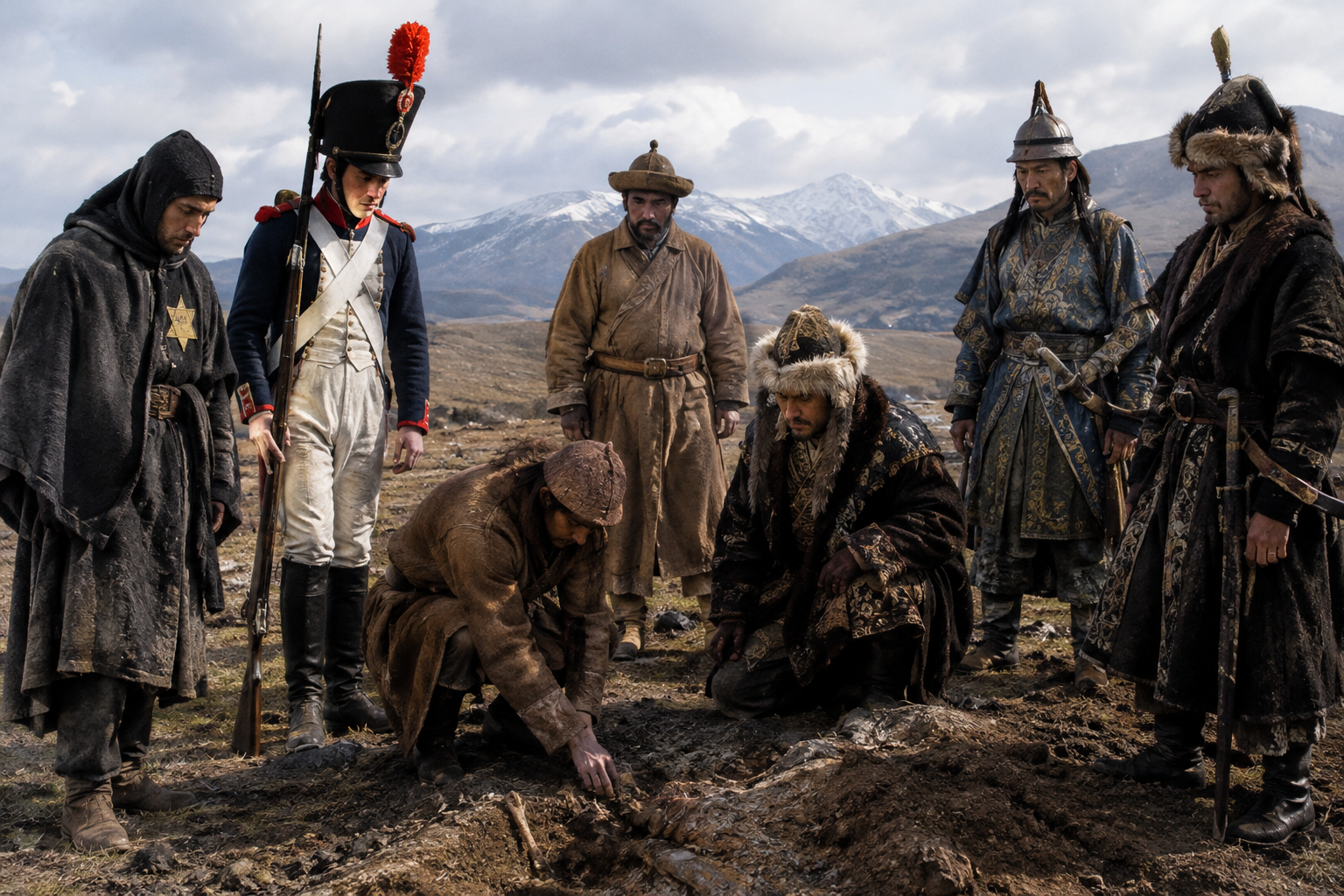
In 1348, in the Catalan town of Tàrrega, violence against the local Jewish community left a burial record that is as sobering as it is historically important. Among the victims from Les Roquetes was an individual identified as ROQ1, one of the ancient men associated here with Y-DNA haplogroup J2a2a1. That matters because it places this paternal line not in an abstract map of "origins," but in a documented medieval community caught in one of the darkest moments of Iberian history.
For anyone exploring J2a2a1 today, that is a useful starting point. Y-DNA traces one direct paternal line only, not a person's whole ancestry, yet even that single line can illuminate remarkable settings: a Jewish burial ground in plague-year Catalonia, a Late Roman cemetery in eastern France, and several individuals from Mongolia across the Xiongnu, Turkic, and Khitan worlds. The result is not one simple migration tale, but a lineage seen moving through very different historical societies.
The Tàrrega evidence is the sharpest opening because the historical context is unusually specific. ROQ1 comes from the Les Roquetes cemetery in Urgell, Catalonia, and dates to AD 1348, the year of the anti-Jewish pogrom linked to the crisis atmosphere of the Black Death. Here, J2a2a1 appears in a setting shaped by medieval Iberian Jewish life rather than by later legend or retrospective nationalism.
A university report on the excavation and genetic study of the Tàrrega burials brought this community into clearer focus, linking the archaeological remains to the recorded violence of 1348 and helping identify biological relationships and broader ancestry patterns within the cemetery. That makes ROQ1 more than a bare label: he belongs to a real, historically attested community in Crown of Aragon territory, one whose destruction can be approached through both documents and ancient DNA. See also the community article on the Tàrrega pogrom burials and the excavation report at UAB.
J lineages, especially branches of J2, are often discussed in connection with the Mediterranean, the Near East, and Jewish diasporic histories. But one should be careful here. ROQ1 does not prove that all medieval Iberian Jews shared this paternal branch, nor does he define the entire history of J2a2a1. What he does show is that this lineage was present within a documented Jewish population in northeastern Iberia at a moment when archaeology and written history meet with unusual force.
A very different glimpse comes from sample R11550, from the Late Roman period necropolis at Marxberg near Sarrebourg in France, dated here to around AD 400. This is a frontier-zone world: late imperial administration, military movement, and the complicated blending of local, regional, and incoming people that marked the western Roman provinces in the fourth and fifth centuries.
That setting is important for understanding a haplogroup like J2a2a1. In the Roman Empire, paternal lines could travel with merchants, soldiers, settlers, enslaved people, and families over generations. A J2-related lineage in a Late Roman cemetery in Gaul is not especially surprising in itself; what matters is that ancient DNA now lets us document that mobility rather than merely assume it. The sample shows this branch present in a provincial Roman context far from the eastern Mediterranean homelands often associated more broadly with haplogroup J.
It also fits a wider picture emerging from archaeogenetics: Roman and post-Roman communities were often far more mixed than older national histories liked to imagine. Eastern and southern connections could appear in places that later came to be narrated as purely "Frankish" or "Gallic." A paternal lineage such as J2a2a1 is one small but telling part of that story.
The most striking pattern in this set, though, is how often the lineage appears in Mongolia and adjacent Inner Asian contexts. The individuals listed here include TUH002 from Tamiryn Ulaan Khoshuu, dated around AD 25; ZAA005 from a Turkic context at Zaan-Khoshuu, around AD 650; UGU001 from Early Medieval Uguumur Uul, around AD 800; and ULA001 from a Liao Dynasty Khitan context at Ulaan Kherem II, around AD 1000.
One must not compress all that into a single ethnic label. These are different centuries and different political worlds: Xiongnu-era Mongolia, Turkic polities, early medieval steppe societies, and the Khitan Liao realm. Still, taken together, they show that a lineage associated here with J2a2a1 was present in eastern steppe populations over a long span of time.
That is historically fascinating because Mongolia is often discussed in genetic shorthand through a few famous paternal expansions, as if the steppe were dominated by only one or two male lines. Ancient DNA keeps correcting that picture. Steppe confederations and empires drew people together from wide distances, and their cemeteries can preserve paternal diversity that mirrors those political networks. Research on the region, including an ancient DNA study of the Mongolian steppe, has helped show just how varied these populations were across time.
For J2a2a1, then, Inner Asia should not be treated as an odd outlier. It may instead reflect the long-distance links of Eurasia: movements through trade corridors, imperial service, frontier settlement, and repeated episodes of admixture. A direct paternal line can persist even while language, culture, and political allegiance change dramatically around it.
The latest individual in this group is YYY094A, from the mass grave of soldiers of Napoleon's Grande Armée in Vilnius, dated to AD 1812. This is a famous archaeological context because the retreat from Russia created precisely the kind of catastrophic event that leaves a sudden collective burial. In such graves, DNA gives us a rare look at the human composition of armies that written sources often describe only in national or regimental terms.
Yet this sample is also a useful warning against easy continuity stories. A man carrying a J2a2a1 paternal line in Napoleon's army does not mean an unbroken traceable path from Roman Gaul or medieval Catalonia to that exact individual. Armies were composite bodies; empires recruited widely; and a Y-line can pass quietly through many generations of ordinary family history before surfacing in the archaeological record again.
What YYY094A does show is that this lineage remained part of European populations into the modern era, appearing in the aftermath of one of the best-known military disasters of the nineteenth century. In that sense, the sample belongs with ROQ1 and R11550: not as proof of a single pedigree, but as evidence that J2a2a1 was repeatedly present in very different historical communities.
The most distinctive thing about J2a2a1 in this set is not a single homeland or a single people. It is the breadth of historical settings in which the lineage appears: a medieval Jewish community in Catalonia, a Late Roman cemetery in France, multiple steppe contexts in Mongolia, and a Napoleonic mass grave in Vilnius. That pattern suits a branch of the wider J2 family, which is often associated with populations connected by long-standing networks across the Mediterranean and western Eurasia, but this narrower subclade must be interpreted through actual evidence, not inherited assumptions.
For someone researching a present-day J2a2a1 paternal line, these ancient finds suggest a past shaped less by one dramatic founding event than by repeated participation in connected worlds: imperial, commercial, urban, and mobile. It is a lineage that turns up where people, routes, and regimes met.






Comments