Haplogroup J2a1a4b

– 5 min read


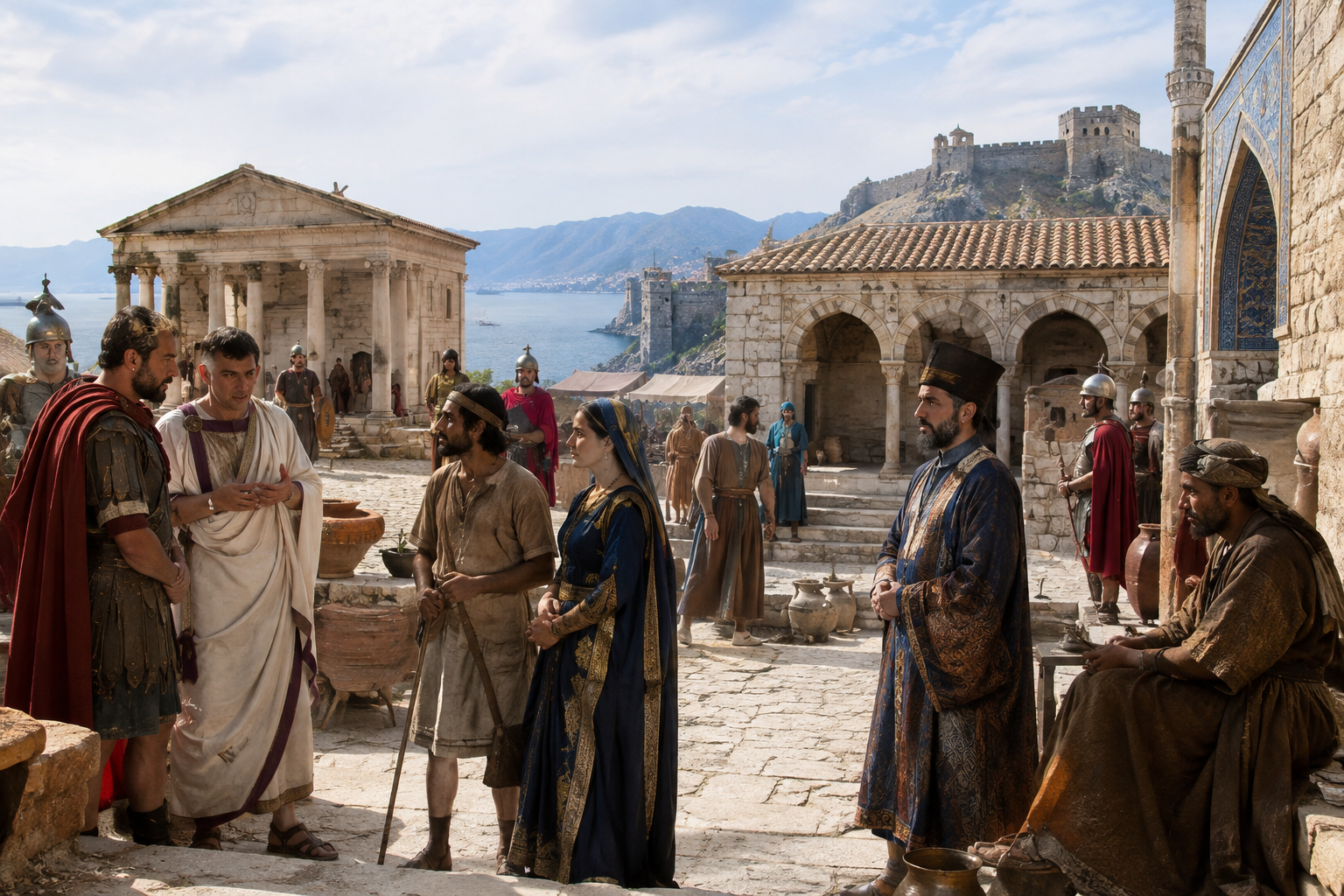
At Hvar-Radošević Palace on the Croatian island of Hvar, one late Imperial Roman male dated to around AD 400, sample I33888, carries a lineage associated here with J2a1a4b. That is already enough to make him interesting. Hvar sat in a part of the Adriatic world where Roman rule, seaborne movement, local continuity, and eastern Mediterranean connections all overlapped, so a Y-chromosome branch like this is not a curiosity dropped into the record from nowhere. It belongs to a wider paternal family, J2, long linked in broad terms with populations of the Near East and eastern Mediterranean, but this exact subclade is a much narrower branch and must be treated more cautiously.
The real fascination of J2a1a4b in the ancient record given here is not a single dynasty or one dramatic burial. It is the pattern. The branch appears in Early Bronze Age Anatolia and Iran, then later in Hellenistic and Byzantine Aegean contexts, in the late Roman Balkans, and even in a medieval Islamic setting at Ghazni. That does not mean one unbroken historical tribe marched across 4,000 years. It means that one paternal line, or closely related paternal lines, kept turning up in the very zones where trade, empire, migration, and urban life most often met.
Sample I33888 comes from Late Imperial Roman Croatia at Hvar Radošević Palace, dated around AD 400. On its own, a Y-DNA result tells us only about a direct paternal line, not a whole identity. But in context, it fits a broader late Roman Adriatic world in which soldiers, officials, merchants, sailors, and families moved readily between Dalmatia, Italy, the Balkans, Greece, and farther east.
That is why a lineage associated with J2a1a4b matters here. It suggests that the paternal ancestry visible at Hvar was part of the Mediterranean-connected male pool that Roman rule had been mixing for centuries. Hvar was not perched at the edge of history; it was tied into it. A related MyTrueAncestry feature on the same site gives useful local background:
This Adriatic find becomes more persuasive when set beside another late antique example: I41235, from the Late Roman era at Han Krum Village in Bulgaria, identified here as the Aul of Kan Omurtag and dated to around AD 400. Whatever the later history of that place-name and monument, the useful point is geographical. We are now in the Balkans, not on an island in Dalmatia, yet the same haplogroup branch appears again in a region that late Roman and post-Roman politics made famously mobile and mixed.
The Aegean-facing evidence is especially suggestive. Sample I20259, from Byzantine-era Caria on the Aegean coast of Anatolia and dated to around AD 604, places the branch in a firmly eastern Roman setting. Another individual, I3303, described as a Near East outlier from Dorian Halikarnassos on the Aegean coast and dated to around 263 BC, pushes the regional story back into the Hellenistic age.
Halikarnassos, Caria, and the Aegean littoral were places where Greek-speaking cities, Anatolian populations, imperial systems, and maritime exchange all met. A paternal lineage recurring in those settings is not proof of ethnicity, but it is entirely compatible with the eastern Mediterranean's habit of knitting together very different communities under shared political and commercial worlds. If you want a broader MyTrueAncestry discussion of how ancient DNA is illuminating Greek colonial and Aegean links, this is a good companion piece:
There is also a wider regional backdrop. An ancient DNA study of Mediterranean and southwest Asian population history published in Science helped show just how connected these zones were over long periods, even while local populations kept their own distinct profiles. That broader picture suits J2-associated paternal lines rather well: recurring, mobile, but never reducible to a single people.
The older evidence is where the time depth of this branch becomes harder to ignore. Sample I7079, from Early Bronze Age Suluova in Black Sea Anatolia and dated to around 2460 BC, places the lineage in northern Anatolia more than two millennia before the Roman world of Hvar. Another early case, I2337 from Tepe Hissar in Iran, dated to around 2800 BC, extends the picture onto the Iranian plateau.
These two sites do not give us a tidy origin myth, and they should not be forced into one. Still, together they show that lineages associated with J2a1a4b were present in the broad arc stretching from Anatolia into Iran in the Early Bronze Age. That is a historically serious point, because this was precisely the era when towns, metallurgy, exchange networks, and increasingly complex regional societies were binding southwest Asia into larger systems.
Research on ancient populations of Central and South Asia, including material published through the Reich laboratory supplement at this study resource, has repeatedly underscored how entangled Iranian plateau, Inner Asian, and neighboring populations could be across deep time. Without over-claiming for any one sample, I2337 sits comfortably inside that larger archaeological reality: Iran was not isolated, and paternal lines there could participate in networks extending far beyond one valley or mound.
The latest sample in this small cluster is I7716, described as Medieval Ghaznavid Mosque, dated around AD 1210. By this point we are far from Bronze Age Anatolia and late Roman Dalmatia, and deep inside the Islamic world of eastern Iran and Afghanistan. Yet the same paternal branch appears again.
This is exactly the sort of result that makes archaeogenetics so good at pricking simple historical stories. It would be easy, and wrong, to imagine one lineage as belonging permanently to one language, state, or religious community. Instead, J2a1a4b appears across pagan, Hellenistic, Roman, Byzantine, and Islamic settings. The men carrying it lived in very different cultural worlds, even if their direct paternal ancestry ultimately linked back through the same narrow Y-chromosome line.
For readers interested in the wider Black Sea and steppe-facing zones that connect some of these regions, this background article is worth exploring:
So what sort of haplogroup is J2a1a4b, historically speaking? On present evidence here, it looks less like the badge of one famous people and more like a durable eastern Mediterranean and southwest Asian paternal thread. Its documented appearances run from Early Bronze Age Iran and Anatolia to Hellenistic Caria, Byzantine Anatolia, the late Roman Balkans, and the medieval Ghaznavid sphere. That pattern suits regions shaped by long-distance contact, urban life, and repeated imperial integration.
For someone researching a modern paternal line in J2a1a4b, the responsible takeaway is not a claim to one ancient ethnicity. It is something subtler and more interesting: your direct male line may belong to a branch with deep roots in the interconnected worlds of Anatolia, Iran, the Aegean, and the Balkans, turning up repeatedly where historical movement was normal rather than exceptional.






Comments