Haplogroup J2a1a1a2a1a2

– 5 min read


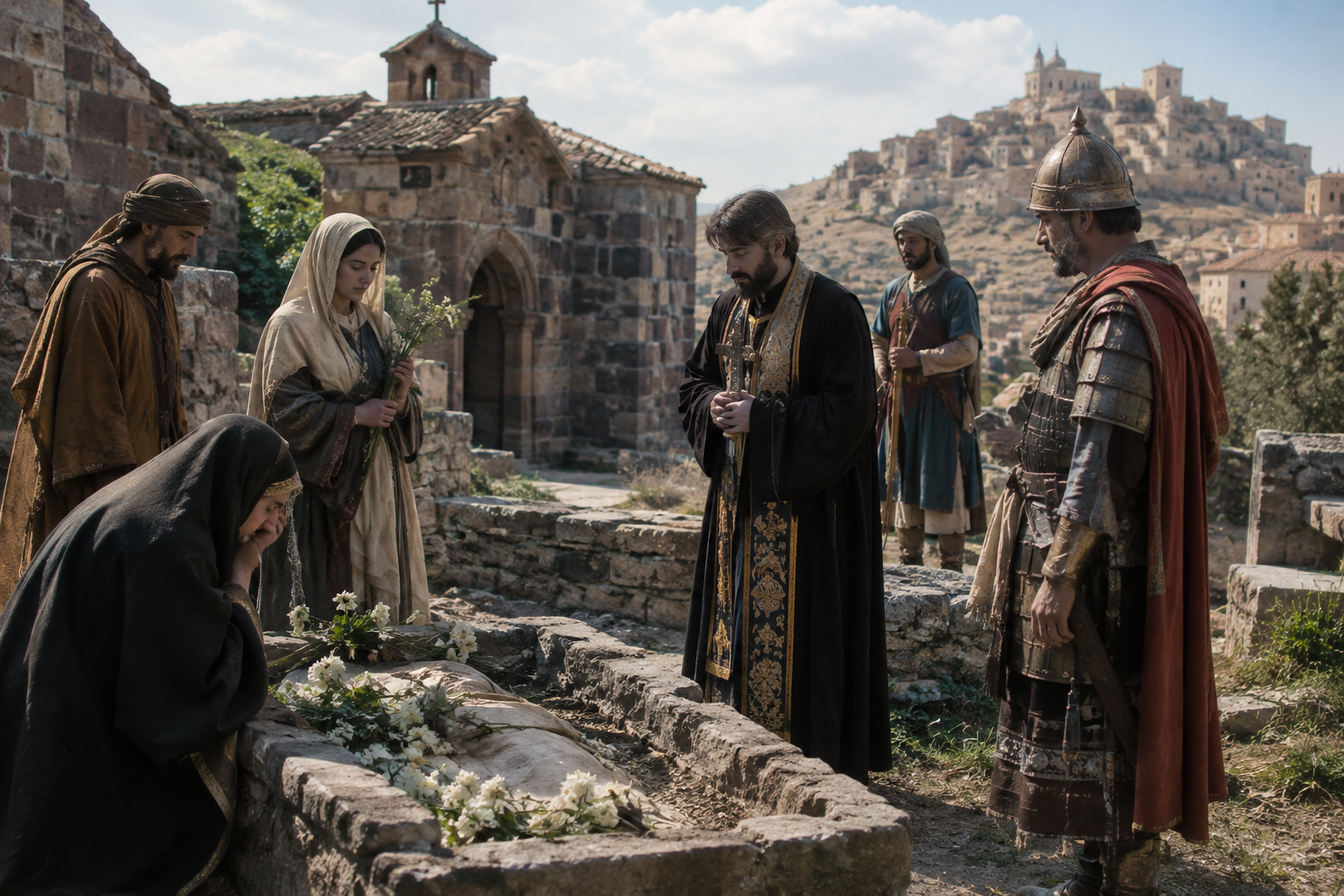
In a Christian burial at Sant'Agata La Vetere in Catania, a man dated to around AD 1125 carries the Y-DNA line J2a1a1a2a1a2, identified in the sample record as SAVBN11b. That is an arresting place to begin, because medieval Sicily was not some tidy frontier between neat populations. It was a crowded, argumentative, multilingual island where Byzantine, Islamic, and Latin worlds overlapped, and where paternal lineages could persist through changing faiths, rulers, and social orders.
This matters because J2 as a wider haplogroup has deep roots in the eastern Mediterranean and Near East, but this article's branch is far narrower: J2a1a1a2a1a2. A Y-DNA branch tracks one direct paternal line only, not a person's whole ancestry, yet when the same branch turns up in samples from Armenia, eastern Anatolia, southeast Anatolia, and then medieval Sicily, it gives us a very specific historical puzzle. We are not looking at one empire, one ethnicity, or one simple migration. We are looking at a paternal thread moving through several of the great contact zones of the ancient and medieval Near East.
SAVBN11b comes from Catania, on Sicily's eastern coast, in a Christian burial context. By the early 12th century, this was a period after the Norman conquest of the island, but the population was still shaped by centuries of Byzantine administration, Islamic rule, Mediterranean trade, and local continuity. A man buried as a Christian in Catania at this date cannot be reduced to any one of those histories, but his paternal line fits very well into Sicily's role as a meeting point for eastern Mediterranean ancestry.
That is precisely why Sicily is such a useful place for ancient DNA. Rather than confirming a romantic myth of a single people, it shows how lineages could survive political turnover. Research on medieval Sicilian populations has repeatedly emphasized diversity and overlapping ancestries rather than sharp replacement, a pattern that makes a branch like J2a1a1a2a1a2 historically plausible in this setting.
The more interesting point is not that the lineage reached Sicily - many eastern Mediterranean lineages did - but that the samples tied to this branch suggest a longer arc through the highlands and borderlands to the east before we ever meet it on the island.
The earliest sample in this small cluster is I17183, from Keti Shirak, Armenia, dated to about 1320 BC in the Late Bronze Age. Even with sparse contextual detail, the geography matters. Shirak lies in the South Caucasus, a region that was never isolated from the wider Near East. It sat amid exchange networks linking Anatolia, the Caucasus, northern Mesopotamia, and the Iranian world.
To find this paternal branch in Bronze Age Armenia is important because it places the line in one of Eurasia's old corridor zones well before the classical and medieval periods. That does not mean every later carrier descended from this particular man, nor that the branch "originated" there in any simple sense. But it does show that lineages of this type were already present in the South Caucasus during an age of fortified settlements, regional polities, and long-distance connections in metals, animals, and prestige goods.
An ancient DNA study on populations of the broader region, published in Science, helped underline just how dynamic the South Caucasus and neighboring lands were over the long term. For a lineage like J2a1a1a2a1a2, that wider setting matters more than any attempt to pin it to a single ancient "people."
The next particularly telling appearance is I14765, from East Van in Anatolia, dated to around 800 BC and described as Iron Age Urartian. Here the historical frame sharpens. Urartu was a kingdom of fortresses, royal inscriptions, irrigation works, and mountain power, centered around Lake Van and locked in competition and exchange with Assyria and its neighbors.
A branch found in both Late Bronze Age Armenia and Iron Age Urartian territory suggests continuity across the upland world stretching from the South Caucasus into eastern Anatolia. That is exactly the sort of zone where paternal lines could persist while languages, loyalties, and political masters changed. Archaeology in this region often reveals continuity in settlement landscapes alongside major shifts in state formation. Y-DNA can sometimes illuminate that same pattern from another angle.
We should be careful here. Carrying J2a1a1a2a1a2 does not make I14765 a representative "Urartian type," still less a spokesman for the kingdom. But it does place this paternal line inside one of the major Iron Age societies of the Armenian highlands, which is more informative than a bare modern frequency map could ever be.
South Caucasus Genomic History
Another key sample is I4474, from Mardin in southeast Anatolia, dated to about AD 635 in the Byzantine period. Mardin is one of those places historians love because it ruins every simple map. Perched above the plains of Upper Mesopotamia, it belonged to a world of Syriac Christianity, imperial rivalry, caravan routes, and communities that were connected southward into Mesopotamia and westward into Anatolia at the same time.
By the 7th century, this was also an age of enormous political transformation. Yet from the perspective of a paternal lineage, regime change need not mean biological rupture. A branch present in Bronze Age Armenia, Iron Age Van, and Byzantine Mardin looks less like a sudden leap and more like repeated survival in connected eastern highland and northern Mesopotamian settings.
That is one reason not to treat Y-DNA as ethnic shorthand. The same paternal branch could pass through households speaking different languages, serving different states, and worshipping in different religious traditions over many centuries. Mardin is exactly the kind of place where that complexity becomes historically visible.
Work associated with newly released ancient genomic material, including material connected with PRJNA1400023, is helping expand the map of such regional continuities and interruptions. Even when a single sample gives us only a few secure facts, its location and period can be extraordinarily revealing when set beside others.
If we line these samples up - I17183 in Late Bronze Age Armenia, I14765 in Iron Age Urartian Van, I4474 in Byzantine-period Mardin, and SAVBN11b in medieval Catania - a pattern emerges across connected basins rather than across isolated nations. The route is not literal and need not be direct, but the geography is telling: South Caucasus, eastern Anatolia, Upper Mesopotamia, then the central Mediterranean.
That sequence fits what historians already know about the movement of people around these regions. Armies marched, merchants traded, clerics traveled, artisans relocated, captives were resettled, and families moved for reasons that leave no inscription behind. Sicily, especially, drew in people from Byzantine and Islamic Mediterranean networks long before and after the Norman takeover.
So J2a1a1a2a1a2 here looks less like the marker of one dramatic migration than the residue of repeated connections between the eastern Mediterranean and Sicily. That is a subtler story, but a better one. Human history is usually built from accumulation, not grand singular events.
For someone exploring J2a1a1a2a1a2 today, the most defensible insight is that this paternal line appears in a chain of ancient settings tied to the Armenian highlands, eastern Anatolia, northern Mesopotamia, and eventually medieval Sicily. That does not assign a single ethnicity or promise descent from any named dynasty. It does, however, place the branch inside some of the most important long-term contact zones of western Eurasia, where continuity and movement went hand in hand.
In other words, this is a lineage with an ancient foothold in the eastern highland world and a documented medieval presence in Sicily's famously mixed society. That is already a rather fine historical inheritance: not a myth of purity, but a record of endurance across complicated landscapes.


Comments