Haplogroup J1a2b2b

– 6 min read


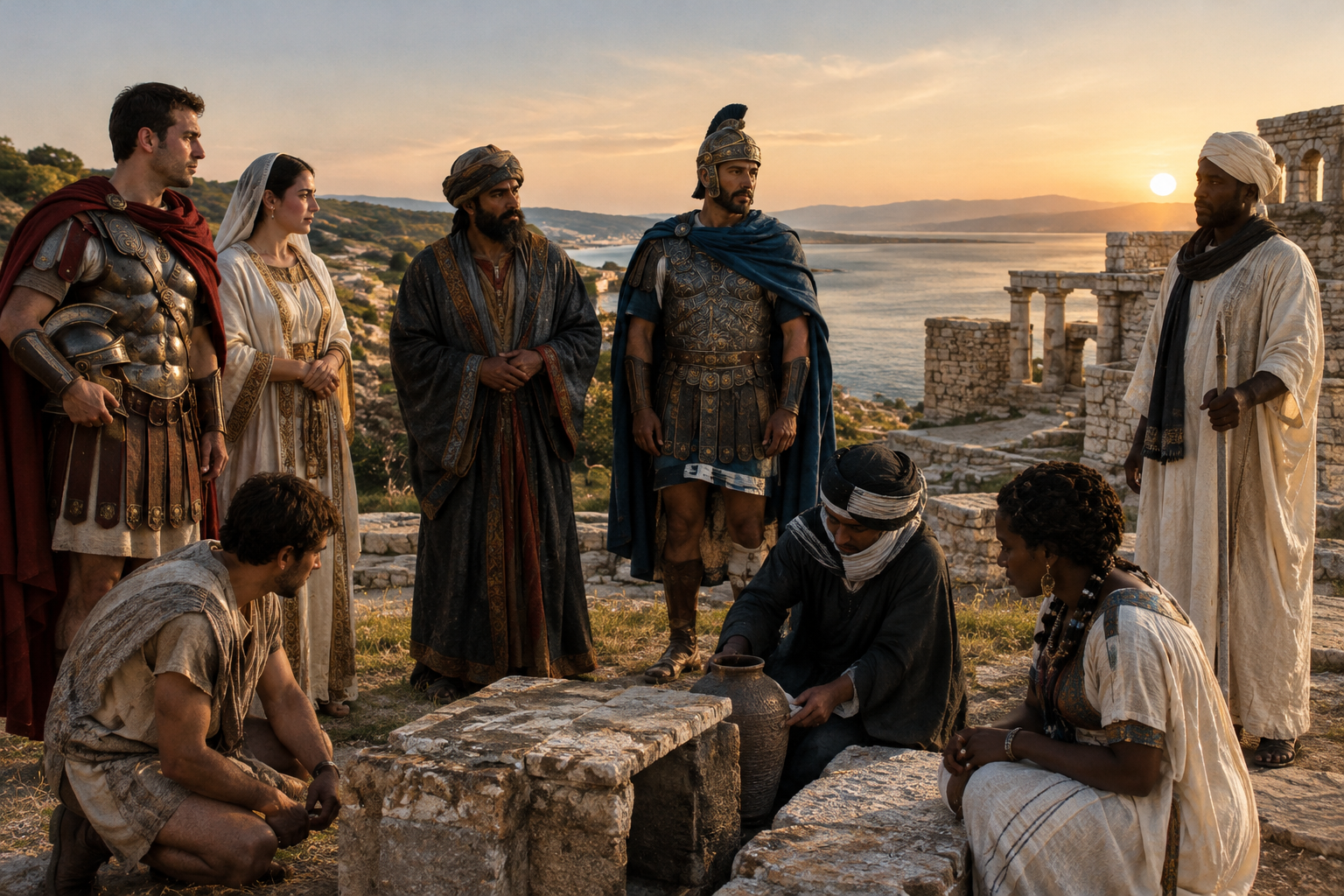
At Pecine, one of the great cemeteries of Roman Viminacium in modern Serbia, an Imperial-era man identified as I15529 was buried around AD 100. Viminacium was not a provincial backwater. It was a legionary centre, a city on the Danube frontier, and a place where soldiers, traders, administrators, and families from very different backgrounds could end up side by side. That matters for haplogroup J1a2b2b, because one of the clearest things about the evidence is that this paternal line appears not in one neatly bounded people, but in several connected worlds of the eastern Mediterranean and the Roman sphere.
That does not mean a Y-DNA branch tells us a man's whole identity. Y-DNA tracks one direct paternal line only. But when the same branch or a reported association with it appears in contexts stretching from the Balkans to Anatolia, Roman Spain, medieval Sicily, Cilicia, and even Christian Nubia, it becomes historically interesting in a very specific way: it points us toward mobility, settlement, and continuity across regions that were linked for centuries by empire, trade, religion, and war.
The Viminacium sample I15529 is a useful place to begin because the site is so unmistakably Roman and so unmistakably connected. A man carrying or associated with J1a2b2b at a Danubian city around AD 100 fits a wider picture in which the Roman Empire did not simply move armies. It moved households, specialists, merchants, captives, and recruits. Frontier towns could contain people whose deeper paternal origins lay far from the place where they died.
We should be careful here. One burial at Viminacium does not prove that this branch was common in the Balkans, nor does it let us assign that man a language or ethnic label. What it does show is that a lineage usually associated in broad terms with Southwest Asian and Near Eastern paternal histories had reached, or was present within, a major Roman military-urban environment very early in the imperial period.
A large ancient DNA study of the Roman world has helped sharpen this broader picture of movement and mixture across imperial settings, especially in regions tied into Mediterranean exchange networks. The significance of I15529 lies less in romantic origin stories than in the simple, solid fact that Roman frontier society could absorb paternal lines from far beyond the local Iron Age base population.
Another striking appearance comes from Late Roman Spain: sample I35943 from Cortijo Basilica del Coracho, Lucena, in Cordoba province, dated around AD 450. Here the importance is geographical as much as chronological. By the fifth century, Roman Hispania was a place of deep entanglement between older Iberian populations, long-established Roman communities, and newcomers of many kinds. A J1a2b2b-associated male in this setting suggests that paternal lines with eastern Mediterranean or Near Eastern affinities were not confined to the empire's eastern half.
That should not surprise us too much if we remember what Roman provinces actually were. They were systems of roads, ports, tax networks, estates, military transfers, and cities. A man buried in southern Iberia in Late Antiquity might descend from people who had moved generations earlier within those systems. His presence is a reminder that "local" populations in the Roman and post-Roman west were often already the product of centuries of movement.
This western occurrence also sits neatly alongside growing evidence for diverse ancestry profiles in Iberia during and after Roman rule. The region did not become homogeneous under empire; if anything, imperial integration made certain places more mixed.
Roman Hispania's Genetic Legacy
If Viminacium and Lucena show the branch at opposite ends of the Roman world, the Anatolian and adjacent samples help explain why that spread is plausible. Sample I20139 from Roman-era Camandras on the Aegean coast of Anatolia, dated around AD 225, places the lineage in one of the most densely urbanized and interconnected zones of the eastern Mediterranean. Anatolia was not merely a bridge between east and west in a poetic sense; it was full of ports, market towns, garrisons, and pilgrimage routes that sustained real demographic movement.
Even more suggestive is the earlier outlier I10392, from Idomenae-Isar Marvinci in the Macedonian Kingdom world around 300 BC, described as an Ancient Near East outlier. That label matters. It hints that, even before the high Roman Empire, movement from the Near East into the Balkans and Macedonian sphere could be visible at the level of individual genomes. In other words, Roman-period examples of J1a2b2b may not represent a brand-new phenomenon, but part of a longer eastern Mediterranean history of mobility.
For this reason, it is wise not to compress everything into one single migration tale. The branch's appearances may reflect several episodes and settings: Hellenistic movement, Roman resettlement, eastern Mediterranean urban continuity, and later medieval circulation. A study of Mediterranean and Near Eastern ancient populations has increasingly shown just how layered these histories were, rather than tidy arrows on a map.
Research on ancient populations across the Mediterranean and adjoining regions has reinforced that impression of long-term connectivity rather than isolation, and the broad framework is well represented in an ancient DNA study of the Roman and post-Roman Mediterranean world.
By the medieval period, the pattern becomes even more evocative. Sample TLBN14a comes from an Islamic burial at Villa del Tellaro in Norman Sicily, dated around AD 1133. Sicily under Norman rule was one of those places historians love because the documents and archaeology alike refuse simple categories. Latin Christians, Greek Christians, Arabic speakers, Muslims, and Jews all belonged to the island's history, and its genetic record is proving just as complicated.
A J1a2b2b-associated male in this context is entirely at home in that world. It does not tell us that the branch was specifically "Norman" or specifically "Arab" or specifically anything else so simple. It tells us that paternal lines rooted in the eastern and southern Mediterranean remained present within Sicily's mixed society during the centuries after the Islamic conquest and into the Norman period.
The same broad zone of medieval eastern Mediterranean complexity appears again in sample I14645 from the Armenian Kingdom of Cilicia near Gaziantep, dated around AD 1200. Cilician Armenia was a frontier kingdom with Armenian elites, local Anatolian populations, crusader contacts, trade routes, and ties reaching toward Syria and the wider Mediterranean. Finding this paternal branch there is historically coherent: it belongs to a region where populations had been interacting for a very long time.
The medieval Sicilian evidence is particularly well matched by recent archaeogenetic work on the island's plural communities, including research on medieval Sicily's multi-faith genetic history. That kind of work matters because it turns old textbook phrases such as "crossroads of the Mediterranean" into something testable in actual burials.
Medieval Sicily's Multi-Faith DNA
The most unexpected sample in the set may be I6257 from Kulubnarti in Makurian Nubia, dated around AD 810. Medieval Nubia is often left out of casual conversations about Mediterranean history, which is a mistake. Christian Nubian kingdoms were connected to Egypt, the Red Sea, and the wider northeast African and eastern Mediterranean worlds. A paternal lineage like J1a2b2b appearing there is a sharp reminder that the zones linked by trade, religion, and political contact ran well beyond the conventional map of "Europe and the Near East."
Again, caution is needed. One Nubian case does not make this a typical Nubian haplogroup. But it does show that the branch could appear in a Christian African kingdom tied into the same long networks that also touched Anatolia, the Balkans, and Sicily. That is, frankly, the sort of pattern archaeogenetics is very good at exposing: not a single people marching across a map, but enduring circuits of human contact.
For someone exploring haplogroup J1a2b2b today, the most distinctive lesson from these ancient samples is not a neat point of origin story, still less a claim to one historic nation. It is the branch's repeated appearance in connected societies of the eastern Mediterranean, Roman imperial world, and their medieval successors: Viminacium on the Danube, Roman Anatolia, Late Roman Spain, Norman Sicily, Cilician Armenia, and Makurian Nubia. That pattern suggests a paternal line shaped by long-distance contact and durable urban and frontier networks rather than isolation.
If your direct paternal line falls under J1a2b2b, these ancient finds responsibly invite you to think in terms of movement through real historical corridors: imperial service, commerce, settlement, and the mixed populations of Mediterranean borderlands.






Comments