Haplogroup J1a2b1b2

– 5 min read


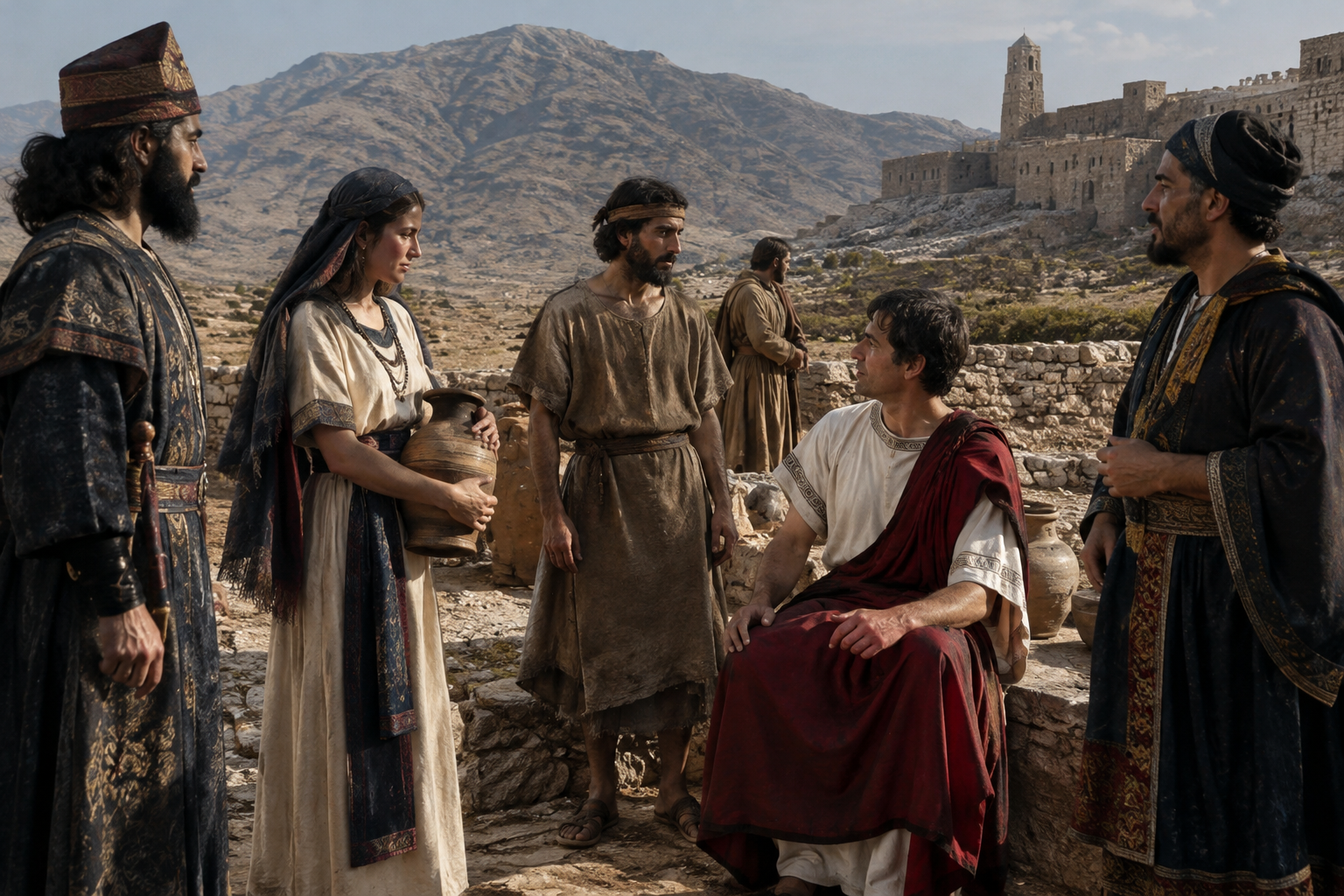
At Hasanlu in northwestern Iran, one Iron Age man catalogued as I4354 offers a sharply focused glimpse of haplogroup J1a2b1b2. He lived around 630 BC, during the Hasanlu period, in a place that sat at a crossroads between the Iranian plateau, the Caucasus, and northern Mesopotamia. That matters because this paternal line does not appear here as an abstract map symbol, but in the remains of a real person from one of the great contact zones of the ancient Near East.
The wider Y-DNA haplogroup J1 has a long and complicated history across West Asia, but this article is about the narrower branch J1a2b1b2. Y-DNA tracks one direct male line only: father to father to father. It does not define a whole people, language, or identity. Still, when the same branch turns up in Bronze Age Armenia, Iron Age Iran, Byzantine-era southeast Anatolia, and even Roman Italy, it becomes historically interesting for a simple reason: it suggests continuity and movement within the connected worlds of the South Caucasus and the northern Fertile Crescent, rather than one isolated appearance.
Hasanlu is one of those sites archaeologists keep returning to because it captures a turbulent region in remarkable detail. By the first millennium BC, this part of Iran was entangled with the political ambitions of powers such as Urartu, Assyria, and local highland polities. Sample I4354 belongs to that broad world. Even without dressing the evidence up into a personal drama, his importance is plain enough: he places the J1a2b1b2 line in Iron Age Iran in a region famous for cultural traffic, warfare, and exchange.
A genetic study of the broader region, published in Science, helped clarify how populations of the southern Caucasus and neighboring lands changed and endured over long stretches of time. For readers with this haplogroup, Hasanlu is useful not because it proves a single origin story, but because it anchors the branch in a historically central landscape where Iranian, Anatolian, and Caucasian connections overlapped.
The deeper clue comes from Armenia. Two much earlier individuals from Dzhoghaz Cemetery, I14340 dated to around 2385 BC and I14341 dated to around 2450 BC, show that this paternal branch, or an assignment associated with it, was present in the South Caucasus in the Bronze Age. That is a significant shift backward in time. Instead of first appearing in historically documented empires, the lineage is already visible in communities living more than a millennium before Hasanlu's Iron Age setting.
Dzhoghaz sits in a region that was never peripheral in prehistory, whatever modern maps may suggest. The South Caucasus formed a corridor linking the steppe, eastern Anatolia, the Iranian plateau, and Mesopotamia. Metal, ideas, and people moved through it repeatedly. A J1a2b1b2-associated presence here in the mid-third millennium BC does not mean every later carrier descends from these exact men, but it does show that this line belonged to the demographic fabric of the region early on.
That early date also helps correct a common mistake in public DNA discussions: assuming that any lineage now common in one modern population must have spread there late, neatly, and from one direction. The Dzhoghaz evidence points instead to depth. This branch was already part of ancient Caucasus-adjacent populations long before classical empires and long before medieval identities took shape.
Another valuable appearance comes much later, with I4533 from Mardin in southeast Anatolia, dated to about AD 829 in the Byzantine period. Mardin is not just another dot on the map. It stands above the plains of Upper Mesopotamia, in a landscape that has long tied together Syriac Christian communities, imperial frontier politics, caravan movement, and agricultural settlement. If Hasanlu shows this lineage in an Iron Age crossroads, Mardin shows it still present in a medieval crossroads.
That continuity across such different political worlds is precisely the point. Between the Bronze Age cemetery in Armenia and the Byzantine-era burial in Mardin lie enormous changes in language, religion, and empire. Yet the paternal line persists in the broader region. This is often how Y-DNA works in the archaeological record: not as a banner of one unchanging ethnicity, but as a thread running through shifting historical settings.
It is especially worth stressing that a Byzantine date here does not make the lineage "Byzantine" in origin. The empire was a political structure, not a biological type. Men carrying related paternal lines could belong to very different local communities under the same imperial umbrella.
Mesopotamian population change
The westernmost sample in this small set is R128 from Casale del Dolce, dated around AD 200 in the Roman Empire. On its own, one Roman-period individual in Italy would be easy to over-interpret. But in context, it is a reminder of how thoroughly the Roman world pulled eastern Mediterranean and Near Eastern populations into Italy.
By the second and third centuries AD, Italy was not genetically sealed off, nor culturally simple. Soldiers, merchants, slaves, administrators, and families moved around the empire in multiple directions. Research on imperial-period population change in the Mediterranean, including work published in Science, has shown just how mobile and mixed Roman-era populations could be. A J1a2b1b2-related Y-line in Roman Italy fits that larger picture very comfortably.
What it does not do is prove a single migration route from Armenia or Iran to Italy for this one man. Roman mobility was messier than that. But it does show that the lineage belonged to the human traffic of the ancient Mediterranean, not only to inland Caucasus and Iranian settings.
With the evidence currently in hand, J1a2b1b2 looks less like a lineage tied to one dramatic conquest and more like one embedded in the long-settled populations of West Asia's northern arc: the South Caucasus, northwest Iran, Upper Mesopotamia, and adjacent Anatolia. The Bronze Age Armenian samples are crucial here because they push the branch into an early horizon. The Iron Age and Byzantine samples show persistence in neighboring regions. The Roman Italian example shows that men from these wider networks could also appear far to the west inside an imperial setting.
That pattern will sound familiar to anyone who studies ancient history of this zone. The highlands and uplands between Armenia, Iran, Anatolia, and Mesopotamia were never isolated. They were full of local continuity, but also full of movement. Traders, farmers, soldiers, herders, officials, and migrants all used the same broad corridors over thousands of years. A paternal lineage can survive all of that change without belonging exclusively to any one historical label.
If you carry J1a2b1b2, the most responsible historical takeaway is not a romantic claim to one empire or one tribe. It is something more interesting and, in truth, more human: your direct paternal line has credible ancient links to the connected landscapes of the South Caucasus, northwestern Iran, Upper Mesopotamia, and the wider eastern Mediterranean world. The strongest signal in these samples is regional depth across time, from Bronze Age Armenia to Iron Age Iran and onward into medieval Anatolia and Roman-era Italy.

Comments