Haplogroup J1a2a1a2d2b2b2c4b

– 5 min read


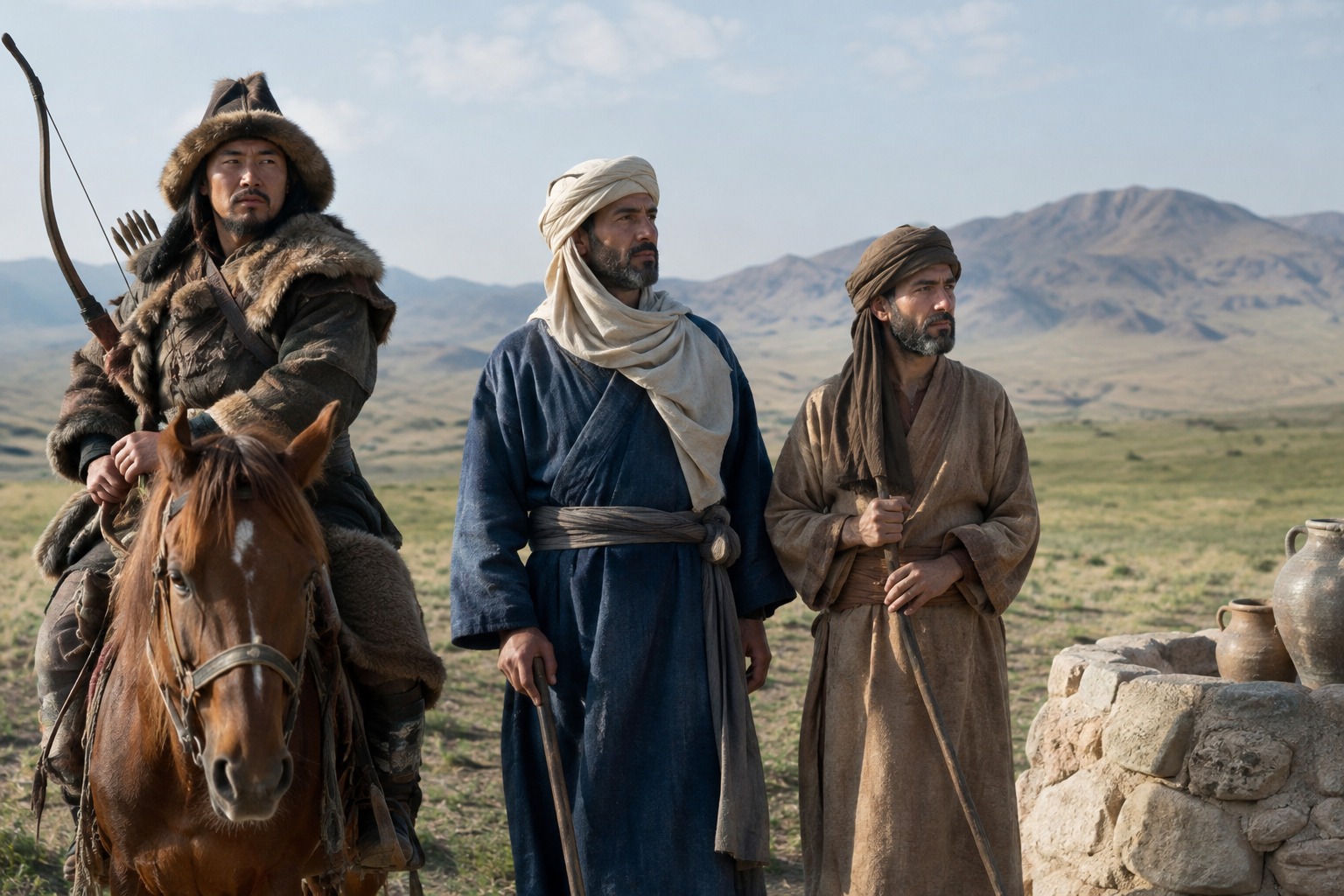
One of the clearest ancient signposts for the paternal line now labeled J1a2a1a2d2b2b2c4b comes from Bronze Age Baq'ah in Jordan, where two men dated to about 1350 BC, samples I6460 and I6569, place this lineage in the southern Levant long before the classical empires or the medieval dynasties that usually dominate popular history. That is already enough to make the branch interesting. It appears first here not as a modern surname cluster or a royal claim, but in an archaeological landscape of Late Bronze Age communities living between larger powers.
Then the trail does something unexpected. The same narrow paternal branch is also represented by UGU006, an individual from Xiongnu-period Mongolia dated around AD 50 at Uguumur Uul, and by BRU001, a Late Medieval Mongol individual from Baruun Khovdiin Am dated around AD 1300. That does not mean one can draw a neat straight arrow from Jordan to Mongolia. But it does show that this paternal line, or men very close to it, appears in remarkably different archaeological worlds across a very wide stretch of Eurasia.
The Baq'ah samples are the oldest anchors in this set, and they matter because they place the lineage in a region central to Bronze Age movement, exchange, and political pressure. Jordan in the fourteenth century BC was not some isolated backwater. It sat amid routes linking Egypt, the Levantine coast, inland Syria, northern Arabia, and Mesopotamia. A Y-chromosome line found there may reflect generations of local continuity, mobility through trade and pastoral networks, or both.
What we can responsibly say is limited but important. I6460 and I6569 show that the paternal ancestry associated here with J1a2a1a2d2b2b2c4b had a documented presence in the southern Levant by the Late Bronze Age. Because Y-DNA follows one direct male line only, it does not define the whole ancestry or identity of these men. But as a historical marker it is useful: it roots this branch in a region where haplogroup J and its sub-branches have long formed part of the wider Near Eastern paternal landscape.
A broader ancient DNA study of Inner Eurasia and adjacent regions, available here in published research on ancient populations across Eurasia, helped underline just how connected seemingly distant regions could become over time. For a branch like this one, that wider context matters more than any simplistic tale of a single migration event.
Bronze and Iron Age Mesopotamia
J1a2a1a2d2b2b2c4b is an extremely fine-grained label, much narrower than the better-known parent haplogroup J1. That distinction matters. Popular discussions often talk as if everything under J1 shares one story, one homeland, and one historical identity. It does not. A very specific subclade can have a much more particular history than its parent branch, and the evidence for that specific history is usually far thinner.
So the safer reading is this: these ancient samples are reported as associated with the article's branch, but the deeper historical interpretation must rest on the archaeological contexts we actually have. Those contexts show a line present in the Bronze Age Levant and later among steppe and Mongol-period populations. They do not, by themselves, prove one uninterrupted family pedigree spanning more than two millennia.
The sample UGU006, dated around AD 50 from Uguumur Uul in Mongolia, brings the lineage into the orbit of the Xiongnu period. This is a striking change of setting. We are no longer in the urbanized and agrarian margins of the southern Levant, but in the politically dynamic world of the eastern steppe, where confederations, herding economies, military mobility, and long-distance exchange tied together peoples from northern China to Central Asia.
The Xiongnu are often presented as if they were a single people with a single ancestry. Ancient DNA has steadily made that picture more complicated. Xiongnu-period cemeteries reveal diversity, and that is exactly why a lineage such as J1a2a1a2d2b2b2c4b is so intriguing in this context. It hints at the incorporation of paternal lines with deeper roots far outside Mongolia into steppe political worlds.
That does not require a dramatic story of conquest by one individual or clan. Steppe empires and confederations were famous absorbers of people. Traders, captives, allied groups, migrants, and military retinues all moved across these landscapes. A single Y-line appearing in a Xiongnu-period burial is therefore most meaningful as evidence of connectivity, not as proof of ethnic identity.
The later Mongolian sample, BRU001 from Baruun Khovdiin Am, dated around AD 1300, shows that this paternal line was still present in Mongolia deep into the medieval period. By then the political map of Eurasia had been transformed. The Mongol world linked East Asia, the steppe, Central Asia, Iran, and parts of eastern Europe in a way unprecedented in scale.
Here again, the lineage fits a historical moment defined by movement and incorporation. By the thirteenth and fourteenth centuries, men could travel or be moved across immense distances within imperial systems. A paternal line with older Near Eastern associations appearing in Late Medieval Mongolia is therefore historically plausible without needing any romantic embellishment. The great lesson of medieval Eurasia is not purity, but mixture under conditions of power, trade, war, and administration.
Research associated with Mongolian ancient DNA, including supplementary materials from a genetic study of populations in this wider region, has helped demonstrate how layered steppe ancestry could be. Even when a specific sample's full historical biography is forever lost, the genetic pattern still tells us that the Mongolian steppe was a meeting ground rather than a sealed world.
Put the evidence together and a distinctive picture appears. The oldest currently listed examples for this branch sit in the Bronze Age southern Levant. Much later, the same lineage appears in Mongolia under both Xiongnu and Mongol-period contexts. That is a very wide chronological and geographic spread, but it is not random. It points toward the great corridors of Eurasian history: the Levantine crossroads, the Inner Asian steppe, and the imperial networks that bound them together.
It would be wrong to collapse all of that into a single label such as "Arab," "Semitic," "Xiongnu," or "Mongol." Archaeology and genetics are not so tidy. What this branch seems to preserve is evidence of male-line survival through changing cultural worlds. Languages changed, political loyalties changed, burial customs changed, but one paternal thread kept turning up in places where people from different regions met and mixed.
For someone researching J1a2a1a2d2b2b2c4b, the most telling insight is not a claim to one famous tribe or dynasty. It is that this paternal line is already visible in the Bronze Age Levant and later appears in major Inner Asian historical settings, including Xiongnu-period and medieval Mongolian contexts. In other words, this is a lineage with a documented history in zones where Eurasian worlds connected, overlapped, and were constantly remade.






Comments