Haplogroup J1a2a1a2d2b2a2
– 5 min read


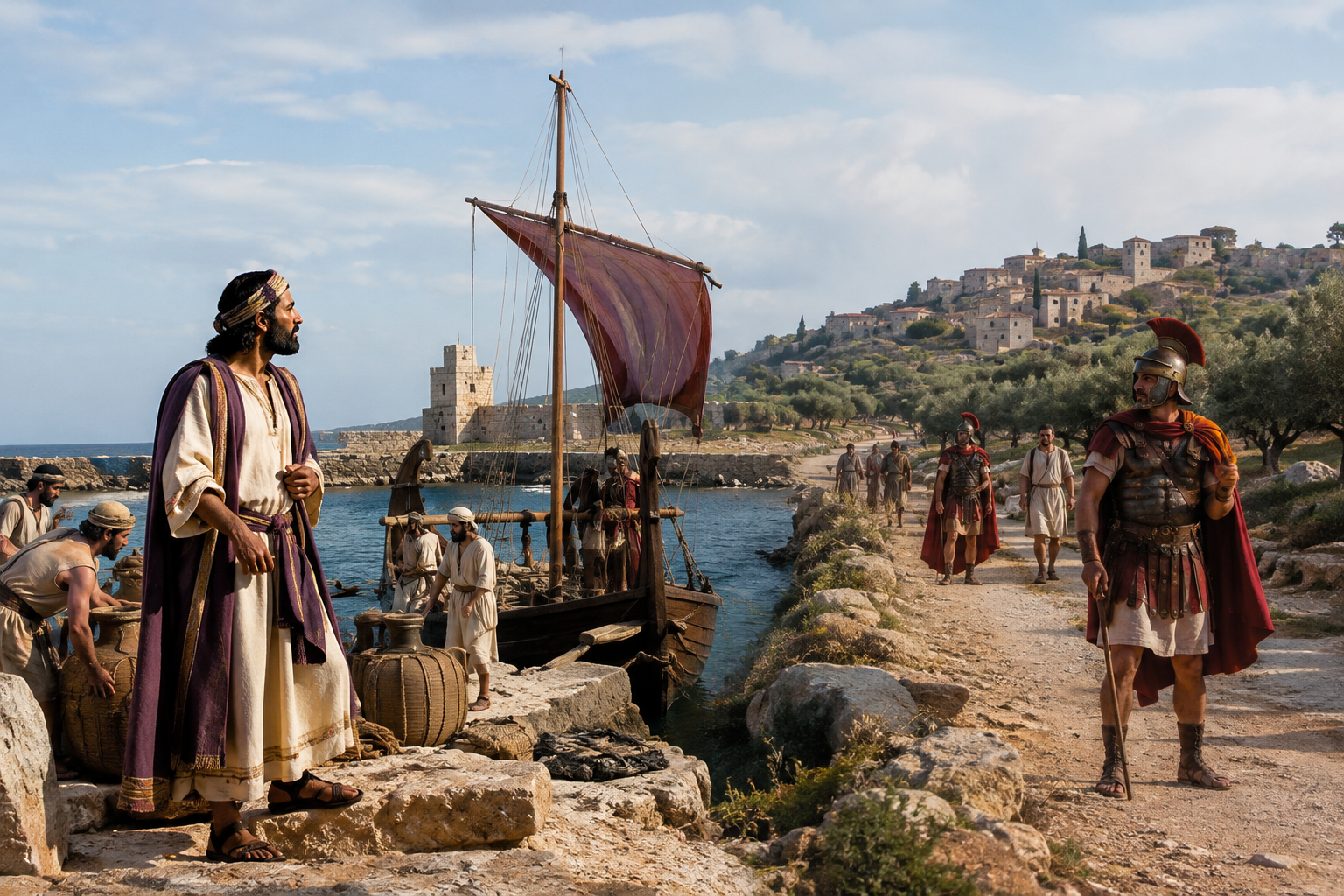
At Achzib on the northern coast of present-day Israel, archaeologists and geneticists have begun to recover something more intimate than trade routes or pottery styles: actual paternal lines carried by men who lived in the Phoenician world. One of the most striking cases for the haplogroup J1a2a1a2d2b2a2 is sample I22254, dated to around 650 BC and identified from Phoenician Achzib near Acre. That matters because Achzib was not some vague "eastern Mediterranean" backdrop. It was a real coastal settlement in a region tied to seaborne exchange, imperial pressure, and the movements of people as well as goods.
The presence of this paternal line in an Iron Age Phoenician context becomes even more interesting when set beside a second sample: R1549 from Monterotondo in Roman Italy, dated to around AD 165. We are not looking at a complete history of the haplogroup from two men alone, and Y-DNA traces only one direct male line rather than a person's whole ancestry. But these finds do place this branch in two historically connected worlds: the Levantine coast and the Roman Mediterranean.
Achzib sits in one of those coastal zones where history is never merely local. In the first millennium BC, communities along the Levantine shore were bound into networks of shipping, craft production, diplomacy, and imperial rivalry. A man carrying the line reported here as J1a2a1a2d2b2a2 appears in precisely that setting, not in legend but in a dated ancient individual: I22254.
That does not make this a "Phoenician haplogroup" in any exclusive sense. Ancient port societies were complicated places, and Phoenician identity was cultural and historical, not reducible to one Y-chromosome branch. What the Achzib sample does provide is a firm reminder that some branches now found in modern testers were already present in the eastern Mediterranean during the Iron Age, among populations involved in the maritime world conventionally associated with the Phoenicians.
A recent ancient DNA study of Phoenician-era populations has helped push these questions beyond old assumptions based only on texts or artifacts. The real value of such work is that it lets us compare individuals from named places, rather than treating the Phoenician world as a single undifferentiated category.
The exact label J1a2a1a2d2b2a2 is a very narrow paternal designation. That is important. Broad haplogroup J1 has a long and geographically wide history across parts of West Asia and neighboring regions, but a deep subclade such as this one is not automatically entitled to the entire story of its parent branch. Good genetic history depends on keeping those scales separate.
So the most careful reading is also the most useful one. This article's branch is associated here with at least one Iron Age man from the Phoenician coast and one man from Roman Italy. That is already enough to suggest a lineage participating in the connected human landscape of the Mediterranean, without pretending we can reconstruct every migration step in between.
The second ancient individual, R1549, comes from Monterotondo and is dated to around AD 165, in the period of the Roman Empire. Monterotondo lies in central Italy, close to Rome's orbit but not identical with the capital itself. A find there matters because Roman Italy was full of people whose family histories did not begin in Latium. Soldiers, merchants, enslaved people, freed families, migrants from the eastern provinces, and their descendants all contributed to the population of imperial Italy.
That broader picture has been strengthened by research on Roman-period mobility, including the well-known genetic study of ancient Rome and central Italy. The point is not that every individual from Roman Italy came from far away, nor that one Y-line can stand in for imperial demography. It is that eastern Mediterranean connections in Roman Italy are historically ordinary, not exceptional, and a paternal lineage found in both an Iron Age Levantine site and Roman central Italy fits that Mediterranean reality rather well.
For someone carrying J1a2a1a2d2b2a2 today, this is where the evidence becomes especially evocative. Not because it proves descent from a named Phoenician trader or Roman migrant, but because it places this paternal line inside the same sea-linked world that connected Tyre, coastal Israel, Sicily, Carthage, and Italy for centuries.
It is tempting to imagine a simple route: first the Levant, then westward expansion, then Rome. Real history is rarely so tidy. People moved in multiple directions across the Mediterranean, sometimes over generations, sometimes through empire, commerce, war, or household formation. The same paternal branch appearing in two places does not prove a single uninterrupted chain of migration, but it does fit a world in which male lines could travel, settle, and reappear in new political settings.
That is particularly true for the centuries between the Iron Age and the high Roman Empire. The Phoenician and Punic spheres were deeply entangled with the wider Mediterranean, and later Roman rule created an even denser matrix of movement. A lineage seen at Achzib in the 7th century BC and again in central Italy in the 2nd century AD is therefore historically plausible in a very grounded sense: these were connected zones long before modern nation-states ever existed.
We should also notice the difference in context. I22254 anchors the branch in a specifically Phoenician coastal setting. R1549 shows it in an imperial Italian environment where identities, origins, and family histories could be mixed in ways that archaeology is only now recovering through DNA.
Two ancient men do not make a population map. Still, small numbers can matter when the contexts are good. Here, the value lies in the combination: an Iron Age coastal Levantine sample and a Roman-period central Italian sample, both associated with the same highly specific paternal branch. That gives us chronological spread, geographic spread, and a setting rich in historical explanation.
It also helps correct a common misunderstanding. Many people expect a Y-DNA lineage to point neatly to one people, one kingdom, or one ethnicity. Ancient DNA usually tells a subtler story. Paternal lines can persist through language shifts, imperial expansion, intermarriage, colonization, and urban life. The Mediterranean, with its ports and provinces, is exactly the sort of place where that subtlety matters most.
Other MyTrueAncestry readers interested in population mixture across Roman territory may also want to compare evidence from western provinces, where local continuity and incoming ancestry can be traced side by side.
What makes J1a2a1a2d2b2a2 distinctive, on present evidence, is not sheer antiquity claimed in the abstract but its appearance in two vividly historical settings: Phoenician Achzib around 650 BC and Roman Monterotondo around AD 165. Together they place this paternal branch within the lived geography of the Mediterranean, where coastal Levantine communities and Roman Italy were linked by centuries of movement. If this is your Y-DNA line, the most responsible takeaway is not a grand claim to one famous people, but a well-supported possibility that your direct paternal ancestry belongs to an old eastern Mediterranean story that remained mobile and connected across time.






Comments