Haplogroup I2a2a2

– 5 min read


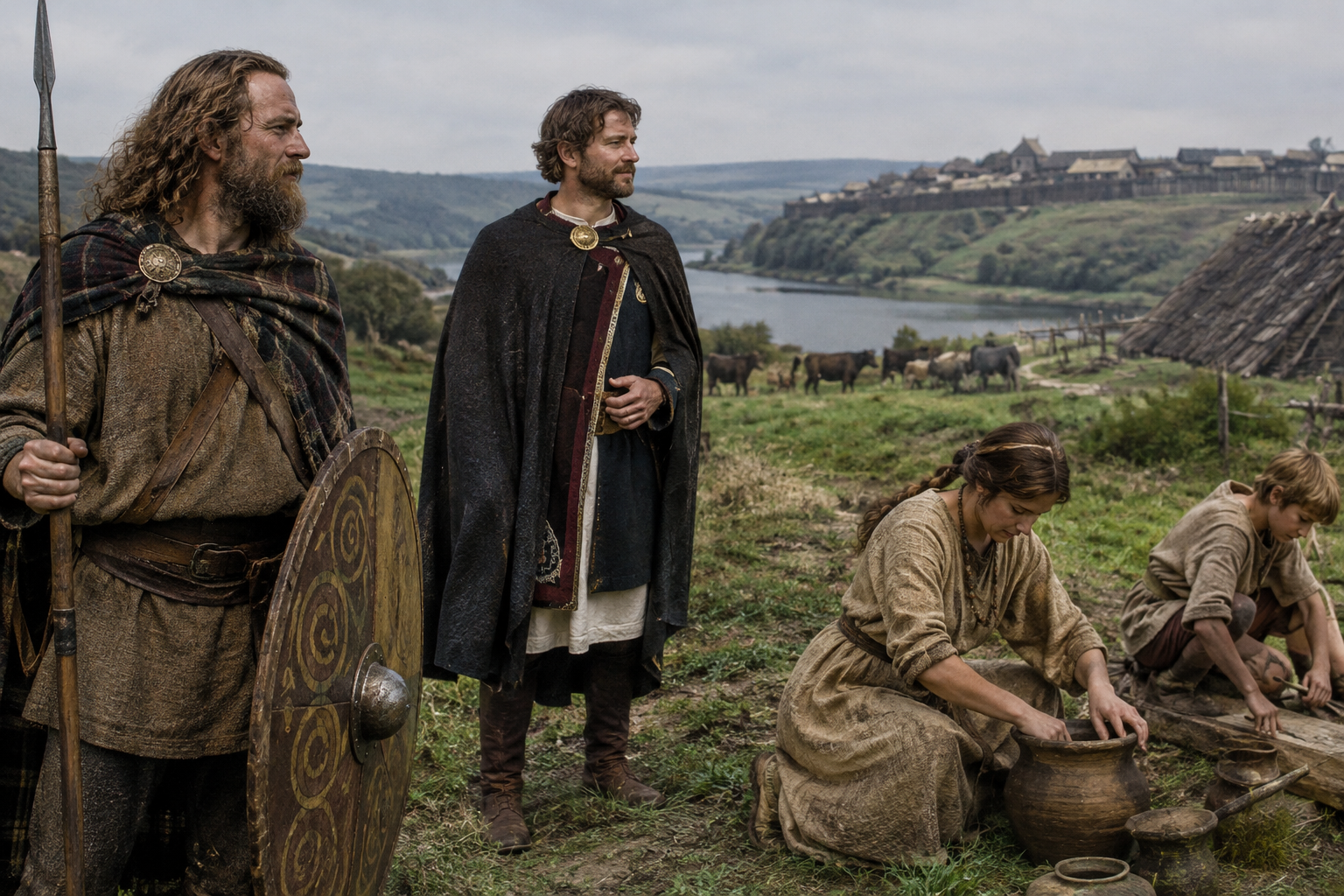
At Wetwang Slack in East Yorkshire, archaeologists uncovered an Iron Age burial belonging to the Parisi, a community long associated with the Arras culture of eastern Yorkshire. One of the men from that landscape, sample I36776, dated to around 225 BC, has been linked in the MyTrueAncestry record to the Y-DNA haplogroup I2a2a2. That matters because it places this paternal line not in one single famous migration or dynasty, but in a very grounded sequence of European lives: a man in Iron Age Britain, another in Early Bronze Age Bohemia, and another in Merovingian-period Germany.
That is the first useful thing to say about I2a2a2. Y-DNA follows one direct paternal line only, not a person's whole ancestry, language, or identity. But when the same branch appears in sharply different archaeological settings, it gives us something better than a slogan: a set of real historical footholds.
The Wetwang Slack burial is the strongest opening point because the place itself is so archaeologically distinctive. East Yorkshire's Arras-culture cemeteries have become central to debates about Iron Age Britain, especially questions of kinship, mobility, and whether local communities were tightly rooted or more mixed than older narratives allowed. Sample I36776, identified as a Celtic Parisi individual from about 225 BC, anchors I2a2a2 in that world.
What makes this interesting is not that one Y-lineage somehow "defines" the Parisi; it plainly does not. Rather, it shows that a branch of haplogroup I2 was present among Iron Age men in eastern Britain during a period when communities were negotiating local tradition, continental contacts, and changing social identities. Recent work on Iron Age Britain has increasingly emphasized that burials and biological kinship do not always line up in simple ways, a point worth bearing in mind when reading any one paternal assignment.
A broader ancient DNA study of Britain and nearby regions, published in Nature, helped reset how archaeologists think about population structure before and after major cultural transitions in northwestern Europe. Even without forcing that paper to answer every question about Wetwang Slack itself, it supports the wider point: paternal lines in Britain were part of long, layered histories, not isolated local curiosities.
The earliest of the three listed men is sample I16110 from Mala Ohrada in what is now the Czech Republic, dated to around 1600 BC. This is a very different setting from Iron Age Yorkshire. We are now in Early Bronze Age central Europe, in a period shaped by local continuity, regional exchange, and the reshaping of older communities after the great population turnovers of the third millennium BC.
Here the value of I16110 is chronological. It shows that a line associated with I2a2a2 was already present in central Europe well before the historically named Celtic peoples of the Iron Age and long before the Frankish world of the early Middle Ages. That does not mean a simple unbroken chain from one excavated man to the next. It does mean that this paternal branch belonged to the deep background of European population history rather than appearing suddenly in one single historic episode.
That point has become clearer as more Bronze Age burials from central Europe are studied genetically. Instead of neat replacement stories, archaeologists increasingly see a patchwork of persistence and change: old paternal branches surviving alongside newcomers, and communities reshaped over centuries rather than overnight.
The third sample, Mln12, comes from Moemlingen in Germany and is dated to around AD 650, in the Merovingian period. The MyTrueAncestry description identifies him as Frankish. That places I2a2a2 in a world often described in older history books as one of "tribes" sweeping across Europe, but the archaeology is much more interesting than that.
By the seventh century, communities in regions under Frankish control were living in landscapes shaped by the Roman imperial past, by local late antique populations, and by centuries of movement across the Rhine frontier. A man buried in this period may be called Frankish in cultural or political terms, but his paternal line could have much older regional roots. That is exactly why a haplogroup like I2a2a2 is so revealing: it reminds us that Merovingian society was not genetically invented in the sixth or seventh century.
Research on early medieval populations in western and central Europe increasingly shows this mixture of continuity and recombination. Labels such as Frankish, Alemannic, or Gothic are historically real, but they do not map neatly onto one lineage each. A paternal branch found in a Merovingian cemetery may connect to deeper local histories as much as to any migration-era identity.
A recent study of early medieval population history in this broader zone, available as a bioRxiv preprint, reflects the current direction of the field: more genomes, more local detail, and less patience for simplistic ethnic storytelling.
The safest way to describe I2a2a2 is as a sub-branch within the broader haplogroup I2 family, one of the long-established paternal lineages of Europe. The important caution is that the history of the large parent group is not automatically the history of this narrower branch. One cannot simply lift a map of "I2 in Europe" and declare that every appearance of I2a2a2 follows the same route or has the same homeland story.
What the three ancient men do show is that this branch, or reported association with it, fits comfortably within a central-and-northwestern European setting across a very long timespan. The Bohemian Bronze Age sample gives it depth. The Yorkshire Iron Age sample gives it a clear presence in pre-Roman Britain. The Merovingian German sample shows it still present in the post-Roman societies of the early Middle Ages.
That is not a royal pedigree and not a tribal badge. It is, if anything, more historically useful than either of those. It suggests a paternal line that persisted through major cultural shifts while the societies around it changed names, languages, and political loyalties.
It is tempting, when faced with a Bronze Age Czech sample and an Iron Age English one, to start drawing arrows across the map. Archaeology does not really reward that kind of haste. The presence of I2a2a2 in both places does not prove that one excavated individual's direct descendants marched from central Europe to Britain and then into the Frankish realm.
What it does support is a broader and more sensible picture. Some paternal lines in Europe endured across many regional populations and historical transformations. They could appear in different cultural settings because men carrying those lines became part of different communities over time, not because a haplogroup itself had an ethnic mission.
That is especially relevant for anyone whose own Y-DNA result falls under I2a2a2. Your paternal line may have a history intertwined with very old European continuities, but any particular historical identity in your family tree will have been shaped by many later events as well: migration, marriage, language shift, war, faith, and simple local rootedness.
If there is one defensible historical theme running through these samples, it is persistence. I2a2a2 appears here not as the signature of one empire or one people, but as a paternal line present in central Europe in the Bronze Age, in eastern Britain in the Iron Age, and in the Frankish world of the early medieval period. For family historians, that makes it less a badge of prestige than a clue to deep European time: a line that survived while almost everything around it changed.






Comments