Haplogroup I2a2a1a1a

– 5 min read


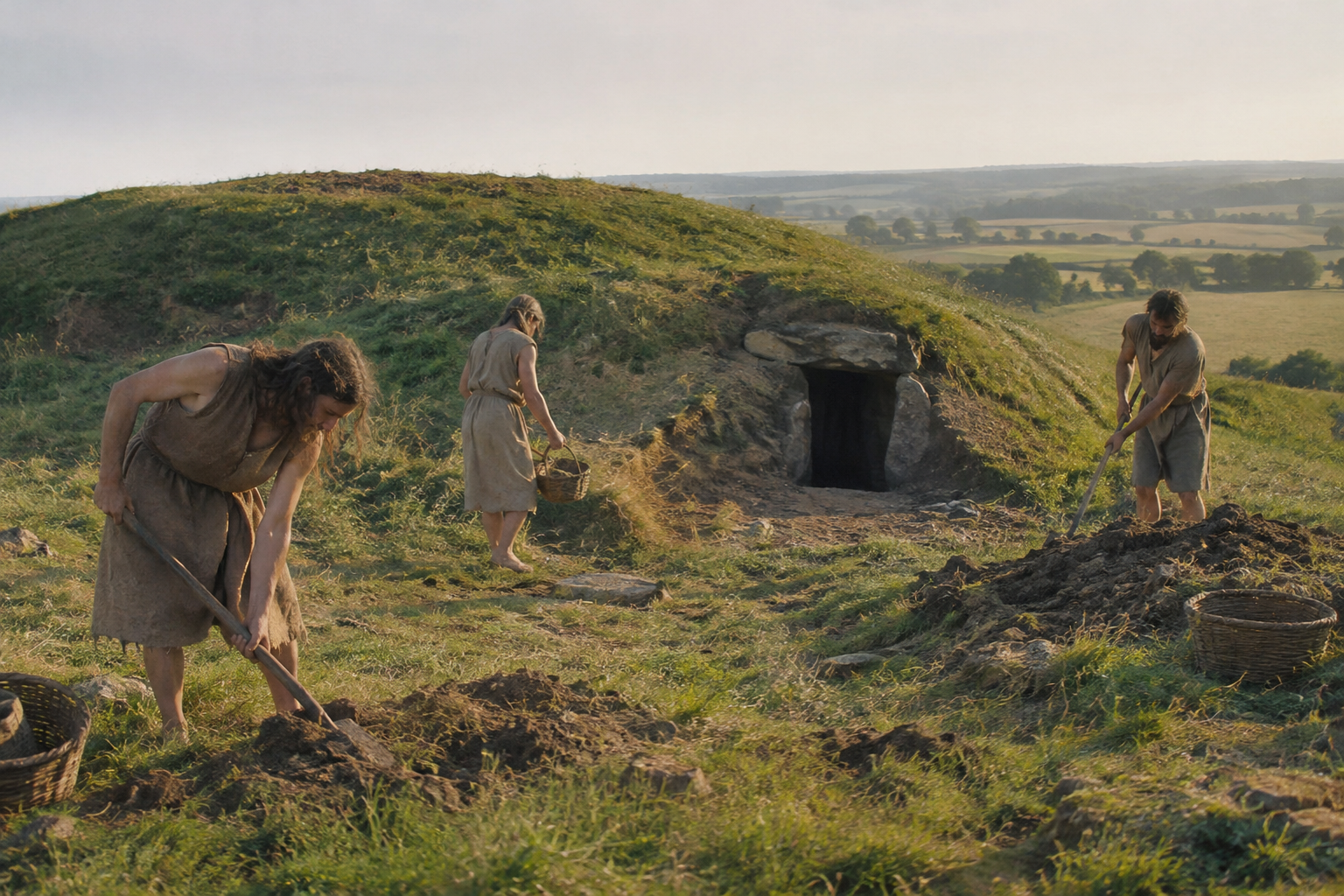
At Barrow Hills near Radley in Oxfordshire, one ancient man has become a small but telling witness to the making of Bronze Age Britain. He is sample I7638, dated to around 2032 BC, and his Y-chromosome is associated here with I2a2a1a1a. That may look like a string of letters and numbers, but in archaeological terms it places a very particular paternal line inside a landscape of barrows, river routes, and social change.
The setting matters. Barrow Hills lies in the Upper Thames region, an area that was anything but marginal in later prehistory. By the early Bronze Age, communities here were burying their dead in ways that marked ancestry, place, and status in the landscape. When a paternal lineage such as I2a2a1a1a appears in this context, it gives us a glimpse not of a whole people or an ethnicity, but of one direct male line living through a period when Britain's populations were already the product of earlier mixtures and movements.
I7638 is important precisely because he is not a legendary king or a conveniently labeled tribal founder. He is an excavated ancient individual from a real burial landscape in southern England. The Barrow Hills cemetery at Radley belongs to a world in which burial mounds were durable statements on the land. Such places were not random spots for disposal. They were remembered locations, used to anchor communities to territory and to ancestors.
For Y-DNA researchers, that gives I7638 unusual value. A Y haplogroup follows one direct paternal line only: father to son, and so on. It does not tell us everything about the man's ancestry, language, or social identity. But it does tell us that lineages associated with haplogroup I, an old European paternal family with deep prehistoric roots, were still present in Bronze Age England alongside the newer demographic patterns that had spread into Britain in the centuries after the Beaker horizon.
A landmark ancient DNA study on prehistoric northwestern Europe, published in Nature, helped show just how dramatic those earlier population shifts had been. Britain in the Bronze Age was not simply a frozen survival of Neolithic populations, nor a blank slate filled by one incoming group. It was a changing society in which older and newer ancestries met, mixed, and persisted in uneven ways. A lineage such as I2a2a1a1a sits squarely inside that complicated human story.
The temptation with any haplogroup is to turn it into a marching arrow on a map. Better to resist that. I2a2a1a1a is a narrow branch within the broader haplogroup I, one of the major Y-chromosome lineages long associated with prehistoric Europe. The wider family has a deep history on the continent, but that does not mean every one of its later branches shared the same route, timing, or cultural associations.
So what can responsibly be said here? In this article's evidence, the branch appears in an early Bronze Age man from Oxfordshire. That shows the presence of this paternal line in southern Britain by the early second millennium BC. It does not by itself prove where his immediate paternal ancestors had lived centuries earlier, what language they spoke, or whether they represented a common or uncommon local lineage.
Still, even one securely placed ancient male can matter. Ancient DNA often works like archaeology itself: one posthole is not a palace, but it may tell you where to start looking. I7638 shows that a branch tied to haplogroup I formed part of the paternal diversity of Bronze Age Britain, a diversity that could survive major social and genetic transitions rather than being swept away in a single tidy replacement.
There is a larger historical point here. Haplogroup I lineages are often linked, at broad scale, to ancient European hunter-gatherer ancestry. But by the time we reach around 2032 BC in Oxfordshire, nobody in Britain was living in a purely Mesolithic world. Farming had long been established. Monument building had transformed the landscape. Contacts across the Channel had brought metals, new burial fashions, and new networks of prestige and exchange.
That means I7638 should not be imagined as a relic from some untouched primeval population. He belonged to a thoroughly Bronze Age society. His paternal line may have had deep time roots in Europe, but his life unfolded in a community shaped by the aftermath of Neolithic settlement and later Beaker-associated population change. In other words, old lineages could live very modern prehistoric lives.
This is one reason ancient Y-DNA is so useful. It reminds us that population history is not a matter of one people replacing another as neatly as entries in a kings list. Some paternal lines expand dramatically; others persist quietly; others disappear. A branch like I2a2a1a1a can therefore be historically interesting not because it dominated the record, but because it shows continuity within change.
Britain's long genetic history
It is easy to think of prehistoric Oxfordshire in local terms only, but the Upper Thames was connected country. Rivers were movement corridors, and burial landscapes often clustered in places that mattered for settlement, memory, and communication. Barrow Hills was part of that wider geography. So when we place I7638 there, we are not pinning him to an isolated hamlet at the edge of events. We are placing his paternal line in one of the active zones of Bronze Age southern Britain.
That matters for how descendants and family historians should read the evidence. A Y-DNA match to a deep branch such as I2a2a1a1a is not a certificate of descent from one named barrow burial. But it does suggest participation in a paternal story that was already established in northwestern Europe by the Bronze Age and present in a region central to Britain's prehistoric development.
The archaeological landscape around Oxfordshire also helps correct another common misunderstanding: that lineages map directly onto cultures. They do not. A Y-chromosome branch can pass through communities that change burial rites, adopt new technologies, or take part in new exchange systems. The men carrying that branch may be thoroughly local in one period and part of wide regional networks in another. The lineage is one thread in the fabric, not the fabric itself.
Some haplogroup articles can draw on a dozen excavated men across many centuries. This one cannot, and that is worth saying plainly by the way we use the evidence. Yet a single well-placed ancient sample can still do serious work. I7638 fixes I2a2a1a1a in a specific archaeological setting: early Bronze Age southern England, at a barrow cemetery in the Thames Valley.
That is already more useful than a vague claim that the lineage is "ancient European." It turns abstraction into context. We can now speak of this branch not just as a technical label on a phylogenetic tree, but as something borne by a real man buried in a monumental funerary landscape over four thousand years ago.
For readers interested in how genetics is reshaping our picture of British population history more broadly, the pattern becomes even richer when later periods are added. Early medieval and post-Roman studies show that Britain repeatedly absorbed migrants and yet retained strong local continuities as well.
The most distinctive thing about I2a2a1a1a in this evidence is not imperial glamour or dynastic fame. It is its presence in an ordinary but archaeologically meaningful Bronze Age burial from Oxfordshire. Sample I7638 shows this paternal branch embedded in the lived reality of barrow-building Britain: a world of remembered places, mixed ancestries, and communities adapting to long-term change.
For someone researching this haplogroup today, that is the useful historical takeaway. Your direct paternal line may connect, at least at broad timescale, to lineages already present in Bronze Age northwestern Europe and documented in ancient Britain itself. Not a legend, not a slogan, but one excavated man in one real landscape, carrying forward a father-line that still has descendants interested enough to ask where it began.
Comments